


CO058 | ELEVATED PLASMA LEVELS OF OMEGA-3 STEARIDONIC ACID ARE ASSOCIATED WITH DECREASED FACTOR VIII COAGULANT ACTIVITY INDEPENDENTLY OF FACTOR VIII ANTIGEN AND VON WILLEBRAND FACTOR LEVELS: PRELIMINARY RESULTS FROM AN ANGIOGRAPHICALLY-CONTROLLED CARDIOVASCULAR COHORT STUDY
N. Osti1, G. Musuraca1, A. Castagna2, M. Spizzo2, P. Pattini2, G. Mango2, M. Baroni3, B. Lunghi3, G. Poli4, C. Brocco1, C. Angheben1, M. Grusse5, P. Van Dreden5, A. Anesi1, G. Lippi3, M. Del Greco1, S. Friso2, A. Ferro1, F. Bernardi3, N. Martinelli2 | 1Azienda Sanitaria Universitaria Integrata del Trentino, Trento, Italy; 2Dip. di Medicina, Università di Verona, Verona, Italy; 3Dip. di Scienze della Vita e Biotecnologie, Università di Ferrara, Ferrara, Italy; 4Sez. di Biochimica Clinica, Università di Verona, Verona, Italy; 5Clinical Research, Diagnostica STAGO, Gennevillers, France
All claims expressed in this article are solely those of the authors and do not necessarily represent those of their affiliated organizations, or those of the publisher, the editors and the reviewers. Any product that may be evaluated in this article or claim that may be made by its manufacturer is not guaranteed or endorsed by the publisher.
Authors
Background and Aims. Although research evidence indicates that lipid binding affects blood clotting, there is still debate about how plasma fatty acids (FA) may influence the coagulation cascade. In this study we aimed to assess the relationships between plasma FAs and biomarkers of the coagulation factor VIII (FVIII) pathway in a single-center cohort of clinically stable subjects undergoing elective coronary angiography, with or without coronary artery disease (CAD).
Methods. Plasma FA concentrations were measured by the gas chromatography method. FVIII coagulant activity (FVIII:C) was determined by one-stage clotting assay. FVIII antigen (FVIII Ag), von Willebrand factor (vWF Ag), and binding capacity of VWF for FVIII (VWF:FVIIIB) were measured by ELISA. Individuals receiving anticoagulant therapy were excluded from the analysis, along with those who experienced any acute illness within the preceding month.
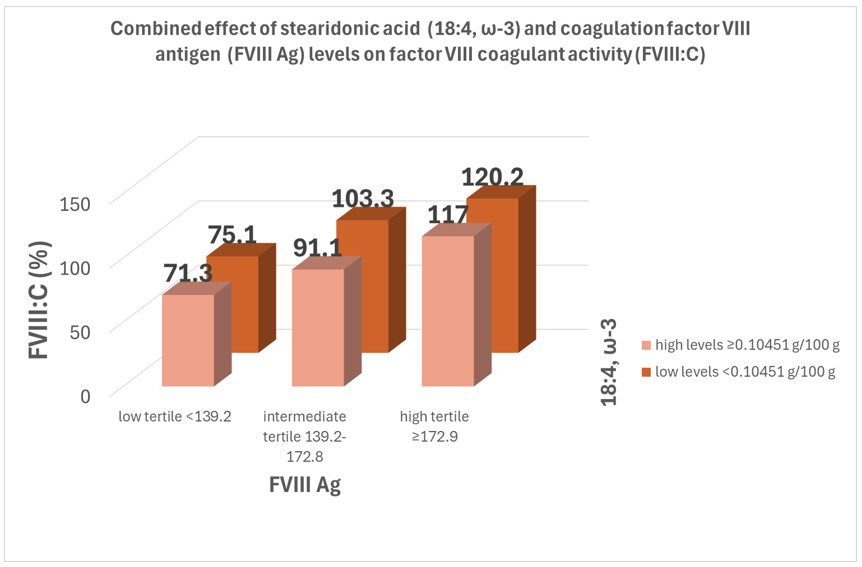
Results. Data were available for 376 subjects (males 75.8%; mean age 68.2±9.8 years, 68 with normal coronary arteries, 46 with coronary lesions with stenosis <50%, and 262 with coronary lesions with stenosis ≥50%). Among all the FAs evaluated, only stearidonic acid (18:4, ω-3) showed a significant correlation with FVIII:C (R=-0.180, P<0.001), which remained significant after adjustment for sex, age, CAD diagnosis, body mass index, renal function, high-sensitivity C-reactive protein, total and HDL cholesterol, triglycerides, FVIII Ag, VWF Ag, and VWF:FVIIIB. In the final linear regression model stearidonic acid (standardized beta coefficient=-0.167, P<0.001), FVIII Ag (standardized beta coefficient=0.483, P<0.001), and VWF Ag (standardized beta coefficient=0.122, P=0.043) were predictors of FVIII:C variability. Plasma concentration of stearidonic acid was not correlated with FVIII Ag, VWF Ag, or VWF:FVIIIB levels. Stratification of the study population according to stearidonic acid and FVIII Ag levels further supported their additive effect on FVIII:C (Figure 1). Consistently, stearidonic acid was also inversely correlated with the peak of thrombin at the thrombin generation assay (R=-0.112, P=0.030), and in a linear regression model adjusted for all the above-mentioned variables, both stearidonic acid (standardized beta coefficient=-0.153, P=0.004) and FVIII Ag (standardized beta coefficient=0.169, P=0.032) remained predictors of the peak of thrombin.
Conclusions. Plasma concentration of stearidonic acid may negatively modulate the activity of FVIII independently of FVIII and VWF antigen levels, thereby indicating a possible anticoagulant function for this ω-3 FA.
Downloads
Citations




How to Cite

This work is licensed under a Creative Commons Attribution-NonCommercial 4.0 International License.



