


CO056 | URINARY MARKERS OF PLATELET ACTIVATION AND OXIDATIVE STRESS IN ATHEROSCLEROTIC CARDIOVASCULAR DISEASE IN TYPE 2 DIABETES
M. Alfonsetti1, P. Simeone1, R. Liani1, M. Frezza1, B. Di Marco1, A. Cipollone1, D. D’ Ardes1, T. Taverriti1, C. Della Penna1, L. Cantagallo1, G. Ciferni1, L. Del Rosso1, M. Caporale1, S. Brandolino2, E. Vitacolonna2, P. Di Carlo3, F. Cipollone1, F. Santilli1 | 1Department of Medicine and Aging Sciences, Center for Advanced Studies and Technology (CAST), University of Chieti, Chieti, Italy, University General Medicine Division, Medical Department, SS. Annunziata Hospital, Chieti, Italy; 2Department of Medicine and Aging, School of Medicine and Health Sciences, G. d'Annunzio University, Chieti, Italy; 3Department of Innovative Technologies in Medicine & Dentistry, "G. d'Annunzio" University of Chieti-Pescara, Chieti, Italy
All claims expressed in this article are solely those of the authors and do not necessarily represent those of their affiliated organizations, or those of the publisher, the editors and the reviewers. Any product that may be evaluated in this article or claim that may be made by its manufacturer is not guaranteed or endorsed by the publisher.
Authors
Background and Aims. In patients with type 2 diabetes (T2D), atherosclerotic cardiovascular disease (ASCVD) is characterized by enhanced platelet activation and increased oxidative stress, both of which contribute to thrombotic risk and disease progression. Carotid artery stenosis represents a clinically relevant manifestation of systemic atherosclerosis and is included among ASCVD conditions. However, the relative contribution of platelet activation and oxidative stress to atherosclerotic burden in patients with T2D remains incompletely defined. This study aimed at investigating urinary markers of platelet activation and oxidative stress—11-dehydro-thromboxane B₂ (11-dh-TXB₂) and 8-iso-prostaglandin F₂α (8-iso-PGF₂α)—in T2D patients with or without ASCVD, including those with carotid artery stenosis ≥50%.
Methods. Urine samples were collected from 179 patients with T2D, with (n=84) or without (n=95) aspirin (ASA) therapy. Urinary levels of 11-dh-TXB₂ and 8-iso-PGF₂α were measured by enzyme immunoassay (EIA) following chromatography-based prostaglandin extraction. Patients were stratified according to the presence of ASCVD (n=98 with ASCVD) and carotid artery stenosis ≥50% (n=84 with carotid stenosis ≥50%).
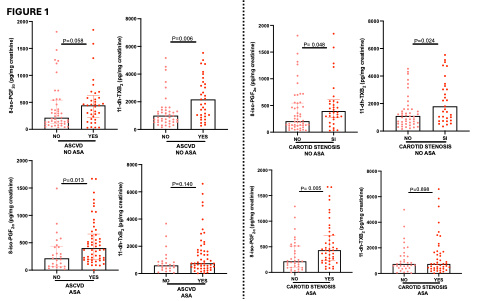
Results. Patients with ASCVD showed higher urinary levels of 8-iso-PGF₂α compared with those without ASCVD, both among patients not receiving ASA therapy (P = 0.058) and among those receiving ASA therapy (P = 0.013), indicating increased oxidative stress in subjects with established atherosclerotic disease. When carotid artery stenosis ≥50% was considered, 8-iso-PGF₂α levels remained significantly higher in patients not receiving ASA therapy (P = 0.048), whereas no significant difference was observed among ASA-treated patients (P = 0.140), supporting an association between oxidative stress and advanced atherosclerotic burden. Urinary 11-dh-TXB₂ levels were significantly higher in patients with ASCVD only among those not receiving ASA therapy (P = 0.006), while no significant difference was observed in patients on ASA therapy (P = 0.140). Similarly, patients with carotid artery stenosis ≥50% showed significantly higher 11-dh-TXB₂ levels only in the absence of ASA therapy (P = 0.024), with no difference among ASA-treated patients (P = 0.898). Urinary levels of 8‑iso‑PGF₂α and 11‑dh‑TXB₂ were directly correlated (rho=0.565, <0.001), further confirming the close interplay between oxidative stress and platelet activation in patients with T2D.
Conclusions. In patients with T2D, oxidative stress—as reflected by increased urinary 8-iso-PGF₂α—is significantly associated with the presence of ASCVD, including carotid artery stenosis ≥50%. Aspirin therapy effectively attenuates platelet activation, as indicated by the lack of association between urinary 11-dh-TXB₂ and atherosclerotic burden in ASA-treated patients. These results highlight oxidative stress as a key mechanism underlying residual cardiovascular risk in diabetes and suggest that urinary oxidative stress markers may represent a useful tool for identifying patients with advanced atherosclerotic disease.
Downloads
Citations




How to Cite

This work is licensed under a Creative Commons Attribution-NonCommercial 4.0 International License.



