


CO055 | COMPARISON OF VISCOELASTIC COAGULATION MONITOR AND ROTATIONAL THROMBOELASTOMETRY FOR HEMOSTATIC PHENOTYPING AND OUTCOME PREDICTION IN SEPSIS
G. Gottardi, E. Campello, C. Simion, C. Samà, A. Benetti, C. Bulato, D. Regazzo, G.P. Arcidiacono, P. Simioni | Department of Medicine, University of Padua, Italy
All claims expressed in this article are solely those of the authors and do not necessarily represent those of their affiliated organizations, or those of the publisher, the editors and the reviewers. Any product that may be evaluated in this article or claim that may be made by its manufacturer is not guaranteed or endorsed by the publisher.
Authors
Background and Aims. Sepsis is a leading cause of morbidity and mortality worldwide, and sepsis-induced coagulopathy encompasses a complex spectrum ranging from hypercoagulable to hypocoagulable states, significantly influencing patient outcomes. Viscoelastic testing, including rotational thromboelastometry (ROTEM) and the novel Viscoelastic Coagulation Monitor (VCM), enables rapid bedside hemostatic profiling. This study evaluates the diagnostic performance of VCM compared to ROTEM and assesses its utility in identifying phenotypes associated with septic shock and clinical outcomes.
Methods. Adult patients with sepsis or septic shock (Sepsis-3 criteria) admitted to our Internal Medicine Unit from May 2024 to February 2026 were included. ROTEM and VCM were performed within 48 hours of diagnosis. Patients were classified as normocoagulable, hypocoagulable (≥2 hypocoagulable parameters in EXTEM or INTEM) or hypercoagulable (≥2 hypercoagulable parameters in EXTEM or INTEM) based on parameters in EXTEM/INTEM and VCM traces. Primary endpoints included 28-day mortality, thrombotic events, and major bleedings. The cohort was stratified according to septic shock. Demographic, laboratory, and clinical data were collected. Group comparisons were performed using non-parametric analysis and Spearman’s correlation.
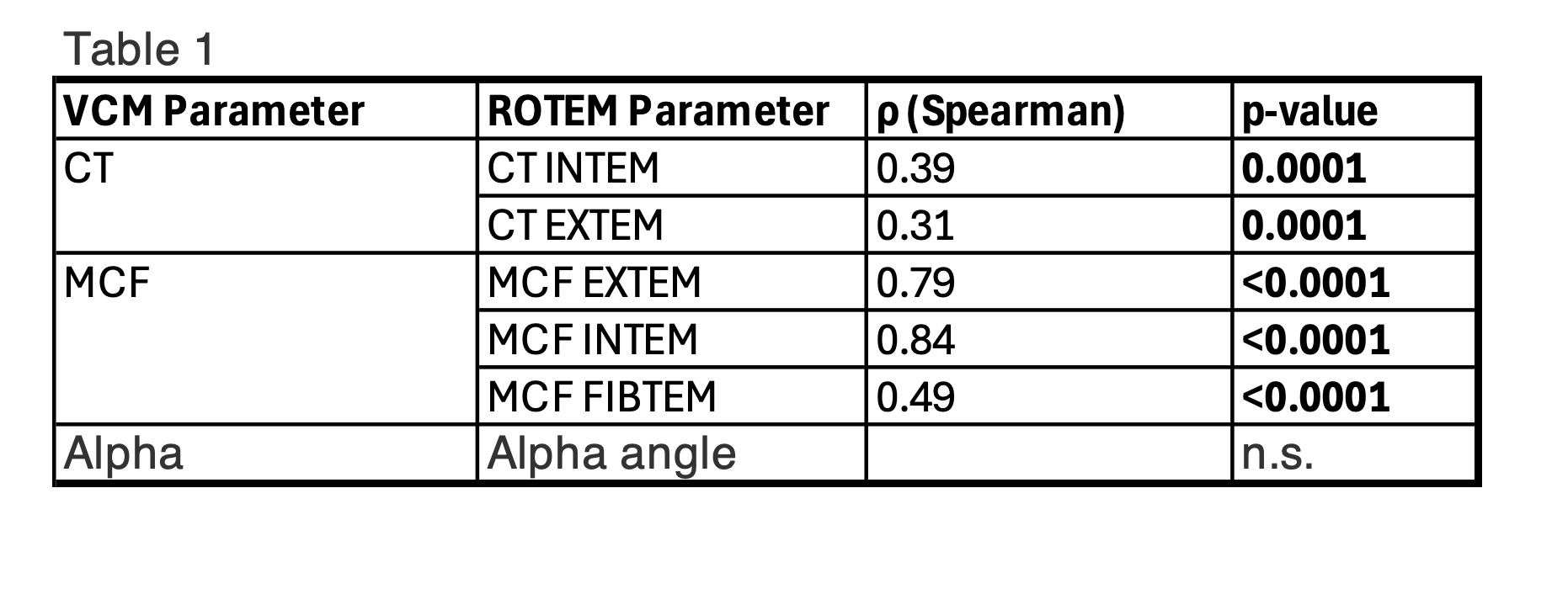
Results. A total of 89 patients were included; 19 (21.8%) developed septic shock. VCM and ROTEM demonstrated strong correlation for maximum clot firmness (MCF) and moderate correlation for clotting time (CT), while no correlation was observed for alpha-angle (Table 1). Based on ROTEM, 28/89 (31.5%) patients were hypercoagulable, 5/89 (5.6%) hypocoagulable, and 56/89 (62.9%) normocoagulable. VCM showed strong agreement with ROTEM in detecting coagulation phenotypes, with high correlation with ROTEM INTEM (r=0.60, p<0.0001) and EXTEM (r=0.55, p<0.0001). Hypercoagulable patients exhibited higher platelet counts (269 vs 159×10⁹/L, p<0.001) and creatinine (224 vs 158 µmol/L, p<0.001). Hypocoagulable patients faced significantly higher 28-day mortality compared to hypercoagulable patients (80.0% vs 25.0%; p=0.009). Notably, in septic shock, VCM identified prolonged CT (459 vs 396 s, p=0.015) and higher 45-minute lysis (LI45) index (98% vs 96%, p=0.015), whereas ROTEM parameters showed no significant differences.
Conclusions. VCM shows robust analytical agreement with ROTEM for haemostatic phenotyping in sepsis. Furthermore, VCM may offer superior sensitivity to ROTEM in detecting specific coagulopathic changes associated with septic shock. Hypocoagulability remains a potent predictor of poor clinical outcomes in this population, highlighting the need for its early detection to identify patients at higher clinical risk.
Downloads
Citations




How to Cite

This work is licensed under a Creative Commons Attribution-NonCommercial 4.0 International License.



