


CO051 | PROTEIN S HEERLEN AND OTHER PROS1 GENE VARIANTS IN PROTEIN S-DEFICIENT PATIENTS: A SINGLE-CENTER STUDY
F. Ramundo, T. Malara, M. Rossi, T. Za, AM. Ciminello, S. Betti, F. Bartolomei, F. Di Landro, P. Arcuri, P. Chiusolo, V. De Stefano, E. Rossi | Catholic University, Fondazione Policlinico A.Gemelli IRCCS, Italy
All claims expressed in this article are solely those of the authors and do not necessarily represent those of their affiliated organizations, or those of the publisher, the editors and the reviewers. Any product that may be evaluated in this article or claim that may be made by its manufacturer is not guaranteed or endorsed by the publisher.
Authors
Background and Aims. Diagnosing protein S (PS) deficiency is challenging due to varied functional defects and diagnostic assays, highlighting the importance of genetic characterization of the PROS1 gene. The clinical significance of the Heerlen (Ser501Pro) variant remains unclear. This study aimed to determine the frequency of coding-region variants in individuals with PS deficiency and assess their correlation with PS phenotype and thrombotic risk.
Methods. We analyzed 55 subjects with persistently reduced free PS levels (<65%) and no identifiable causes of acquired deficiency. Free PS was measured using immunological methods. Genetic analysis of peripheral blood DNA was conducted with next-generation sequencing to detect germline PROS1 variants. Variants were annotated, classified by established criteria, and correlated with biochemical and clinical data.
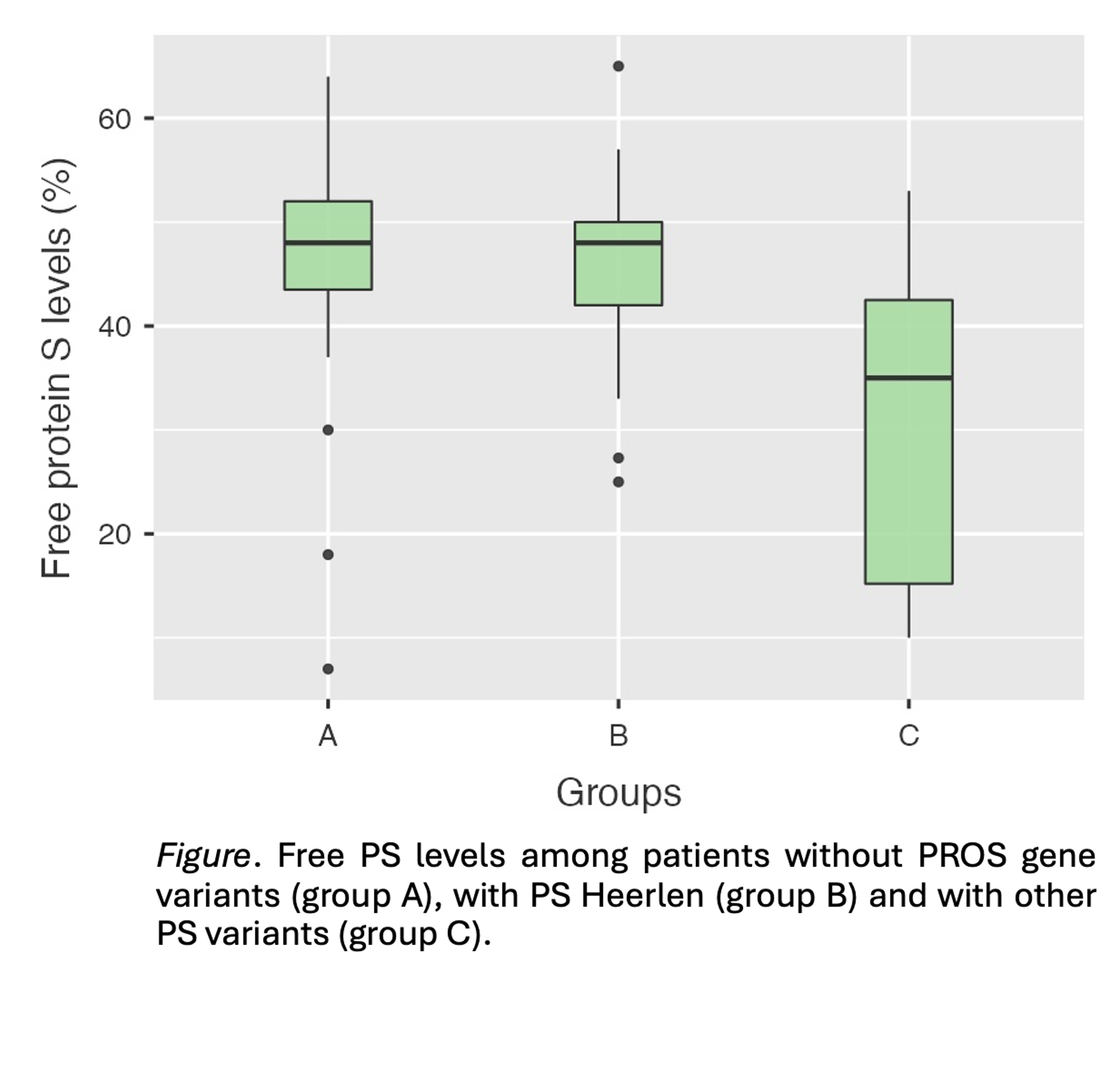
Results. The cohort comprised 34 females (61.8%) and 21 males (38.2%), with a mean free PS level of 41.6% (range 7–65%). Thrombotic events occurred in 38.2% of subjects (venous n=17; arterial n=4). The median age at the first event was 49 years (range 17–88), with recurrence in 9.1%. Family history revealed both PS deficiency and venous thromboembolism (VTE) in 21.8% of patients, VTE alone in 18.1%, and asymptomatic PS deficiency in 21.8%. Free PS levels did not differ significantly between patients with and without VTE (41.1% vs 42.4%, p = 0.7469). No mutations were found in 27 patients (49.1%, group A), of whom 40.7% had VTE and 29.6% had a family history of VTE. Thirteen patients (23.6%, group B) carried the Heerlen variant; 7.6% had VTE and 30.7% had a family history of VTE. Fifteen patients (27.3%, group C) carried other PROS1 variants; 33.3% had VTE and 60% had a family history of VTE. Detected variants included Arg330Trp (n=3, two families), Gly357Arg (n=2, unrelated), and single cases (3.6% each) of Ala525Val, Pro667Leu, Glu360Lys, Ala557Val, Ile591Met, Arg316His, Glu437Lys, Tyr332Ter, Gln563Ter, and Ile546MetfsTer16. Median free PS levels were 48% in group A (range 7-64%) and B (range 25-65%) and 35% (range in group C (10-53%)) (group C vs A or B, p < 0.001) (Figure). Patients with truncating variants (frameshift and nonsense mutations) (n=3) had lower free PS levels (median 12%, range 10–16), indicating a severe loss-of-function effect.
Conclusions. PS-deficient subjects without coding-sequence variants or with the Heerlen variant had significantly higher free PS levels than carriers of other PROS1 variants. Additionally, carriers of the Heerlen variant had a low rate of VTE. Amino acid substitutions were identified in only about half of patients with free PS deficiency, suggesting that other defects may involve non-coding mutations or copy number variations affecting PROS1 expression.
Downloads
Citations




How to Cite

This work is licensed under a Creative Commons Attribution-NonCommercial 4.0 International License.



