


CO050 | INTERACTION BETWEEN DIRECT ORAL ANTICOAGULANTS AND ANTIEPILEPTIC DRUGS: A MULTICENTER OBSERVATIONAL STUDY
A. Lipari1, S. Sorrentino1, M. De Siati1, L. D'Innocenzo1, A. Ferretti1, D. Menichelli2, V. Cammisotto2, P. Pignatelli2, G. Ragna3, MC. Vedovati3, C. Becattini3, G. Frisullo4, V. Forte5, T. Pirozzi1, L. Di Gennaro1, M. Basso1, E. De Candia1 | 1Unit of Haemostasis and Thrombosis Diseases, Fondazione Policlinico Universitario A. Gemelli IRCCS, Roma, Italy; 2Department of Clinical Internal, Anesthesiological and Cardiovascular Sciences, Sapienza University of Roma, Roma, Italy; 3Department of Internal and Cardiovascular Medicine and Stroke Unit, University of Perugia, Perugia, Italy; 4Dipartimento di Neuroscienze, Organi di Senso e Torace, Fondazione Policlinico Universitario A. Gemelli IRCCS, Roma, Italy; 5Hematology, Department of Biomedicine and Prevention, University of Rome Tor Vergata, Roma, Italy
All claims expressed in this article are solely those of the authors and do not necessarily represent those of their affiliated organizations, or those of the publisher, the editors and the reviewers. Any product that may be evaluated in this article or claim that may be made by its manufacturer is not guaranteed or endorsed by the publisher.
Authors
Background. Direct oral anticoagulants (DOACs) are widely used for stroke prevention in non-valvular atrial fibrillation and for venous thromboembolism. Their pharmacokinetics depend on P-glycoprotein (P-gp) transport and, variably, on cytochrome P450 3A4 (CYP3A4) metabolism. Enzyme-inducing antiepileptic drugs (AEDs) may reduce DOAC plasma concentrations and potentially impair efficacy.
Aims. To evaluate the effect of enzyme-inducing and non–enzyme-inducing AEDs on DOAC plasma concentrations.
Methods. This prospective, observational, multicenter study enrolled outpatients receiving DOACs for atrial fibrillation or venous thromboembolism, with (cases) or without (controls) concomitant AED therapy. DOAC plasma concentrations were measured at trough (PRE) and peak (POST, ~2 h after intake) after ≥2 4 weeks of stable treatment. Apixaban, rivaroxaban, and edoxaban were measured using anti-factor Xa assays, and dabigatran using a thrombin time–based assay. Analyses were performed by individual DOAC. Normalized concentrations (case value/median of age- and sex-matched controls receiving the same DOAC) were used to account for inter-drug variability. AEDs were classified as enzyme-inducing (carbamazepine, oxcarbamazepin, fenobarbital) or non-enzyme-inducing (levetiracetam, gabapentin, pregabalin, lamotrigine, clonazepam, lacosamide). Given its enzyme-inhibiting properties, valproic acid was analyzed separately from other AEDs.
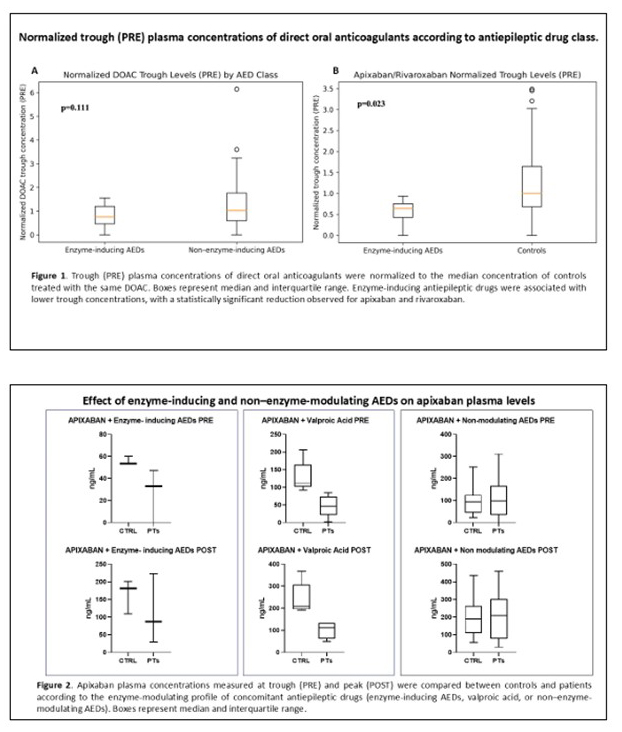
Results. A total of 328 patients (76 cases, 252 controls) were included, with similar baseline characteristics. Overall PRE and POST DOAC concentrations did not differ between cases and controls. Normalized trough concentrations across all DOACs showed a non-significant trend toward lower levels in patients receiving enzyme-inducing AEDs (Fig. 1A). In analyses restricted to apixaban and rivaroxaban, normalized trough concentrations were significantly reduced in patients treated with enzyme-inducing AEDs compared with controls (Fig. 1B), whereas peak concentrations were unaffected. On the contrary, non-enzyme inducing AEDs did not affect trough concentration of apixaban and rivaroxaban. Quite surprisingly, valproic acid induced reduced trough concentrations of apixaban and rivaroxaban.
Conclusions. While overall DOAC plasma concentrations were not affected by concomitant AED therapy, enzyme-inducing AEDs were associated with reduced trough levels of apixaban and rivaroxaban. These findings support a CYP3A4/P-gp–mediated interaction and underscore the need for careful DOAC selection or the use of non–enzyme-inducing AEDs in patients receiving DOACs.
Downloads
Citations




How to Cite

This work is licensed under a Creative Commons Attribution-NonCommercial 4.0 International License.



