


CO049 | RANDOMIZED CONTROLLED TRIAL TO IDENTIFY THE OPTIMAL SCHEME OF HEPARIN FOR TREATMENT OF DEEP VEIN THROMBOSIS IN PREGNANCY
E. Grandone1|3, E. Antonucci2, A. de Laurenzo1, L. Latino1, M. Mastroianno1, G. Tiscia1, M. Margaglione3, P. Prandoni2 | 1IRCCS Casa Sollievo della Sofferenza, S.Giovanni Rotondo, Italy; 2Fondazione Arianna, Italy; 3Università di Foggia, Italy
All claims expressed in this article are solely those of the authors and do not necessarily represent those of their affiliated organizations, or those of the publisher, the editors and the reviewers. Any product that may be evaluated in this article or claim that may be made by its manufacturer is not guaranteed or endorsed by the publisher.
Authors
Background. Venous thromboembolism (VTE) is a major cause of maternal morbidity and mortality worldwide. Low-molecular-weight heparin (LMWH) is the recommended treatment for pregnancy-associated deep vein thrombosis (DVT), yet evidence guiding optimal dose intensity and duration during pregnancy is limited and largely extrapolated from non-pregnant populations. Prolonged administration of full-dose LMWH twice daily is effective but burdensome and may increase bleeding risk, particularly in the peripartum period. Whether anticoagulant intensity can be safely reduced after an initial phase of full treatment remains uncertain.
Aims. The APRICOT study (Adapt hePaRin In pregnanCy-assOciated vTe) aims to assess whether a reduced-dose LMWH regimen is non-inferior to standard full-dose LMWH in preventing recurrent VTE and whether it improves safety with respect to bleeding complications in pregnant women with acute DVT.
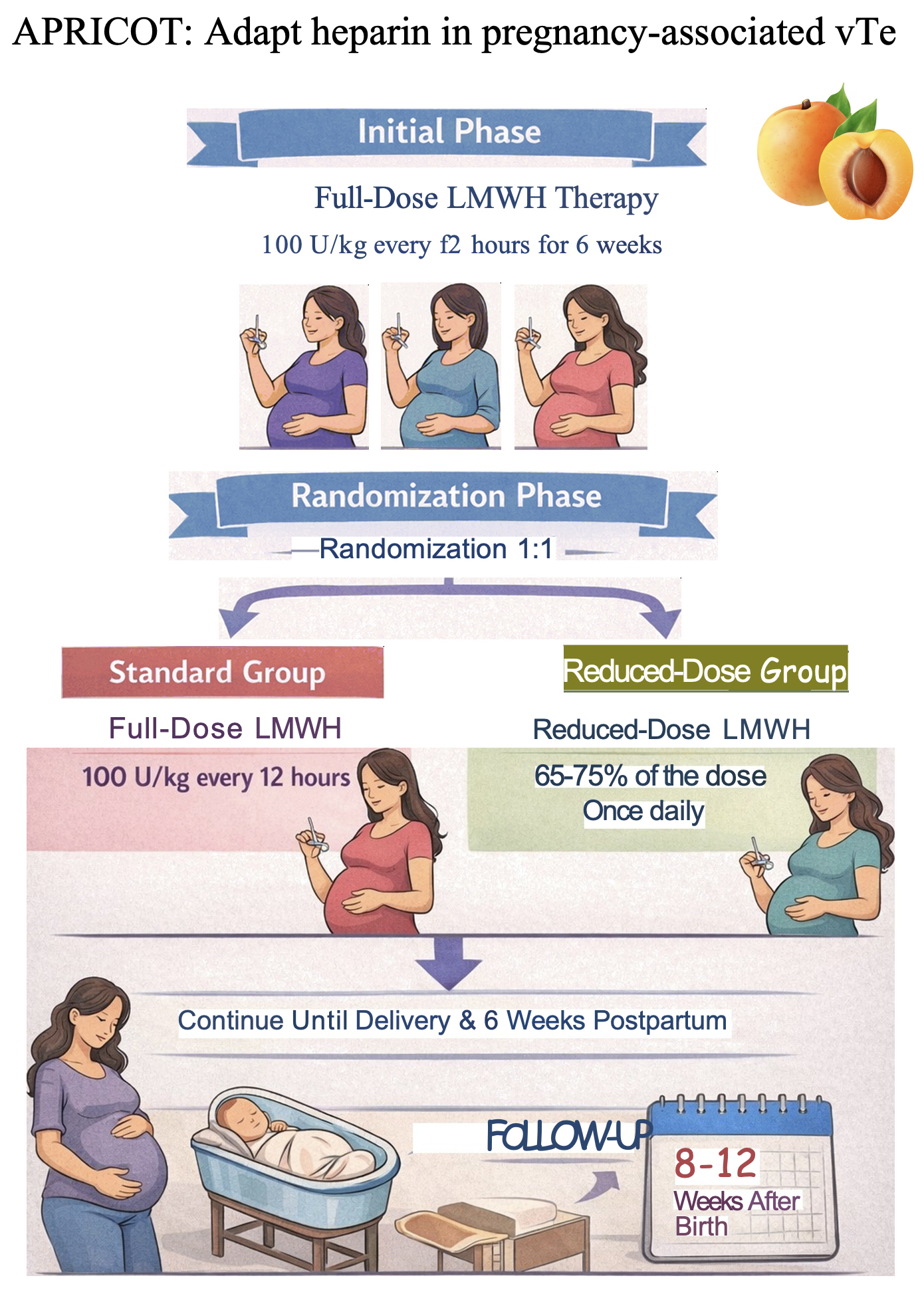
Methods. APRICOT is a multicenter, randomized, open-label, controlled, non-inferiority trial (EUCT: 2025-521566-10-00). Pregnant women aged ≥18 years with a first objectively confirmed proximal DVT occurring between 5 and 30 weeks of gestation will be eligible. The study will be conducted in accordance with the Declaration of Helsinki and Good Clinical Practice and will require authorization from the National Ethics Committee and local Institutional Review Boards. All participants will provide written informed consent prior to enrollment. All women will receive initial therapeutic LMWH at a dose of 100 U/kg every 12 hours for six weeks. Thereafter, participants will be randomized 1:1 to continue full-dose LMWH or to switch to a reduced-dose regimen (65–75% of the full therapeutic dose administered once daily) until delivery and for six weeks postpartum. Randomization will be centralized and web-based, stratified by center. Patients will be followed throughout pregnancy and up to 8–12 weeks after delivery. The primary efficacy endpoint is recurrent VTE, defined as symptomatic DVT or pulmonary embolism. The primary safety endpoint is major bleeding according to ISTH criteria. Secondary endpoints include VTE extension and clinically relevant non-major bleeding. All outcomes will be adjudicated by an independent blinded central committee. A minimum sample size of 96 women provides 80% power to demonstrate non-inferiority with a 10% margin.
Conclusions. APRICOT addresses a critical evidence gap in the management of pregnancy-associated DVT and may inform safer, more individualized, and less burdensome anticoagulant strategies during pregnancy.
Downloads
Citations




How to Cite

This work is licensed under a Creative Commons Attribution-NonCommercial 4.0 International License.



