


CO045 | BEYOND THE VISIBLE: LIPOPROTEIN(a) AS A SILENT DRIVER OF RETINAL VASCULAR DAMAGE
L. Agrelli1, M. Berteotti2, E. Lotti2, F. Crudele2, D. Poli2, A.M. Gori2, A Rogolino2, D. Prisco2, R. Marcucci2 | 1Department of Internal Medicine, University of Salerno, Italy; 2Department of Medical and Surgical Critical Care, Thrombosis Centre, University of Florence, AOU Careggi, Firenze, Italy
All claims expressed in this article are solely those of the authors and do not necessarily represent those of their affiliated organizations, or those of the publisher, the editors and the reviewers. Any product that may be evaluated in this article or claim that may be made by its manufacturer is not guaranteed or endorsed by the publisher.
Authors
Background and Aims. Retinal vein occlusion (RVO) is a major cause of vision loss. Recent evidence suggests RVO aligns more closely with an arterial rather than a venous phenotype, sparking interest in Lipoprotein(a) [Lp(a)] as a potential driver of vascular inflammation and impaired fibrinolysis. However, conclusive evidence remains limited. The aim of this retrospective observational study was to evaluate the interplay between traditional cardiovascular risk factors and Lp(a) levels in affecting the incidence of major cardiovascular events (MACE) in patients followed up after an RVO.
Methods. We included in the analysis 250 patients (111 females, 139 males; median age 62 years) with RVO (BRVO/CRVO) referred to the Atherothrombosis Center of Florence between 2001 and 2026. Lp(a) serum concentrations were measured in a subgroup of 172 patients. Lipid-lowering and antithrombotic therapies were documented both pre- and post-event, with a specific focus on antiplatelet therapy prior to RVO recurrence. Median follow-up was 12 months.
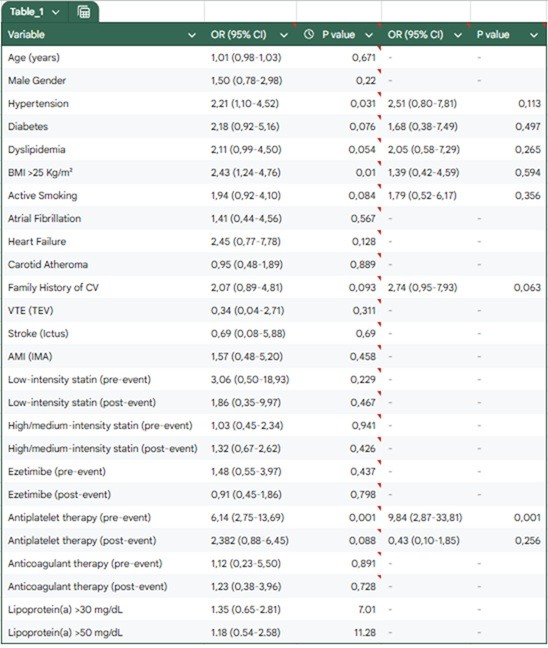
Results. Hypertension and dyslipidemia were the most prevalent risk factors. Elevated Lp(a) levels ≥30 mg/dL and >50 mg/dL were present in 45.3% and 30.2% of cases, respectively. In the younger cohort (<55 years), males exhibited higher Lp(a) concentrations than females: a mean of 39.1 mg/dL (median: 24.5; IQR: 61.3) vs. 31.3 mg/dL (median: 14.8; IQR: 32.2). Conversely, older females (≥55 years) showed the highest overall concentrations: mean 48.3 mg/dL (median: 33.6; IQR: 49.7), compared to older males: mean 42.0 mg/dL (median: 19.6; IQR: 54.4). No statistical significance was found between CRVO and BRVO subtypes (p>0.05). RVO recurrence was observed in 19/47 patients (40.4%) with Lp(a) levels ≥30 mg/dL; notably, 13/47 (27.7%) presented values >50 mg/dL, while 59.6% and 72.3% of recurrent patients remained below the 30 and 50 mg/dL thresholds, respectively. At multivariate analysis (Table 1), the only independent predictor of recurrence was the “pre-event antiplatelet therapy” (OR 9.84, 95% CI 2.87–33.81; p<0.001), whereas hypertension and BMI >25 kg/m² did not confirm the independent role demonstrated at univariate analysis. Lp(a) levels did not correlate with recurrence (p=0.421). During a median follow-up of 12 months (range: 1–240), five MACE were recorded (2 MI, 3 strokes). Notably, 80% of these events occurred in patients with comorbidities and already on antithrombotic therapy, underscoring the high vulnerability of the cohort despite standard treatment.
Conclusions. RVO should be regarded not as an isolated ocular event but as a clinical manifestation of a compromised systemic vascular and metabolic profile. While post-event therapy is typically intensified, the high recurrence rate among patients already on antiplatelets (p<0.001) highlights a "residual risk" that standard treatments fail to neutralize, necessitating stricter metabolic control and long-term monitoring. In this context, Lp(a) emerges as a pivotal biomarker for risk stratification: while its rise in women is age-dependent (post-menopausal), in younger males it identifies high-risk genetic phenotypes often overlooked by traditional assessments. Screening for Lp(a) is therefore essential to implement aggressive primary and secondary prevention strategies on modifiable factors, especially in younger cohorts, while awaiting targeted Lp(a)-lowering therapies.
Downloads
Citations




How to Cite

This work is licensed under a Creative Commons Attribution-NonCommercial 4.0 International License.



