


CO041 | GLOBAL COAGULATION ASSESSMENT FOR THE RISK OF HEAVY MENSTRUAL BLEEDING IN WOMEN ON ORAL ANTICOAGULANT THERAPY – THE COHMBO STUDY
M. Abbattista, E. Scalambrino, M. Clerici, A. Truma, A. Artoni, P. Bucciarelli | Fondazione IRCCS Ca' Granda Policlinico, Italy
All claims expressed in this article are solely those of the authors and do not necessarily represent those of their affiliated organizations, or those of the publisher, the editors and the reviewers. Any product that may be evaluated in this article or claim that may be made by its manufacturer is not guaranteed or endorsed by the publisher.
Authors
Background. Heavy menstrual bleeding (HMB) is a primary side effect in women starting direct oral anticoagulants (DOACs). Defining predictors and management protocols for DOAC-related HMB remains a clinical challenge.
Aims. To assess HMB incidence and to evaluate coagulation parameters, viscoelastic profiles, and iron and gynecological status in women starting DOAC.
Methods. This prospective study included women who started DOAC. Menstrual loss was measured via PBAC, pre-DOAC, and post-DOAC (mean value months 1-2 after DOAC start). HMB was defined as PBAC >100, and severe HMB as PBAC >150. Uterine dimensions and iron status were recorded after at least 2 menstrual cycles in DOAC. Coagulation was assessed via ROTEM at trough and peak (after 2 h) of DOAC assumption. Parametric and non-parametric tests were used (Wilcoxon paired test, Mann-Whitney, Spearman’s correlation). Ethical approval and informed consent were obtained.
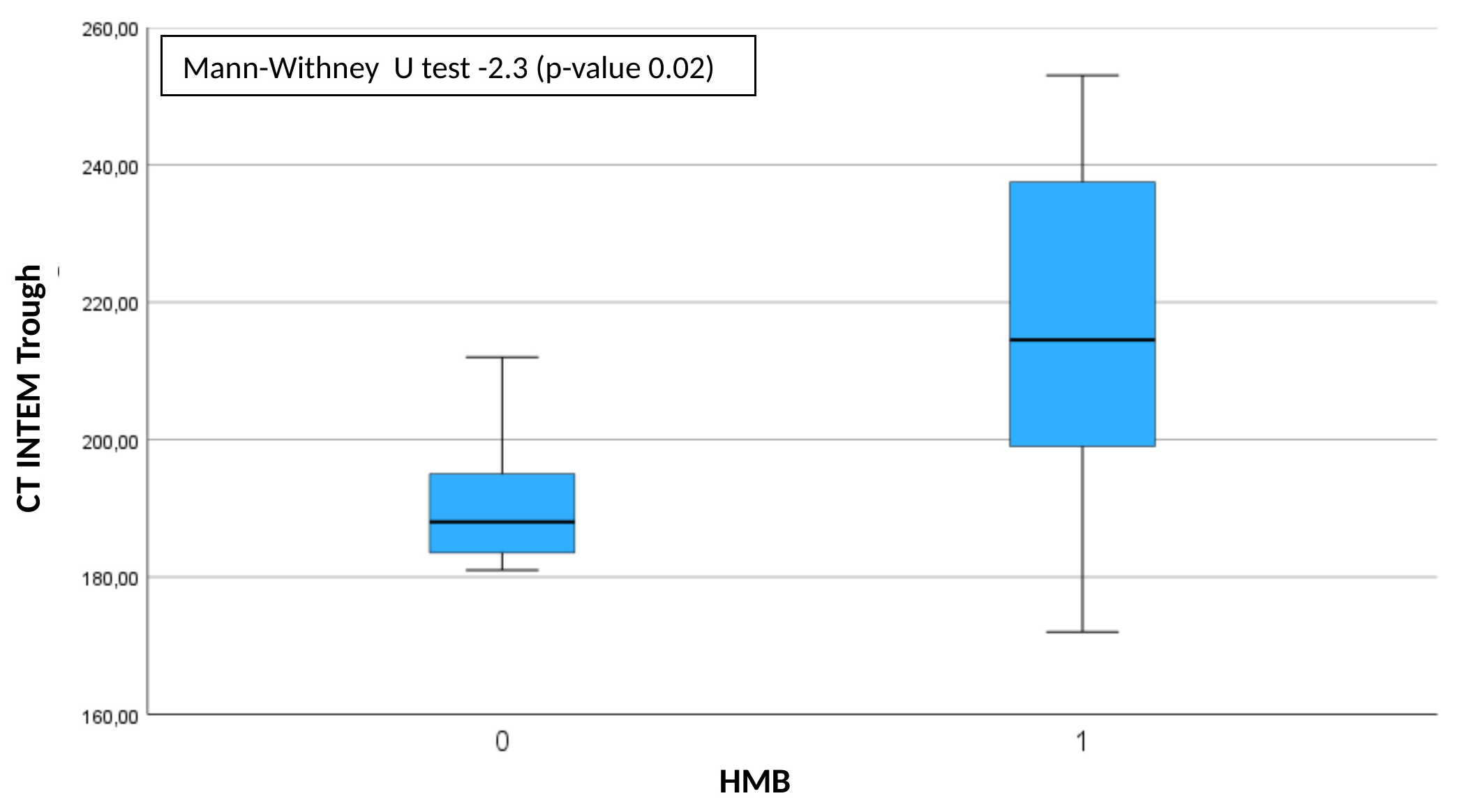
Results. To date, 28 women were enrolled (8 rivaroxaban, 8 apixaban, 10 edoxaban, and 2 dabigatran); the median age was 35 years. PBAC increased from a median of 89.0 pre to 166 post DOAC (Z-test -2.2, p-value 0.02). Negligible effect size for the change in the menses duration. HMB occurred in 20 (71.4%) and severe HMB in 17 (61%) women and has been reported with all four DOACs. At trough, iron deficiency was present in 25% of women (ferritin <15.0 ng/mL). Uterine measurements showed no significant correlation with bleeding severity. INTEM CT(sec) at trough is significantly different between women with HMB and women without, U test -2.3, p-value 0.02 (Figure 1).
Conclusions. High incidence of HMB was observed after DOAC initiation, and it has been reported with all four DOACs. Bleeding severity is associated with a longer time of clot formation at the trough (CT) rather than uterine size or systemic bleeding history. Enrollment is still ongoing. The study is supported by institutional funding.
Downloads
Citations




How to Cite

This work is licensed under a Creative Commons Attribution-NonCommercial 4.0 International License.



