CO038 | PROGNOSTIC PERFORMANCE OF BLEEDING SEVERITY CLASSIFICATIONS IN HOSPITALIZED PATIENTS WITH GASTROINTESTINAL BLEEDING ON DIRECT ORAL ANTICOAGULANTS
G. Maraziti, A. Vinci, M. Verso | Internal and Emergency Medicine - Stroke Unit, S. Maria della Misericordia Hospital – University of Perugia, Perugia, Italy
All claims expressed in this article are solely those of the authors and do not necessarily represent those of their affiliated organizations, or those of the publisher, the editors and the reviewers. Any product that may be evaluated in this article or claim that may be made by its manufacturer is not guaranteed or endorsed by the publisher.
Authors
Background and Aims. Bleeding severity classifications, such as the International Society on Thrombosis and Haemostasis (ISTH), Bleeding Academic Research Consortium (BARC), and Thrombolysis in Myocardial Infarction (TIMI), are widely used to categorize hemorrhagic events in patients receiving direct oral anticoagulants (DOACs). However, their prognostic relevance in patients hospitalized for gastrointestinal bleeding (GIB) remains unclear. Our aim was to evaluate the prognostic performance of current bleeding severity classifications in patients hospitalized for GIB in DOAC therapy.
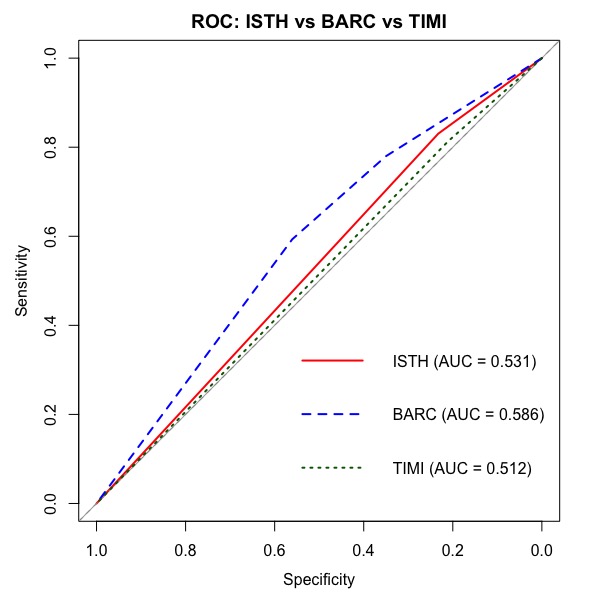
Methods. We conducted an observational study including consecutive patients hospitalized for GIB while on DOAC therapy. Bleeding severity was classified according to ISTH, BARC, and TIMI criteria. The primary outcome was all-cause mortality at 90 days. Binary logistic regression models were used to assess the association between bleeding severity and mortality. Discriminative performance was evaluated using the area under the receiver operating characteristic curve (AUC) with 95% confidence intervals (CIs), and overall model performance and clinical utility were assessed using the Brier score and Decision Curve analysis (DCA).
Results. A total of 377 patients were included, with a median age of 84 years, of whom 85.6% were aged ≥75 years, and most patients had multiple comorbidities. Ninety-day mortality was 16.7%. Overall discrimination for 90-day mortality was limited for all bleeding classifications. Comparatively, BARC demonstrated higher prognostic discrimination, with an AUC of 0.59 (95% CI 0.52–0.66), versus 0.54 (95% CI 0.49–0.59) for ISTH and 0.51 (95% CI 0.46–0.57) for TIMI. BARC also showed a slightly better overall performance and a greater net clinical benefit across a clinically relevant range of risk thresholds.
Conclusions. In our cohort of patients hospitalized for GIB while receiving DOAC therapy, bleeding severity classifications according to ISTH, BARC, and TIMI demonstrated limited prognostic performance for 90-day mortality. Among the evaluated scores, BARC demonstrated comparatively better prognostic performance and clinical utility than ISTH and TIMI. Bleeding severity scores, although useful for event classification, have limited value as standalone prognostic tools in this clinical setting.
Downloads
Citations




How to Cite

This work is licensed under a Creative Commons Attribution-NonCommercial 4.0 International License.