


CO037 | PERFORMANCE OF A QUALITATIVE POINT-OF-CARE TEST IN PATIENTS EXPERIENCING ACUTE THROMBOEMBOLIC OR MAJOR BLEEDING EVENTS TREATED WITH DOACs: THE T-BLEEDOAC MULTICENTER PROSPECTIVE COHORT STUDY
M. Vedovati1, G. Pepe2, S. Vanni3, E. Campello4, F. Morello5, S. Beccatini1, D. Giudici1, F. Lucarini2, L. Parmeggiani3, G. Fabiani3, P. Simioni4, M. Santoro5, P. Nazerian6, M. Mosconi1, C. Becattini1 | 1University of Perugia, Perugia, Italy; 2Versilia Hospital, Tuscany North West Health System, Lido di Camaiore (LU), Italy; 3Università di Firenze, Firenze, Italy; 4University of Padua, Padova, Italy; 5A.O.U. Città della Salute e della Scienza, Torino, Italy; 6Careggi University Hospital, Firenze, Italy
All claims expressed in this article are solely those of the authors and do not necessarily represent those of their affiliated organizations, or those of the publisher, the editors and the reviewers. Any product that may be evaluated in this article or claim that may be made by its manufacturer is not guaranteed or endorsed by the publisher.
Authors
Background and Aims. Management of acute thromboembolic or hemorrhagic events occurring during treatment with direct oral anticoagulants (DOACs) is challenging. Point-of-care tests to detect DOAC levels have been developed, but their role in emergency situations is poorly defined. The aim of the study was to evaluate the performance of a urinary, qualitative, strip test in comparison to plasma measurement to detect clinically relevant DOAC levels in patients with acute thromboembolism or major bleeding (MB) while on treatment with these agents.
Methods. Patients admitted to the Emergency Department for acute thromboembolism or MB while on treatment with full-dose DOA Cs were included in a multicenter, prospective, cohort study where urine and blood samples were collected within 60 minutes of each other. Performance of the DOAC dipstick (separate pads for factor Xa and thrombin inhibitor) to detect DOAC plasma levels ≥30 ng/mL was assessed. DOAC plasma levels were assessed by drug-calibrated chromogenic assays or diluted thrombin time.
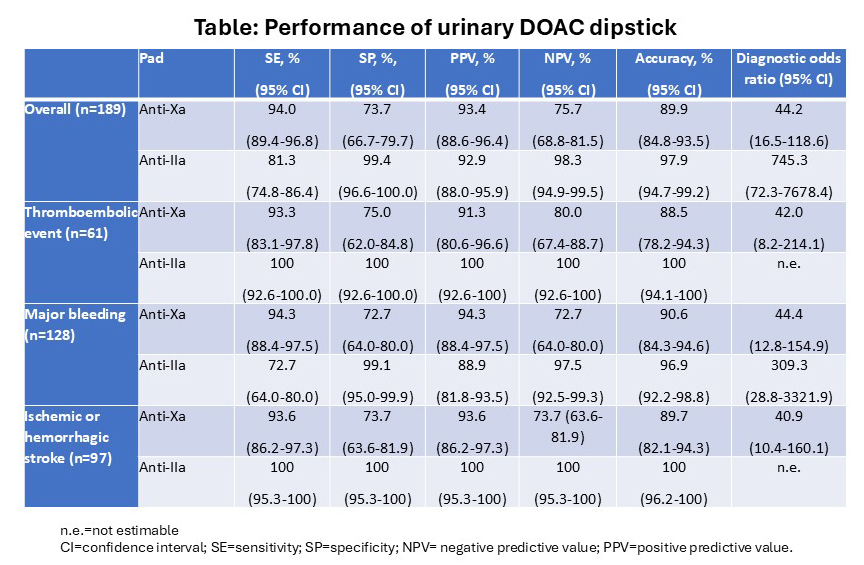
Results. Of 232 patients enrolled in the study, 189 were included in the analysis (43 were excluded as in 42 samples were collected beyond 60 minutes of each other, and 1 DOAC plasma level was unavailable), 61 were admitted for acute thromboembolic events, and 128 for MB. One-hundred-seventy-two patients were treated with an anti-Xa inhibitor (76 apixaban, 55 rivaroxaban, 41 edoxaban) and 17 with dabigatran. Creatinine clearance <30 ml/min was found in 22.2% of patients: 26.6% vs 13.1% (p=0.038) of those with index MB or thromboembolic event, respectively. In the overall study population, the diagnostic performance of the urinary DOAC dipstick was good (accuracy 89.9% and 97.9% for anti-Xa and anti-IIa pads, respectively). Similar findings were observed across subgroups: accuracy was 88.5% and 90.6% for anti-Xa pads and 100% and 96.9% for anti-IIa pads in the thromboembolic and MB populations, respectively (Table).
Conclusions. The urinary DOAC dipstick showed a good performance in detecting clinically relevant DOAC exposure in patients with acute thrombotic or bleeding events, with a better profile for anti-IIa. Management studies are needed to assess the role of this test in clinical practice.
Downloads
Citations




How to Cite

This work is licensed under a Creative Commons Attribution-NonCommercial 4.0 International License.



