


CO036 | NEUROCOGNITIVE ASSESSMENT OF IMMUNE-MEDIATED THROMBOTIC THROMBOCYTOPENIC PURPURA PATIENTS USING A COMPREHENSIVE TEST BATTERY IN A CROSS-SECTIONAL MRI-INTEGRATED STUDY
A. Truma1, T. Difonzo2, F. Lo Russo3, G. Conte3|4, I. Mancini1, E. Cesari1, M. Gagliardi1, J.A. Giannotta1, A. Artoni1, E. Piccin3, P. Agosti4, F. Triulzi3|4, F. Peyvandi1|4 | 1Fondazione IRCCS Ca’ Granda ospedale maggiore policlinico, Angelo Bianchi Bonomi hemophilia and thrombosis center, Milano, Italy; 2Fondazione IRCCS Ca’ Granda ospedale maggiore policlinico, neurology unit, Milano, Italy; 3Fondazione IRCCS Ca’ Granda ospedale maggiore policlinico, neuroradiology unit, Milano, Italy; 4Università degli studi di Milano, Milano, Italy
All claims expressed in this article are solely those of the authors and do not necessarily represent those of their affiliated organizations, or those of the publisher, the editors and the reviewers. Any product that may be evaluated in this article or claim that may be made by its manufacturer is not guaranteed or endorsed by the publisher.
Authors
Background and aims. Immune-mediated thrombotic thrombocytopenic purpura (iTTP) patients frequently report cognitive impairment during clinical remission, but magnetic resonance (MRI) findings linking cognitive impairment to cerebral small vessel disease (cSVD) MRI markers are limited. To characterize cognitive test abnormalities in iTTP patients and evaluate their associations with MRI markers of cSVD.
Methods. Fifty-one iTTP patients in clinical remission followed at our outpatient clinic (at least 12 months after the last acute episode) underwent a standardized neuropsychological assessment covering global cognitive function, attention, logical deductive reasoning, language, memory, and prefrontal function, along with brain MRI. Scores were standardized using Italian age- and education-adjusted norms and compared with population references using one-sample t-tests. Domain impairment was defined as at least one abnormal test per domain. cSVD was assessed both as individual MRI markers (lacunes, cerebral microbleeds [CMB], white-matter hyperintensities [WMH], and enlarged perivascular spaces [EPVS]) and as a composite total cSVD score (0-4). The association with iTTP-related variables was also explored.
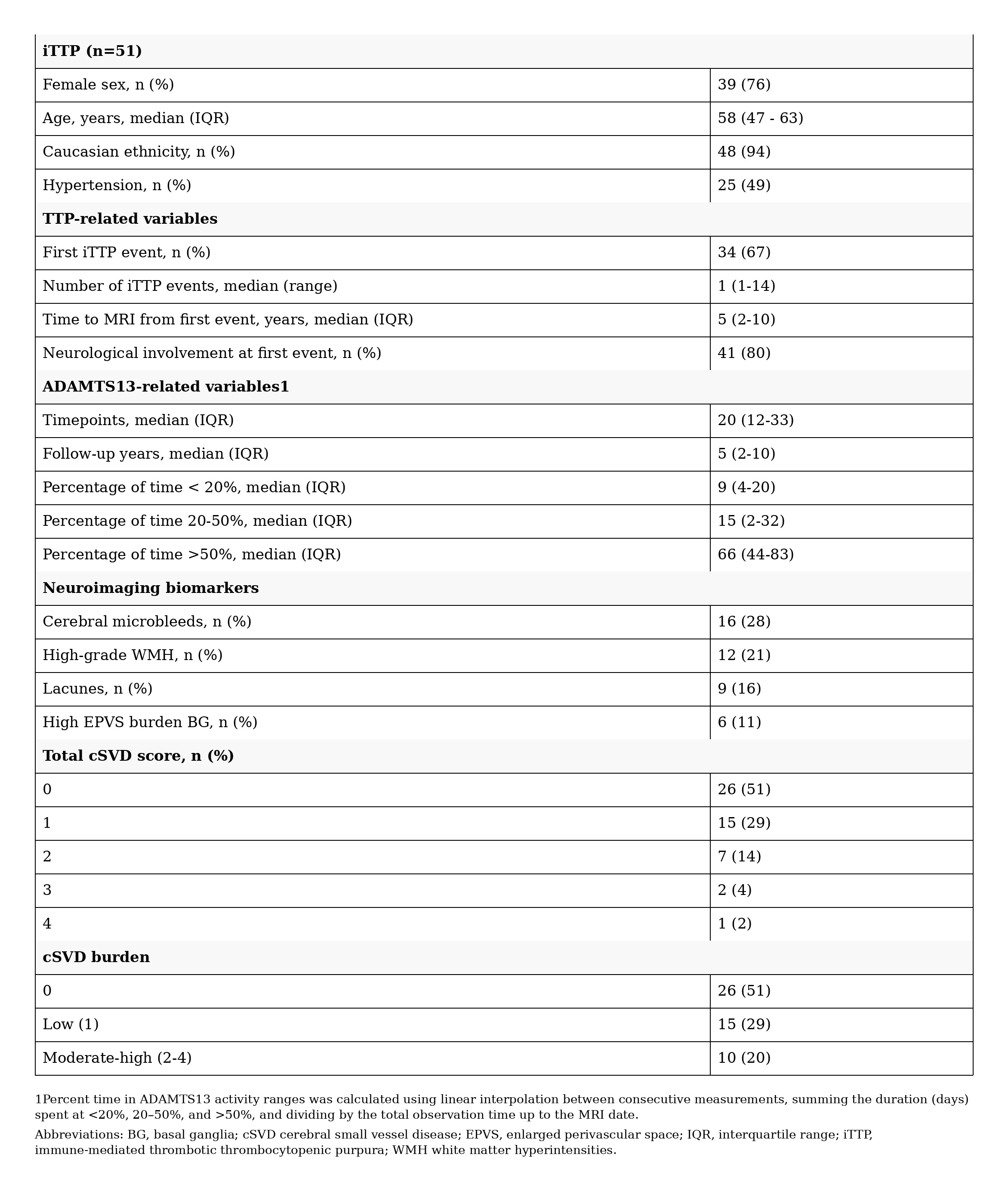
Results. ITTP patients were mostly female (76%) with a median age of 58 years (Table 1). ITTP-patients showed preserved global cognition but selective deficits compared with the general population in working memory (digit span forward and backward) and prefrontal function tests (cognitive estimates of errors/bizarreness, Tower of London-accuracy). After adjustment for age and hypertension, memory impairment was associated with CMB (adjusted OR 8, 95% CI 1.5-44.1; p=0.02) and language impairment with lacunes (adjusted OR 8.7, 95% CI 1.1-70.7; p=0.04). The percentage of patients with at least 1 impaired domain increased with cSVD severity (cSVD≥2: 82% vs. cSVD=1: 75% vs. cSVD=0: 66%). No associations were observed between domain impairment and iTTP-related variables such as the number of relapses, time from the first acute episode, or ADAMTS13-activity levels throughout the observation time.
Conclusions. The prevalence of domain-specific deficits was higher in iTTP patients compared with the general Italian population. CMB and lacunes were associated with memory and language impairment, whereas the composite cSVD score showed no consistent domain-specific associations, suggesting that individual cSVD markers may be more informative than total cSVD burden for neurocognitive vulnerability.

Downloads
Citations




How to Cite

This work is licensed under a Creative Commons Attribution-NonCommercial 4.0 International License.



