


CO033 | THE BURDEN OF CEREBRAL SMALL VESSEL DISEASE AND GLOBAL CORTICAL ATROPHY IN PATIENTS WITH IMMUNE-MEDIATED THROMBOTIC THROMBOCYTOPENIC PURPURA DURING REMISSION
A. Truma1, F. Lo Russo2, G. Conte2|3, I. Mancini1, E. Cesari1, M. Gagliardi1, J.A. Giannotta1, A. Artoni1, E. Piccin2, P. Agosti3, F. Triulzi2|3, F. Peyvandi1|3 | 1Fondazione IRCCS Ca’ Granda Ospedale Maggiore Policlinico, Angelo Bianchi Bonomi Hemophilia and Thrombosis Center, Milano, Italy; 2Fondazione IRCCS Ca’ Granda Ospedale Maggiore Policlinico, Neuroradiology Unit, Milano, Italy; 3Università degli Studi di Milano, Milano, Italy
All claims expressed in this article are solely those of the authors and do not necessarily represent those of their affiliated organizations, or those of the publisher, the editors and the reviewers. Any product that may be evaluated in this article or claim that may be made by its manufacturer is not guaranteed or endorsed by the publisher.
Authors
Background and aims. Immune-mediated thrombotic thrombocytopenic purpura (iTTP) can lead to long-term sequelae related to acute microvascular brain injury. Cerebral small vessel disease (cSVD) reflects chronic small vessel dysfunction and is a risk factor for stroke and cognitive decline. Global cortical atrophy (GCA) is a diffuse cortical brain loss reflecting neurodegeneration and/or vascular injury. Both are detectable on brain magnetic resonance (MRI). Data on the prevalence of cSVD and GCA in iTTP survivors are limited. To assess the prevalence of cSVD and GCA in iTTP patients during clinical remission.
Methods. Fifty-seven iTTP patients underwent a brain MRI at least 12 months after the last acute episode. The cSVD burden was scored (0–4) based on lacunes, cerebral microbleeds (CMB), white-matter hyperintensities (WMH), and enlarged perivascular spaces (EPVS). GCA was graded 0 to 3 using the Pasquier scale. Associations between iTTP and cSVD/GCA were evaluated using binary and ordinal logistic regression with age adjustment. The associations of cSVD/GCA with cardiovascular risk factors, iTTP history, and ADAMTS13 activity were also explored.
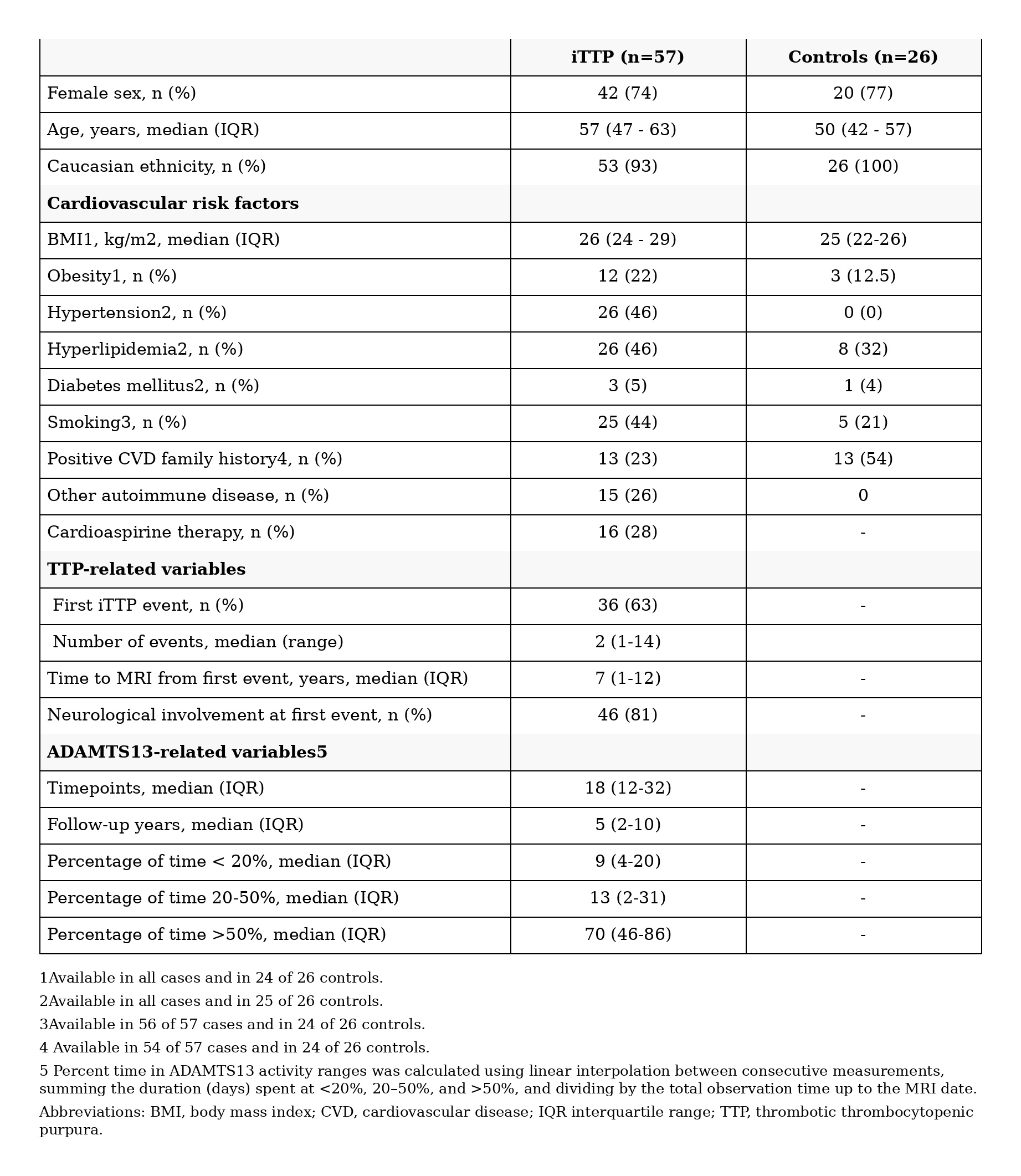
Results. ITTP patients had a median age of 57 years, with hypertension as the most prevalent cardiovascular risk factor (Table 1). cSVD was detected in 49% of iTTP patients vs 27% of controls, and there was a moderate burden (score ≥ 2) in 19% vs none. In iTTP, the most frequent lesions were CMB, WMH, and lacunes. cSVD scores were higher in iTTP vs. controls (ordinal OR 3.04, 95% CI 1.11-8.36), after age adjustment: OR 2.90, 95% CI 0.93-9.02. In analyses restricted to non-hypertensive participants, the case-control difference was less pronounced. GCA was significantly higher in iTTP than controls (age-adjusted logistic regression OR 12.27, 95% CI 2.07–72.89; ordinal logistic regression OR 15.87, 95% CI 2.60–96.72). cSVD and GCA were not significantly associated with other cardiovascular risk factors, time from first event, neurological symptoms at iTTP onset, number of relapses, or time with ADAMTS13 activity below 50%.
Conclusions. ITTP patients during remission showed an increased prevalence of cSVD and GCA, and hypertension may contribute to the cSVD burden. Optimizing modifiable risk factors may mitigate long-term neurological sequelae.

Downloads
Citations




How to Cite

This work is licensed under a Creative Commons Attribution-NonCommercial 4.0 International License.



