CO032 | VENOUS THROMBOEMBOLISM IN ACUTE IMMUNE MEDIATED THROMBOTIC THROMBOCYTOPENIC PURPURA, A SINGLE-CENTER RETROSPECTIVE COHORT STUDY
M. Zerbinati, E. Cosi, I. Bertozzi, G. Bogoni, A. Bertomoro, A. Galbiati, I. Cortella, L. Gianesello, D. Regazzo, S. Ferrari, P. Simioni | Department of Medicine, University of Padova, Italy
All claims expressed in this article are solely those of the authors and do not necessarily represent those of their affiliated organizations, or those of the publisher, the editors and the reviewers. Any product that may be evaluated in this article or claim that may be made by its manufacturer is not guaranteed or endorsed by the publisher.
Authors
Background and Aims. Immune-mediated thrombotic thrombocytopenic purpura (iTTP) is a rare and life-threatening disorder caused by a severe deficiency of the von Willebrand factor–cleaving metalloprotease ADAMTS13, due to anti-ADAMTS13 autoantibodies, leading to microvascular thrombosis in arterioles and capillaries. Venous thromboembolism (VTE) may complicate acute iTTP, and its management is challenging because of the frequent coexistence of bleeding manifestations, thrombocytopenia, and routinary use of caplacizumab. Moreover, evidence regarding the occurrence of VTE in acute iTTP is limited, making the assessment of thrombotic risk in these patients challenging. The aim of this study was to describe the prevalence and characteristics of VTE events during acute iTTP in clinical practice.
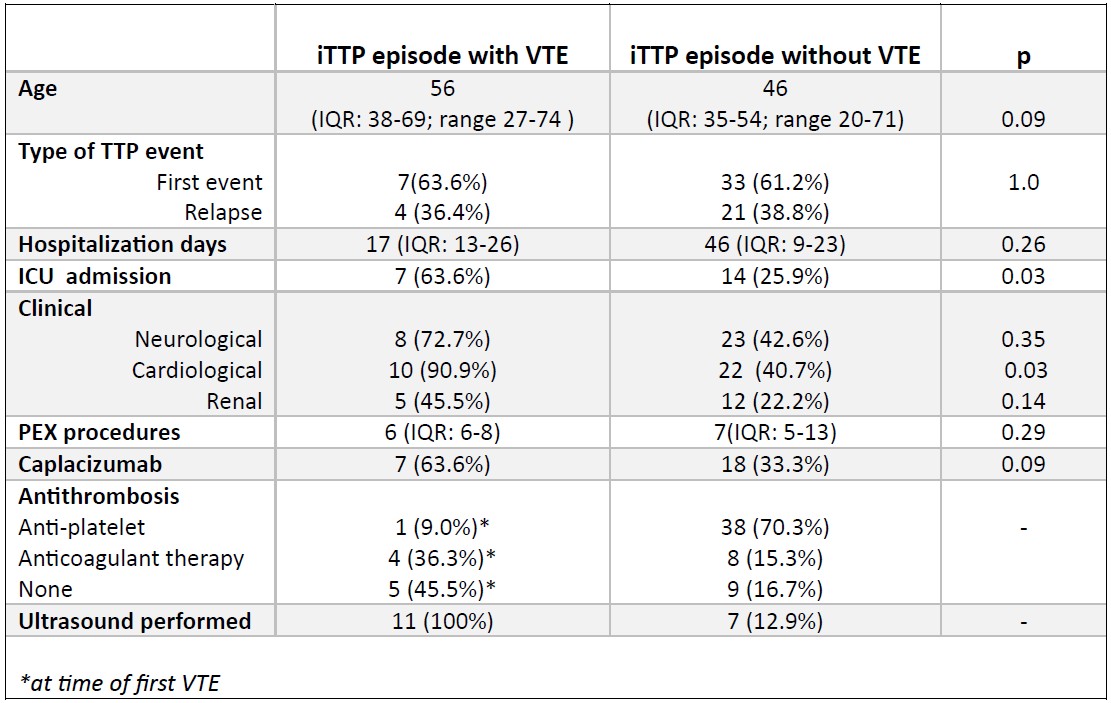
Methods. We conducted a single-center retrospective cohort study including all patients admitted to our department between November 2008 and March 2026 with a diagnosis of first-episode or relapsed iTTP. Diagnosis was confirmed by measurement of ADAMTS13 activity and inhibitor titer. For each episode, demographic, clinical, and laboratory data were collected, including age, length of hospitalization, ICU admission, neurological, cardiac, and renal involvement, and use of caplacizumab, antiplatelet agents, or anticoagulants during the episode, as reported in the table. The use of Doppler ultrasonography for VTE diagnosis was also recorded. The occurrence of deep vein thrombosis (DVT) in typical or atypical sites, superficial venous thrombosis (SVT), and pulmonary embolism (PE) was documented.
Results. A total of 65 iTTP episodes in 47 patients (30 females, 17 males) were identified. Fourteen VTE events were recorded, occurring across 11 iTTP episodes (16.9%) and affecting 11 distinct patients. In three episodes, two VTE events occurred, while no patient experienced VTE in more than one episode. SVT was documented in 2 episodes (3%), whereas DVT occurred in 9 episodes (13.8%), including cases with multiple events. No PE was observed. All thrombotic events were asymptomatic; all but one were catheter-related, and none were fatal. VTE was diagnosed at a median of 6 days (IQR 5–16) after hospital admission. Eight patients with VTE had at least one risk factor, and 3 had multiple risk factors (5 were active smokers, 2 were obese, 1 had a prior PE, 1 carried a heterozygous prothrombin variant, 1 had a family history of VTE, and 1 was receiving oral estrogen–progestin therapy). Cardiac involvement and ICU admission were significantly more frequent in iTTP episodes complicated by VTE compared with those without VTE. No statistically significant differences were observed for other variables (Table 1). However, VTE-related iTTP episodes were characterized by a higher median age and a greater frequency of neurological and renal involvement.
Conclusions. These findings indicate a clinically relevant risk of VTE in patients with iTTP. Notably, the true incidence is likely underestimated, as these events are predominantly asymptomatic; on this basis, we advocate for more intensive ultrasound surveillance. Furthermore, we believe it is important to implement preventive strategies; in particular, we suggest the prompt removal of central venous catheters when no longer needed and the use of pharmacological thromboprophylaxis when the platelet count allows in patients of advanced age with multiple risk factors or with multiple/severe organ involvement.
Downloads
Citations




How to Cite

This work is licensed under a Creative Commons Attribution-NonCommercial 4.0 International License.