CO030 | MILD HEMOPHILIA A AND JOINT HEALTH IN REAL LIFE: IS THAT AN EMERGING ISSUE? A SINGLE CENTER EXPERIENCE
G. Murante1|2|3, F. Valeri1|2, S. Bergonzi1|2|3, M. Capetta1|2|3, C. Dainese1|2, A. Valpreda4, R. Pastorino1|3, F. Bocchi1|3, B. Bruno2|3, A. Borchiellini1|2 | 1Regional Centre for Hemorrhagic and Thrombotic Diseases, AOU Città della Salute e della Scienza di Torino, Italy; 2Division of Hematology, AOU Città della Salute e della Scienza, Università di Torino, Italy; 3Dep. of Molecular Biotechnology and Health Sciences, University of Turin, Italy; 4Central Lab. Baldi and Riberi, AOU Città della Salute e della Scienza di Torino, Italy
All claims expressed in this article are solely those of the authors and do not necessarily represent those of their affiliated organizations, or those of the publisher, the editors and the reviewers. Any product that may be evaluated in this article or claim that may be made by its manufacturer is not guaranteed or endorsed by the publisher.
Authors
Background and aims. Mild hemophilia A (mHA), defined by factor VIII levels between 0.05 and 0.40 IU/mL, is characterized by sporadic bleeds that rarely lead to symptomatic arthropathy. However, the definition of mHA includes different bleeding phenotypes with manifestations that can widely vary between patients, and data concerning the extent of joint damage in mHA are limited. The aim of this study is to investigate joint status in our cohort of mHA patients in order to detect any significant sign of arthropathy and to explore any relationship between joint health and FVIII levels, body mass index (BMI), and age. Furthermore, we perform a quality of life (QoL) assessment in order to detect any impairment related to health.
Methods. Patients with FVIII between 0.05 and 0.35 IU/ml and between 18 and 65 years old referred to our center in 2025 were included. For each patient, elbows, knees, and ankles were evaluated by HJHS (Hemophilia Joint Health Score) and by musculoskeletal ultrasound according to the HEAD US (Hemophilia Early Arthropathy Detection with Ultrasound) protocol. Data regarding FVIII basal value, BMI, and pain (according to the NRS scale) were also collected. Variables were analyzed for the entire cohort and split according to age (< 49 years and > 50 years) and FVIII levels (from 0.05 UI/ml to 0.20 UI/ml and from 0.21 UI/ml to 35 UI/ml). EQ-5D-3L, SF36, and IPAQ questionnaires were administered to explore QoL and physical activity.
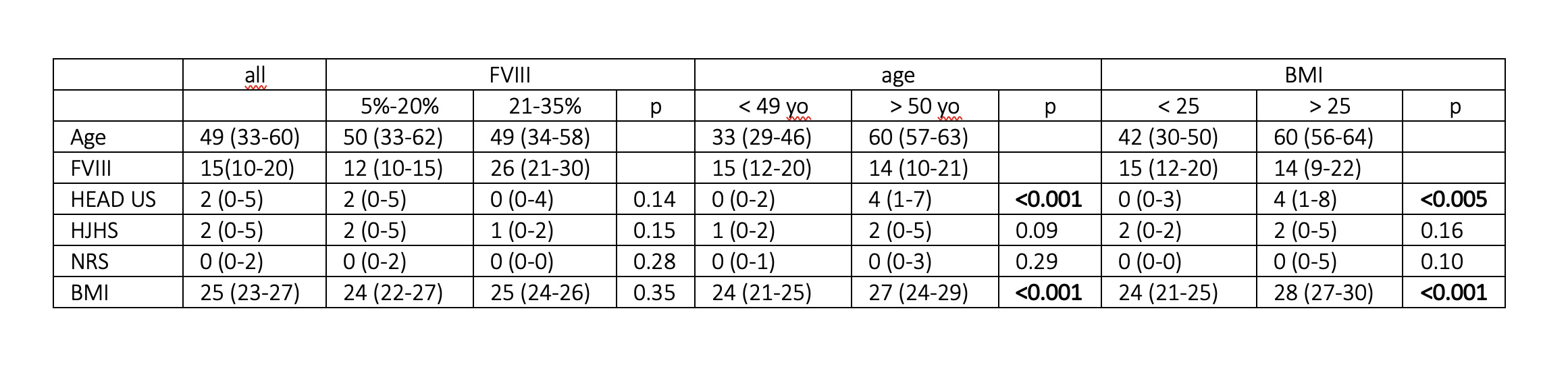
Results. Of the 96 mHA patients treated at our center, 42 hemophilia patients fulfilled inclusion criteria and were enrolled in the study. Results are reported in Table 1. We globally found low joint health scores; the median HEAD US was 2 (IQR 0-5), and the median HJHS was 2 (IQR 0-5). However, only 15 (36%) patients had no joint damage (HEAD-US=0), and 27 (64%) had at least one joint with a HEAD-US (table 1). No differences were found in HEAD-US and HJHS according to FVIII; nevertheless, we found that for elderly patients and for those with higher BMI there is a statistically significant increase in HEAD-US. 20 patients fulfilled all QoL questionnaires: 14/20 (70%) patients showed no impairment in QoL, and 6/20 (30%) expressed discomfort related to musculoskeletal criticalities. In the IPAQ evaluation, 15/20 (75%) patients were classified as quite or very active and 5/20 (25%) inactive. Despite low sample size, we observed a correlation trend between high HJHS and worse QoL perception. No correlation between QoL and FVIII levels, HEAD US, age, or BMI was found.
Conclusions. Our data suggest that mHA patients show overall better joint status compared to severe or moderate HA patients, without any differences according to severity of FVIII deficiency. No correlation between HJHS and other variables was detected; in contrast, we found a significant correlation between HEAD US and age and BMI, identifying these two parameters as risk factors for early arthropathy development. mHA patients showed overall good QoL, with only critical issues represented by pain and/or musculoskeletal impairment, suggesting that the disease burden is related to articular health rather than the disease itself. In conclusion, ultrasound joint alterations, even in the absence of clinical signs of arthropathy, should be routinely investigated in mHA patients in order to prevent or detect any reversible damage that can occur, especially in adulthood and in overweight patients, and can affect QoL.

Downloads
Citations




How to Cite

This work is licensed under a Creative Commons Attribution-NonCommercial 4.0 International License.