


CO027 | PREIMPLANTATION GENETIC TESTING IN FAMILIES AT RISK OF HEMOPHILIA: RESULTS FROM A SINGLE CENTER
M. Mortarino1, I. Garagiola1, V. Nicotra2, A. Riccaboni3, C. Guarneri3, E. Somigliana3, F. Peyvandi1|4 | 1Fondazione IRCCS Ca’ Granda Ospedale Maggiore Policlinico, Angelo Bianchi Bonomi Hemophilia and Thrombosis Center and Fondazione Luigi Villa, Milano, Italy; 2Medical Genetics Unit, Fondazione IRCCS Ca' Granda Ospedale Maggiore Policlinico, Milano, Italy; 3Infertility Unit, Fondazione IRCCS Ca' Granda Ospedale Maggiore Policlinico, Milano, Italy; 4Department of Pathophysiology and Transplantation, Università degli Studi di Milano, Milano, Italy
All claims expressed in this article are solely those of the authors and do not necessarily represent those of their affiliated organizations, or those of the publisher, the editors and the reviewers. Any product that may be evaluated in this article or claim that may be made by its manufacturer is not guaranteed or endorsed by the publisher.
Authors
Background and aims. Preimplantation genetic testing for monogenic diseases (PGT-M) is a reliable and safe reproductive option for couples at high risk of transmitting inherited genetic disorders. It is a well-established diagnostic procedure that involves the biopsy and analysis of embryonic cells, either blastomeres at the cleavage stage or trophectoderm cells at the blastocyst stage, allowing the detection of monogenic disorders prior to embryo transfer. This approach allows couples at risk of transmitting a genetic disease to avoid invasive prenatal diagnosis and the potential interruption of the pregnancy in case of an affected male fetus, often representing a more acceptable option for most couples. We report a ten-year single-centre PGT-M experience in families at risk of hemophilia, an X-linked recessive bleeding disorder caused by gene variants in F8 or F9 genes.
Methods. Following a multidisciplinary consultation involving a geneticist, gynecologist, psychologist, and hematologist, a pre-clinical PGT work-up was performed for couples in which the female was a carrier of hemophilia A or B. To reduce the risk of bleeding episodes during oocyte pickup, specific hemostatic management was administered to carriers with low levels of coagulant activity. Intracytoplasmic sperm injection (ICSI) was used to generate embryos. Blastocysts on days 5–7 were biopsied for genetic testing, and subsequently cryopreserved by vitrification. Informative polymorphic short tandem repeat (STR) markers were used for linkage analysis, either alone or in combination with the familial pathogenic variant detection using a multiplex PCR approach. Embryos identified as unaffected were suitable for transfer one at a time, while affected embryos remained cryopreserved.
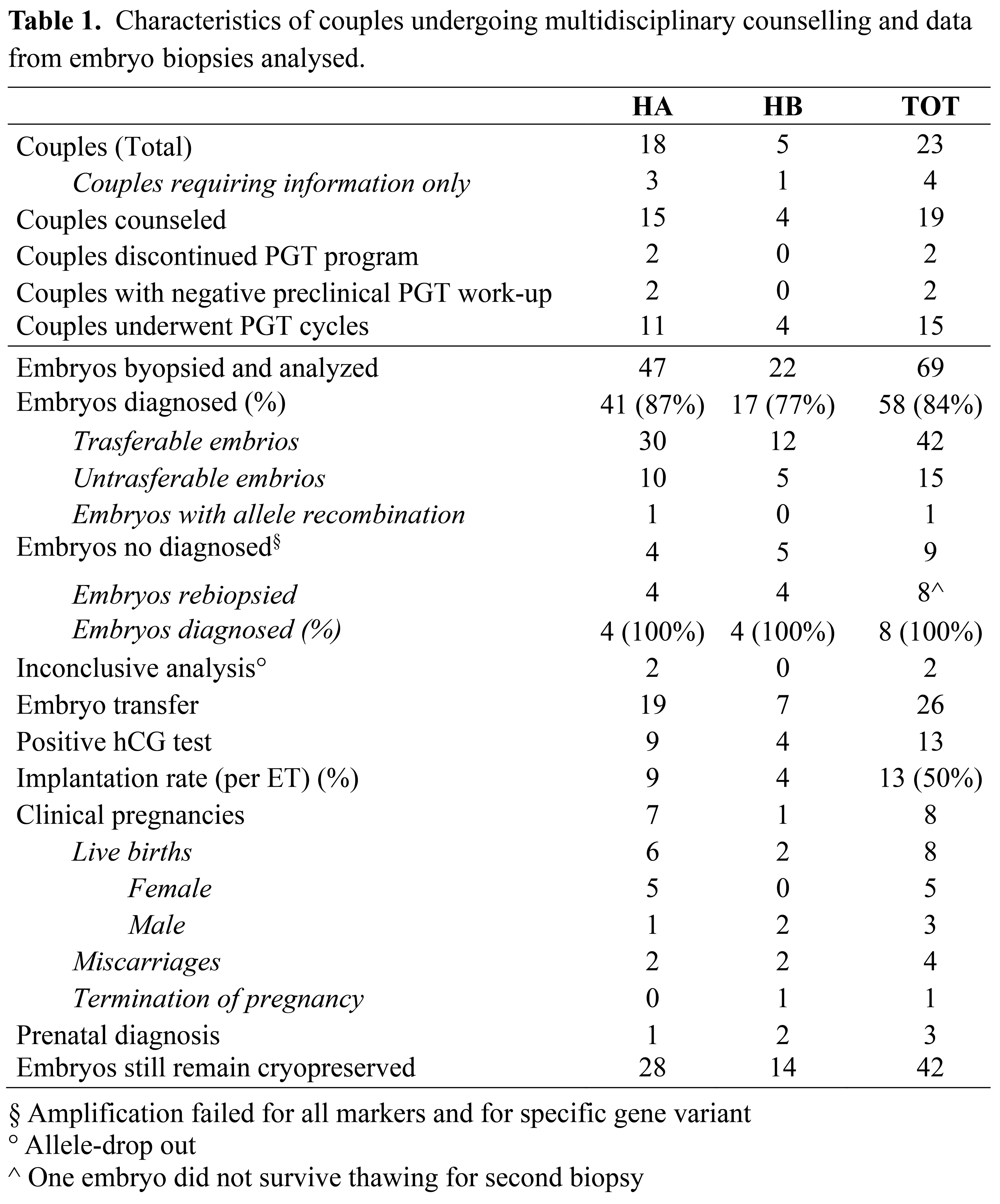
Results. A total of 23 couples contacted the center for information on the PGT-M program, of whom 19 underwent multidisciplinary counseling and preclinical PGT work-up (Table 1). In two cases, the analyzed STR markers were not informative, and therefore the embryo testing was not feasible. Two additional couples discontinued the process for personal reasons. Overall, 15 couples, eleven with hemophilia A and four with hemophilia B, proceeded with PGT-M cycles. Following ICSI, 69 embryos (47 tested for hemophilia A and 22 for hemophilia B) were biopsied and genetically characterized. A conclusive genetic diagnosis was obtained for 58 embryos (84%), 43 of which were classified as unaffected embryos suitable for transfer. Twenty-six vitrified embryos were transferred, resulting in 13 pregnancies (50% implantation rate per transfer), leading to eight live births (live birth rate of 31%), four miscarriages, and one therapeutic abortion (Table 1). Prenatal diagnosis by chorionic villus sampling, performed in three cases, confirmed the PGT-M results. Amplification failure occurred in nine cases, eight of which were successfully re-biopsied and genetically characterized. Allele drop-out was observed in two embryos, and recombination in one embryo.
Conclusions. Our ten-year experience shows that PGT-M represents a transformative advancement in reproductive medicine, enabling the avoidance of transmitting hereditary diseases through early genetic testing, reducing the risk of affected pregnancies and alleviating the emotional burden linked to therapeutic abortion.

Downloads
Citations




How to Cite

This work is licensed under a Creative Commons Attribution-NonCommercial 4.0 International License.



