


CO014 | INCIDENCE OF NEW OR RECURRENT MALIGNANCY AFTER SUPERFICIAL VEIN THROMBOSIS: A SYSTEMATIC REVIEW AND META-ANALYSIS
D. Santagata1, D. Todorovic1, G. Di Cugno1, G. Bassanese1, L. Girardi1|2, A. Abenante1, O. Cohen3, P. Santini4, M.P. Donadini1, A. Squizzato1 | 1Department of Medicine and Surgery, University of Insubria, Varese and Como, Italy; 2Department of Medicine, the Ottawa Hospital Research Institute, University of Ottawa, Ottawa, Canada; 3Kaplan Medical Center and Faculty of Medicine, Hebrew University of Jerusalem, Jerusalem, Israel; 4Thrombosis Unit, Department of Geriatric, Orthopedic, and Rheumatologic Sciences, Fondazione Policlinico Universitario A. Gemelli IRCCS, Università Cattolica del Sacro Cuore, Roma, Italy
All claims expressed in this article are solely those of the authors and do not necessarily represent those of their affiliated organizations, or those of the publisher, the editors and the reviewers. Any product that may be evaluated in this article or claim that may be made by its manufacturer is not guaranteed or endorsed by the publisher.
Authors
Background. Superficial vein thrombosis (SVT) has been associated with occult malignancy, but the risk magnitude and the timing of cancer diagnosis remain uncertain. Consequently, the role of cancer screening after SVT is not well defined.
Aims. To estimate the cumulative incidence of new or recurrent malignancy after SVT and to explore its potential clinical implications through estimation of the number needed to screen (NNS).
Methods. A systematic review and meta-analysis were conducted according to PRISMA 2020 guidelines. Four major databases were searched from inception to November 2025. Studies enrolling adult patients with SVT and reporting incident or recurrent cancer during follow-up of ≥6 months were included. A random effects meta-analysis of proportions was performed using inverse-variance methods with Freeman–Tukey double arcsine transformation. Heterogeneity was evaluated according to I². Among others, a prespecified sensitivity analysis restricted to studies with 12-month follow-up was conducted. NNS estimates were indirectly derived using the obtained pooled incidence of cancer and the published sensitivities of common screening tests, under best-case and more realistic uptake scenarios.
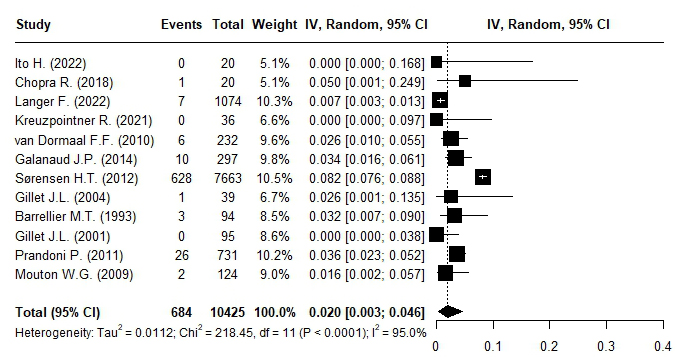
Results. Twelve studies, including 10,425 patients with SVT, were included. In the main analysis, the pooled cumulative incidence of new or recurrent malignancy was 2.0% (95% CI 0.3–4.6), with substantial heterogeneity (I² = 95%). (Figure 1) Sensitivity analyses yielded consistent results. Restriction to studies reporting 12-month follow-up showed a pooled incidence of 1.2% (95% CI 0.3–2.5). Subgroup analyses based on screening strategies did not demonstrate statistically significant differences between systematically and non-systematically screened cohorts. Based on pooled incidence estimates, best-case NNS ranged from approximately 99 to 153 depending on cancer type. When adjusted for test sensitivity and assuming 80% screening uptake, realistic NNS values substantially increased. The contrast CT thorax/abdomen protocol yielded far lower realistic NNS of 71.
Conclusions. The cumulative incidence of new or recurrent cancer diagnoses after SVT was not negligible. Although this risk may be clinically relevant, indirect NNS estimates of routine systematic cancer screening after SVT in unselected patients are unlikely to be efficient. A routine CT-scan strategy focusing on high-risk subgroups may be feasible
Downloads
Citations




How to Cite

This work is licensed under a Creative Commons Attribution-NonCommercial 4.0 International License.



