


CO012 | LONG-TERM RISK OF RECURRENT VENOUS THROMBOEMBOLISM IN ADULT PATIENTS WITH ACTIVE CANCER AND FIRST CATHETER-RELATED UPPER EXTREMITY DEEP VEIN THROMBOSIS AFTER DISCONTINUATION OF ANTICOAGULANT TREATMENTS AND LINE REMOVAL: A RETROSPECTIVE MULTI-CENTER COHORT STUDY – CANCER-CRT STUDY
L. Girardi1|2, W. Ageno3, L. Bertù1, C. Lodigiani4, L.A. Ciuffini4, M.C. Vedovati5, C. Becattini5, A. Sammarco6, G. Camporese6, G. Cuni1|7, C. Ambaglio7, M.P. Donadini1 | 1Research Center on Thromboembolic Diseases and Antithrombotic Treatment, Department of Medicine and Surgery, University of Insubria, Varese, Italy; 2Department of Medicine, The Ottawa Hospital Research Institute, University of Ottawa, Ontario, Canada; 3Department of Medicine, University of Padua, Padova, Italy; 4Center for Thrombosis and Hemorrhagic Diseases, IRCCS Humanitas Research Hospital, Rozzano, Milano, Italy; 5Internal and Cardiovascular Medicine-Stroke Unit, University of Perugia, Perugia, Italy; 6Clinica Medica 1, Department of Medicine, DIMED, Padova University Hospital, Padova, Italy; 7Immunohematology and Transfusion Medicine, Department of Transfusion Medicine and Hematology, ASST Papa Giovanni XXIII, Bergamo, Italy
All claims expressed in this article are solely those of the authors and do not necessarily represent those of their affiliated organizations, or those of the publisher, the editors and the reviewers. Any product that may be evaluated in this article or claim that may be made by its manufacturer is not guaranteed or endorsed by the publisher.
Authors
Background and Aims. Central venous catheters (CVCs) are commonly used in patients with cancer, mainly for the administration of cancer treatments. Catheter-associated upper extremity deep vein thrombosis (UEDVT), also known as catheter-related thrombosis (CRT), is a common complication of CVCs. The available evidence reports rates of symptomatic VTE of 7% over 3 months in patients with active cancer and a new CVC. Current clinical guidelines recommend therapeutic anticoagulation for at least 3 months and as long as the catheter is in place. Evidence on the long-term risk of recurrent venous thromboembolism (VTE) after catheter removal and after treatment discontinuation in patients with ongoing active cancer is scarce, and significant heterogeneity in therapeutic approach after the initial 3-month duration is frequently observed in clinical practice. Our study aims to assess the incidence of recurrent VTE following a first CRT in patients with active cancer who discontinued anticoagulation after completion of at least 3 months of treatment and after line removal.
Methods. This is a retrospective multi-center cohort study of adult patients with cancer who have been diagnosed with CRT from Jan 2019 to Dec 2023. Inclusion criteria were discontinuation of anticoagulation, catheter removal, and persistent active cancer. We excluded patients with concomitant other sites VTE, history of VTE, and an indication for long-term anticoagulation (e.g., atrial fibrillation). The minimum duration of follow-up was 90 days after anticoagulant treatment discontinuation. The primary outcome was recurrent VTE. Secondary outcomes included major bleeding events, clinically relevant non-major bleeding events, and all-cause mortality. Assuming a 3% annual rate of recurrent events (corresponding to the observed risk of recurrent events after a first episode of VTE provoked by a transient risk factor in the general population), a calculated sample size of 250 patients would yield an expected one-sided 95% upper confidence bound within 5% (corrected calculation 4.8% evaluated considering normal approximation). Outcomes were calculated as point-estimate risks at 90 days. Kaplan-Meier method was used to estimate the cumulative probability of recurrent VTE, bleeding, and mortality among the overall population.
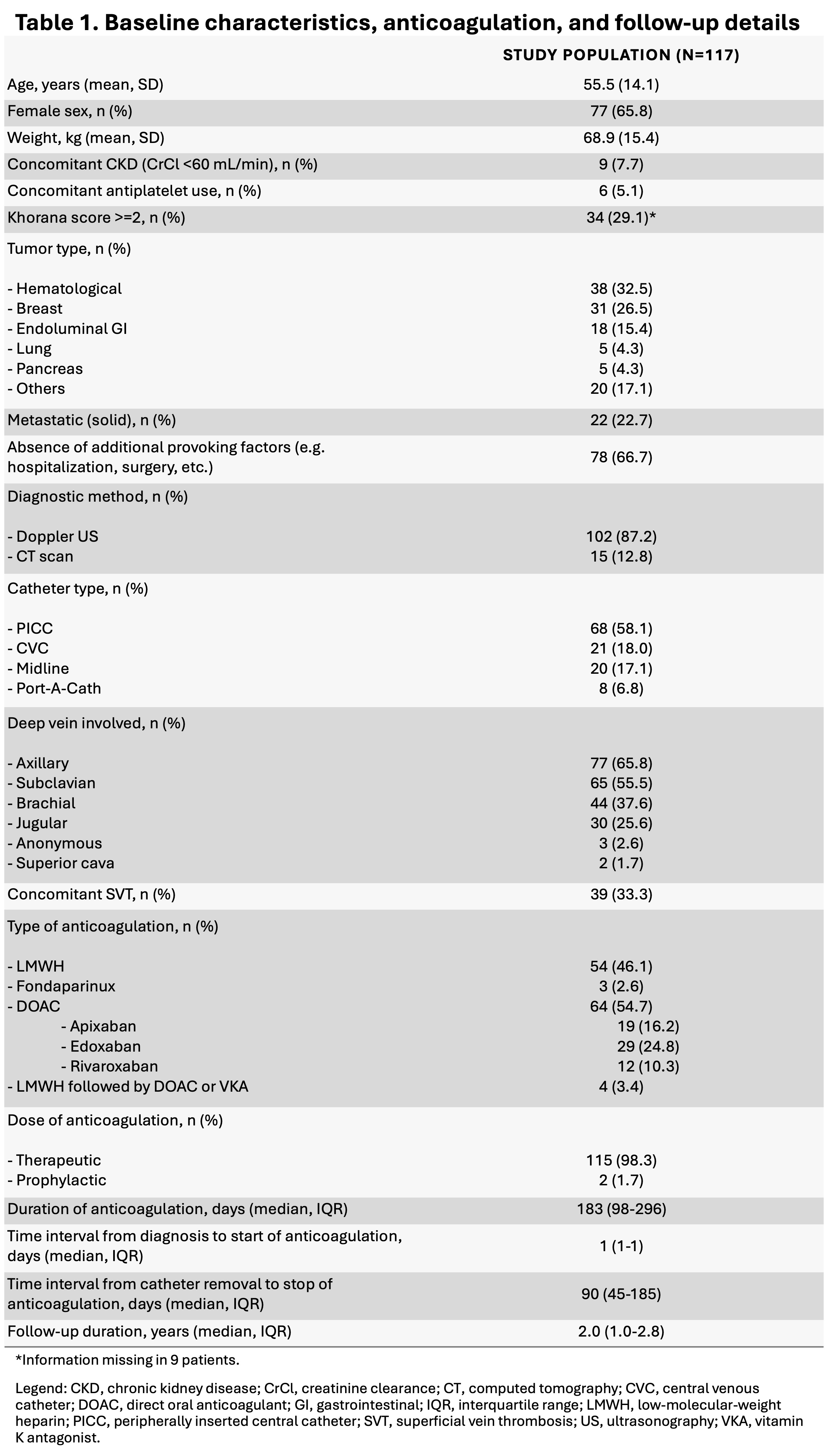
Results. While recruitment is ongoing, we here report the results of the analysis of 117 patients from 5 Italian hospitals. Baseline characteristics and treatment details are described in Table 1. At 90 days after treatment discontinuation, 2 recurrent VTEs (1.7%) occurred. After a median follow-up of 2 years, the cumulative incidence rate was 2.6 (6 events) per 100 patient-years (95% CI 1.2-5.8). Recurrent VTEs were represented by one pulmonary embolism and five UEDVTs, most of them (n:3) related to a new catheter placement and two incidentally diagnosed. No major bleeding events were observed. The mortality rate was 6.9 per 100 patient-years (95% CI 4.2-11.3), and all events were related to the underlying malignancy.
Conclusions. Our preliminary results showed that recurrent VTE after anticoagulation discontinuation was relatively low, suggesting that the presence of active cancer alone should not warrant long-term anticoagulation in this setting. Results from a larger sample will be presented at the congress.

Downloads
Citations




How to Cite

This work is licensed under a Creative Commons Attribution-NonCommercial 4.0 International License.



