


CO008 | ALLOSTATIC LOAD AND THE RISK OF ARTERIAL AND VENOUS VASCULAR EVENTS: A PROSPECTIVE ANALYSIS FROM THE MOLI-SANI STUDY
T. Panzera1, A. Di Castelnuovo1, M. Bonaccio1, S. Magnacca1, A. De Curtis1, F. Bracone1, W. Ageno2, C. Cerletti1, M.B. Donati1, G. de Gaetano1, L. Iacoviello1|3, S. Costanzo1|4 | 1Research Unit of Epidemiology and Prevention, IRCCS NEUROMED, Pozzilli, Italy; 2Department of Medicine, University of Padua, Padova, Italy; 3Department of Medicine and Surgery LUM University “Giuseppe Degennaro”, Casamassima, Italy; 4Department of Medicine and Surgery, University of Insubria, Varese, Italy
All claims expressed in this article are solely those of the authors and do not necessarily represent those of their affiliated organizations, or those of the publisher, the editors and the reviewers. Any product that may be evaluated in this article or claim that may be made by its manufacturer is not guaranteed or endorsed by the publisher.
Authors
Background and Aims. Allostatic load (AL) reflects cumulative multisystem biological dysregulation induced by chronic exposure to stressors and has emerged as an integrative marker of chronic physiological burden. However, prospective evidence on whether AL captures long-term risk across both arterial and venous vascular outcomes remains limited. We therefore aimed to evaluate the association between AL and mortality, cardiovascular disease (CVD), and venous thromboembolism (VTE) in a large prospective cohort.
Methods. We analyzed 22,255 participants from the Moli-sani study, a population-based cohort in Italy (aged ≥35 years, 52% women), apparently free of cardiovascular disease (CVD) and venous thromboembolism (VTE) at baseline (2005-2010). Outcomes included all-cause and CVD mortality, as well as fatal and non-fatal CVD, coronary heart disease (CHD), stroke subtypes, and unprovoked VTE. AL was computed as the sum of standardized (z-score) biomarkers across multiple physiological systems, with inversion of protective markers and equal weighting. Variables included cardiovascular (systolic and diastolic blood pressure, heart rate), inflammatory/immune (C-reactive protein, fibrinogen, white blood cell count, albumin [inverted], glycoprotein acetyls), metabolic (HDL cholesterol [inverted], total cholesterol, triglycerides, glucose, body mass index, waist-to-hip ratio, insulin, lipoprotein(a), apolipoprotein B), respiratory (FEV1 and FVC [both inverted]) and renal markers (creatinine, cystatin C). Higher values of the AL index indicated greater biological dysregulation; the index was categorized into quartiles. Cox proportional hazards models were used to estimate hazard ratios (HRs) and 95% confidence intervals (CIs), adjusting for demographic, socioeconomic, and lifestyle factors.
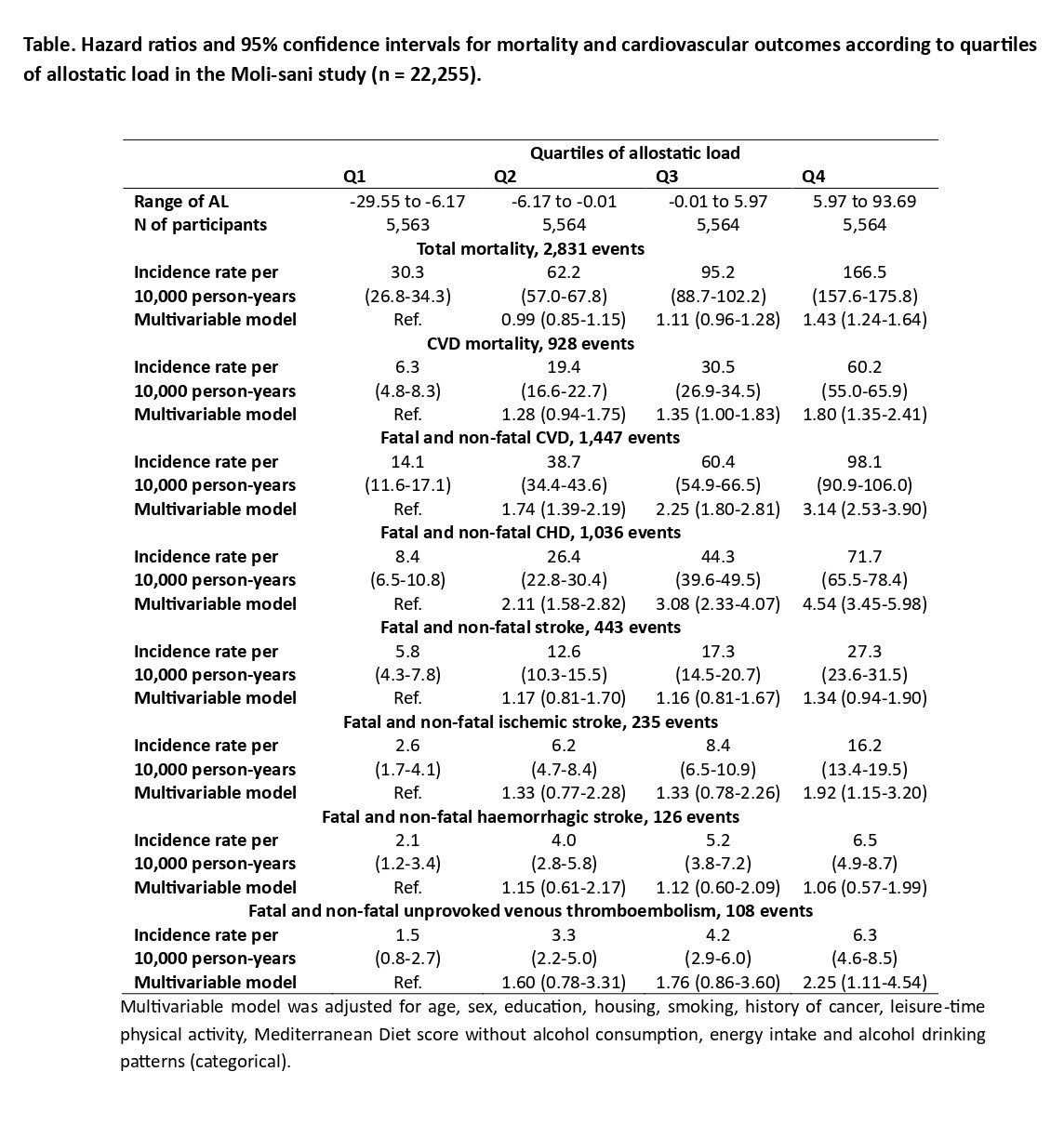
Results. Median follow-up ranged from 13 to 15 years across outcomes. During follow-up, 2,831 deaths and 1,555 incident arterial and venous vascular events were recorded, as reported in the table. Participants in the highest global AL index quartile, compared with those in the lowest one, had an increased hazard of all-cause mortality (HR 1.43; 95% CI 1.24-1.64) and cardiovascular mortality (HR 1.80; 95% CI 1.35-2.41). A strong graded association was observed for fatal and non-fatal CVD (HR 3.14; 95% CI 2.53-3.90), with the strongest effect observed for coronary heart disease (HR 4.54; 95% CI 3.45-5.98). Associations with overall cerebrovascular outcomes were weaker than those observed for CHD, although participants in the highest versus lowest AL index quartile still showed an almost twofold higher hazard of fatal and non-fatal ischemic stroke (HR 1.92; 95% CI 1.15-3.20). This adverse association extended beyond arterial outcomes to venous thrombotic events, with a higher AL index being associated with more than a twofold higher risk of fatal and non-fatal unprovoked venous thromboembolism (HR 2.25; 95% CI 1.11-4.54).
Conclusions. In this large population-based prospective cohort, a higher global AL index was associated with an excess hazard of all-cause and cardiovascular mortality and major arterial cardiovascular events, particularly CHD. The association also extended to unprovoked VTE. A cumulative multisystem biological dysregulation may capture long-term vascular vulnerability beyond traditional arterial outcomes and may represent an integrative marker for risk stratification.

Downloads
Citations




How to Cite

This work is licensed under a Creative Commons Attribution-NonCommercial 4.0 International License.



