


CO007 | TPO-RECEPTOR AGONISTS AS AN INDEPENDENT RISK FACTOR FOR VENOUS THROMBOTIC EVENT IN IMMUNE THROMBOCYTOPENIA PATIENTS WITH PERSISTENT ANTIPHOSPHOLIPID ANTIBODIES POSITIVITY
M. Biglietto, B. Mandelli, S. Sorella, S. Ligia, C. Andriola, R. Mormile, E. Baldacci, A. Chistolini, S. Truglia, C. Santoro | Sapienza, University of Rome, Italy
All claims expressed in this article are solely those of the authors and do not necessarily represent those of their affiliated organizations, or those of the publisher, the editors and the reviewers. Any product that may be evaluated in this article or claim that may be made by its manufacturer is not guaranteed or endorsed by the publisher.
Authors
Background and Aims. The presence of antiphospholipid antibodies (aPL) and exposure to thrombopoietin receptor agonists (TPO-RAs) may increase thrombotic risk in patients with immune thrombocytopenia (ITP). This study aimed to identify predictors of thrombotic events (TEs) in ITP patients with persistent aPL positivity.
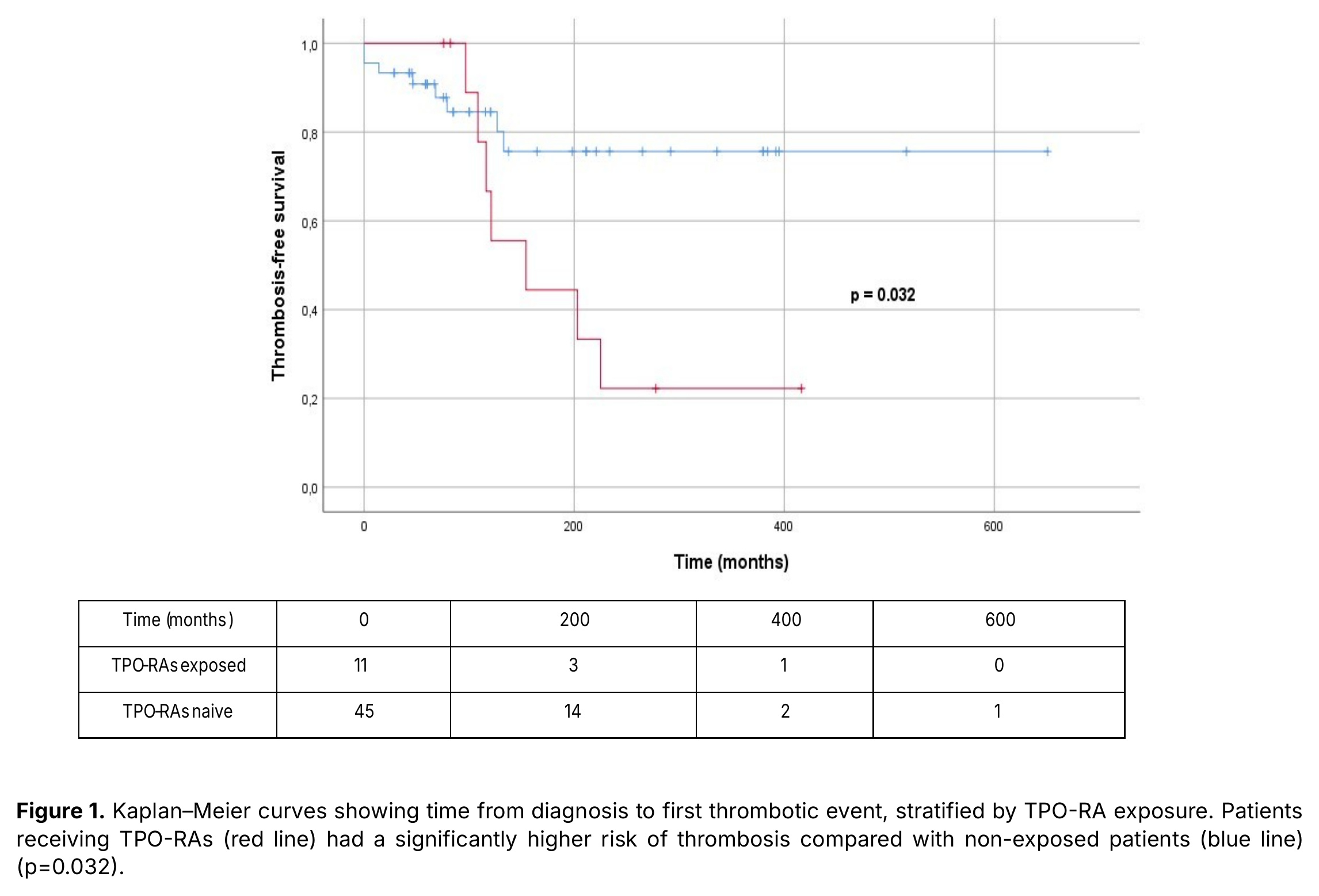
Methods. We conducted a retrospective observational study including 56 consecutive ITP patients with persistent aPL positivity. Clinical, laboratory, and treatment data were collected. aPL testing included lupus anticoagulant (LA), anticardiolipin (aCL) IgG/IgM, and anti-β2 glycoprotein I (aβ2GPI) IgG/IgM. A high-risk aPL profile was defined according to ACR/EULAR 2023 criteria (LA positivity, high-titer single positivity, or double/triple positivity). Thrombosis-free survival (t-EFS) was defined as the time from ITP diagnosis to the first thrombotic event or last follow-up. Statistical analyses included univariate and multivariate logistic regression to identify predictors of thrombosis. Time-to-event analysis was performed using the Kaplan–Meier method, censoring patients without events at last follow-up. Odds ratios (OR), adjusted ORs (aOR), and 95% confidence intervals (CI) were calculated. A p-value <0.05 was considered statistically significant.
Results. Median age at diagnosis was 37 years (range 10–81); 44 patients (78.6%) were female. All patients were persistently aPL-positive: 32 (57.1%) had single positivity, 16 (28.6%) double, and 8 (14.3%) triple positivity. A high-risk aPL profile was observed in 47 patients (83.9%), of whom 26 (55.3%) received primary antithrombotic prophylaxis (low-dose aspirin or clopidogrel). Twenty patients (35.7%) had concomitant autoimmune diseases, and 32 (57.1%) had cardiovascular comorbidities. Antirheumatic therapy was administered in 24 patients (42.9%), mainly hydroxychloroquine. Fifteen patients (26.8%) experienced a total of 20 thrombotic events: 12 venous and 4 arterial. The median platelet count at thrombosis was 72,000/µL (range 30,000–298,000). Eleven patients (19.6%) received TPO-RAs; among them, 6 (54.5%) developed venous thromboembolism (VTE) during treatment, corresponding to an incidence rate of 15.6 events per 100 patient-years. Kaplan–Meier analysis showed significantly reduced thrombosis-free survival in patients exposed to TPO-RAs (p=0.032). In univariate analysis, TPO-RA exposure was associated with increased thrombotic risk (OR 6.94; 95% CI 1.58–30.43; p=0.01), whereas antiplatelet prophylaxis (OR 0.20; 95% CI 0.048–0.799; p=0.02) and female sex (OR 0.26; 95% CI 0.07–0.99; p=0.048) were protective. In multivariate analysis, TPO-RA exposure remained an independent risk factor (aOR 6.98; 95% CI 1.36–35.78; p=0.02), while antiplatelet therapy retained a protective effect (aOR 0.20; 95% CI 0.04–0.97; p=0.046). Female sex was no longer significant (p=0.42). Other variables, including age, aGAPSS score, and aPL profile, were not associated with thrombosis.
Conclusions. TPO-RA therapy appears to significantly increase the risk of VTE in ITP patients with persistent aPL positivity, whereas antiplatelet prophylaxis may reduce this risk. These findings support systematic aPL screening at ITP diagnosis and careful risk assessment before initiating TPO-RA therapy. Prospective studies are warranted to confirm these results.
Downloads
Citations




How to Cite

This work is licensed under a Creative Commons Attribution-NonCommercial 4.0 International License.



