


CO003 | GENOMIC INCIDENTAL FINDINGS IN DISORDERS OF HEMOSTASIS
M. D'Apolito, G D'Andrea, G.P. Palladino, C. Ceccarini, G. Cordisco, A. Leccese, I. Adipietro, P. Stanziale, M. Margaglione, R. Santacroce | Medical Genetics, Dept. of Clinical and Experimental Medicine, University of Foggia, Italy
All claims expressed in this article are solely those of the authors and do not necessarily represent those of their affiliated organizations, or those of the publisher, the editors and the reviewers. Any product that may be evaluated in this article or claim that may be made by its manufacturer is not guaranteed or endorsed by the publisher.
Authors
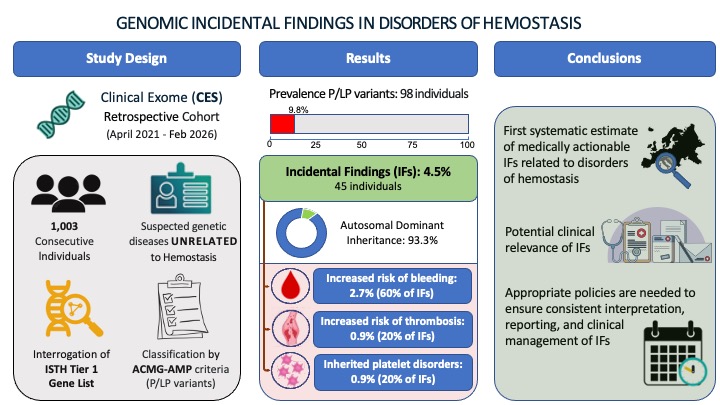
Clinical exome sequencing (CES) is widely used for the diagnosis of rare genetic diseases and may incidentally reveal variants unrelated to the primary testing indication but with potential clinical relevance. Data on incidental findings (IFs) related to inherited thrombotic, bleeding, and platelet disorders are currently lacking. We retrospectively analyzed 1,003 consecutive individuals referred for CES between April 2021 and February 2026 for suspected genetic conditions unrelated to disorders of hemostasis. Genomic data were interrogated for variants within the 99 genes included in the International Society on Thrombosis and Haemostasis (ISTH) TIER1 gene list. Pathogenicity was assessed according to ACMG-AMP criteria using multiple annotation tools and databases. Overall, 98 individuals (9.8%) carried at least one pathogenic or likely pathogenic variant in genes associated with thrombotic, bleeding, or platelet disorders. Among these, 45 individuals showed variants classified as IFs with potentially medically actionable phenotypes unrelated to the testing indication, corresponding to an overall rate of 4.5%. Most IFs were associated with autosomal dominant conditions (93.3%). Predisposition to bleeding was identified in 2.7% of individuals (60.0%), whereas IFs conferring susceptibility to thrombosis and inherited platelet disorders were each detected in 0.9% of the cohort (20.0% each). These findings provide the first systematic estimate of medically actionable IFs related to disorders of hemostasis in a large CES cohort tested for unrelated indications. The results highlight the potential clinical relevance of such variants and underscore the importance of appropriate policies for the interpretation, reporting, and clinical management of incidental genomic findings.
Downloads
Citations




How to Cite

This work is licensed under a Creative Commons Attribution-NonCommercial 4.0 International License.



