


CO-85 | ACQUIRED HEMOPHILIA A IN LIVER CIRRHOSIS: BALANCING HEMOSTASIS BETWEEN HIGH HEMORRHAGIC AND THROMBOTIC RISKS
N. Portesi, G. Martini | ASST Spedali Civili di Brescia, Italy
All claims expressed in this article are solely those of the authors and do not necessarily represent those of their affiliated organizations, or those of the publisher, the editors and the reviewers. Any product that may be evaluated in this article or claim that may be made by its manufacturer is not guaranteed or endorsed by the publisher.
Authors
Background. Acquired hemophilia A (AHA) is a rare, life-threatening bleeding disorder caused by autoantibodies against factor VIII (FVIII). Diagnosing AHA alongside pre-existing bleeding etiologies is challenging, as emerging symptoms are easily misattributed to baseline conditions, delaying treatment. Furthermore, liver cirrhosis induces alterations in pro- and anti-coagulant pathways, resulting in an unstable hemostatic equilibrium that maximizes risks for localized hemorrhage and systemic thrombosis.
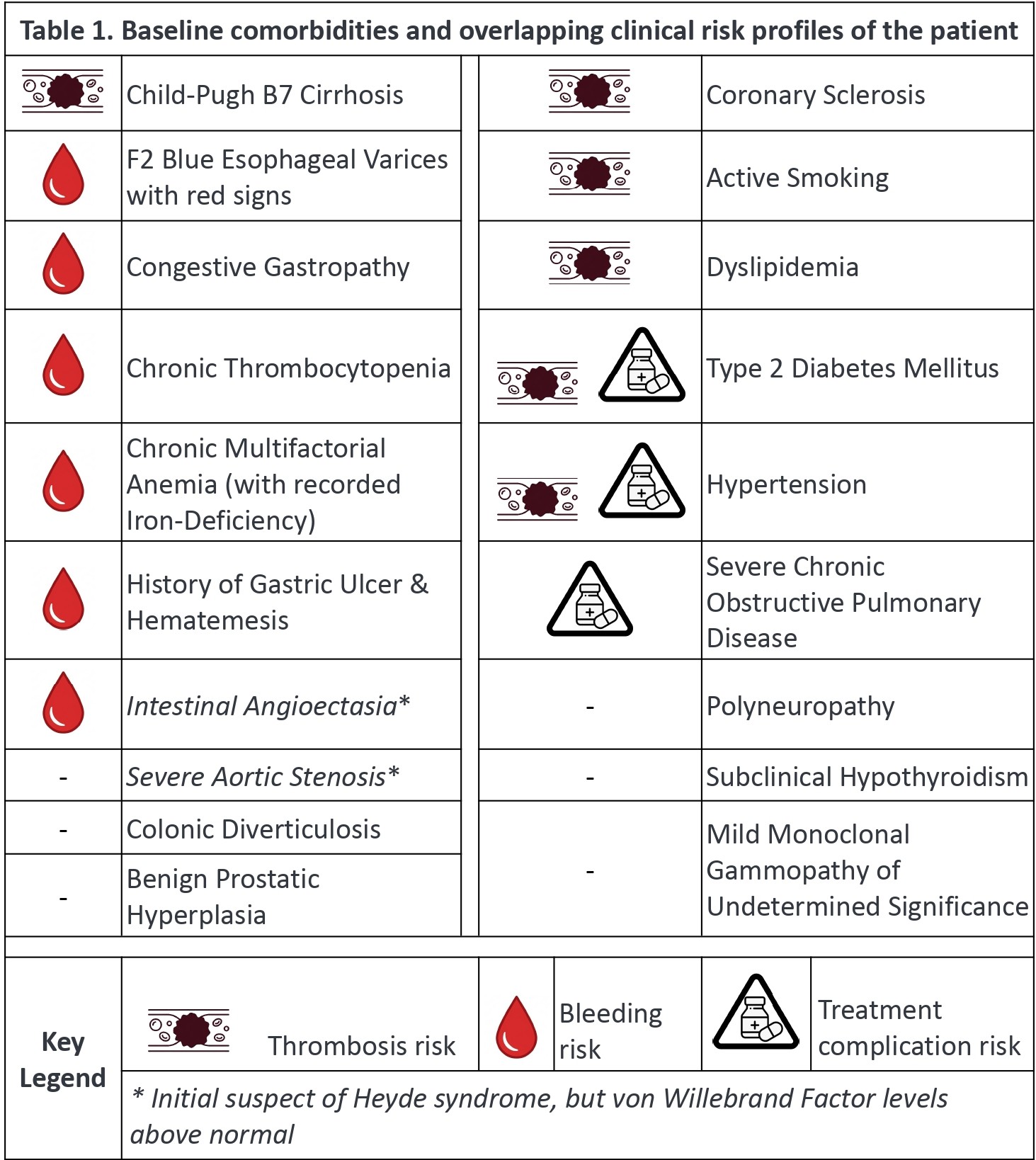
Case Report. We report a 75-year-old male with Child-Pugh B7 alcoholic-metabolic cirrhosis complicated by portal hypertension (F2 blue esophageal varices, congestive gastropathy, and mild thrombocytopenia) with multiple comorbidities (see table 1). Following seven months of recurrent bleeding episodes requiring 25 packed red blood cell (PRBC) units despite normal baseline coagulation times, he was readmitted with severe anemia (Hb 5.0 g/dL). His aPTT ratio was 1.52 upon admission and progressively lengthened; AHA was suspected when it reached 2.76, accompanied by extensive truncal ecchymoses and a large subscapular hematoma requiring near-daily transfusions (totaling 35 PRBC units). Assays confirmed FVIII deficiency (FVIII:C 4%) and a 5.0 Bethesda Unit inhibitor. Hemostasis was initiated with an activated prothrombin complex concentrate (aPCC, 50 U/kg q12h) and rapidly switched to recombinant porcine FVIII (rpFVIII, 50 U/kg q12h). Strict FVIII:C monitoring enabled safe dose tapering to 25 U/kg/day and successful discontinuation after three weeks; tranexamic acid (1 g q12h) was maintained until discharge. Immunosuppression began with prednisone (1 mg/kg/day); due to early steroid resistance, cyclophosphamide (50 mg/day for 5 weeks) was added, successfully eradicating the inhibitor. Transfusion requirements dropped after starting RP-FVIII. Clinical improvement of ascites was observed. Treatment-related complications included severe glycemic flare, oral candidiasis, and intercostal herpes zoster reactivation. A temporary fibrinogen drop occurred post-hemostatic therapy (nadir 1.06 g/L), returning to baseline (3.10 g/L) at discharge. Long-term octreotide (10 mg/month) was introduced for intestinal angioectasias.
Conclusions. A pre-existing bleeding phenotype can confound AHA diagnosis, especially in liver cirrhosis, where prolonged coagulation times can be overlooked. In this case, the sequential use of bypassing agents and monitored rpFVIII achieved safe hemostasis without inducing thrombotic events. In patients with tight thromboembolic and hemorrhagic thresholds, monitorable agents represent a crucial asset to navigate narrow therapeutic windows. Concomitant improvement in ascites may reflect the emerging role of FVIII in vascular permeability regulation.
Downloads
Citations




How to Cite

This work is licensed under a Creative Commons Attribution-NonCommercial 4.0 International License.



