


CO-83 | ACQUIRED FACTOR V DEFICIENCY IN A HIGH-THROMBOTIC-RISK PATIENT: DIAGNOSTIC DILEMMA AND SUCCESSFUL MANAGEMENT
G. Gazzelli1, L. Banov1, Y. Azzanelli1, C. Vernarecci1, F. Marotta1, F. Giacopelli1, E. Cenni2, V. Agostini2, A.C. Molinari1 | 1IRCCS Istituto Giannina Gaslini, Italy; 2IRCSS AOM S. Martino, Genova, Italy
All claims expressed in this article are solely those of the authors and do not necessarily represent those of their affiliated organizations, or those of the publisher, the editors and the reviewers. Any product that may be evaluated in this article or claim that may be made by its manufacturer is not guaranteed or endorsed by the publisher.
Authors
Background. Acquired Factor V (FV) inhibitors are rare and typically present with unexplained prolongation of Prothrombin Time (PT) and activated Partial Thromboplastin Time (aPTT) with normal Thrombin Time (TT). Presentation varies from asymptomatic laboratory findings to life-threatening hemorrhage or, paradoxically, thrombosis.
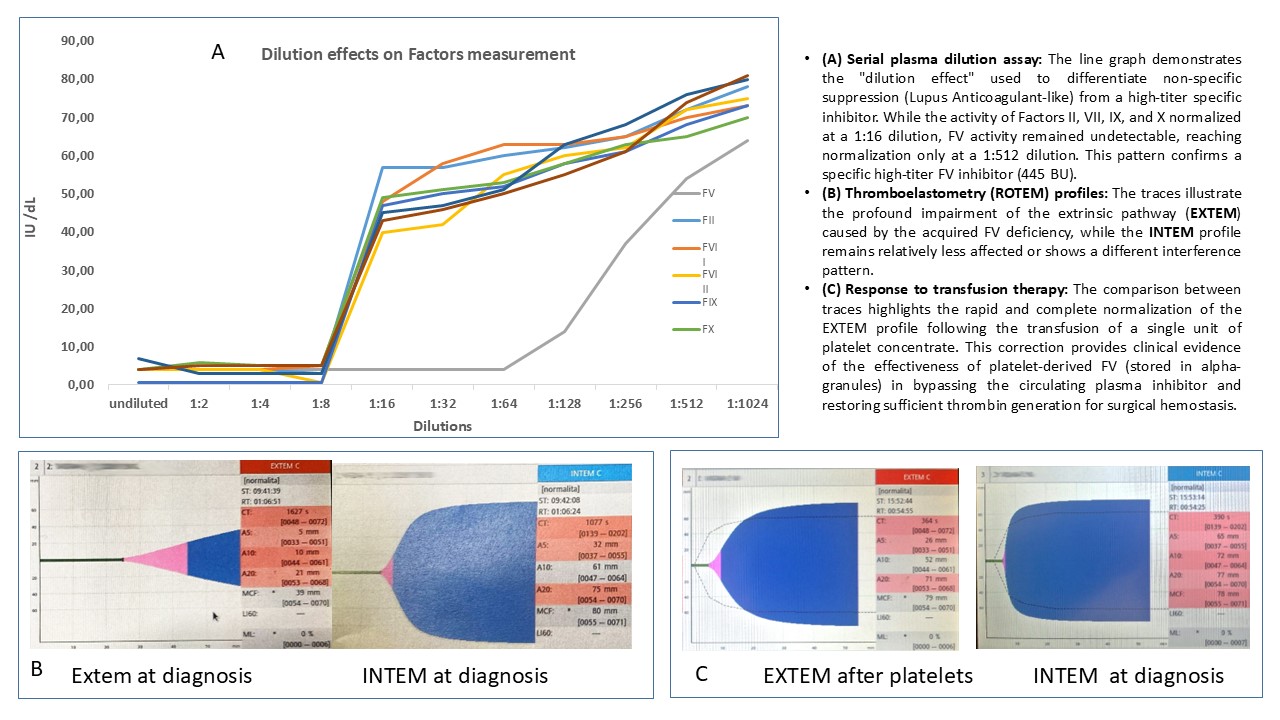
Case Report. An 80-year-old male recently discharged following severe pneumonia presented to the emergency department with pain and a large ecchymosis on his upper arm. His medical history included hypertension, aortic stenosis, a previous myocardial infarction, and peripheral obstructive arterial disease (external iliac artery) treated with clopidogrel. Initial tests showed extreme PT/aPTT prolongation with normal platelets, TT, fibrinogen, and Factor XIII. dRVVT assays revealed a strong lupus anticoagulant (LA) effect (ratio 2.8). To distinguish a "pseudo-deficiency" from a true inhibitor, serial plasma dilutions were performed: all factors normalized at 1:16 except for Factor V, which normalized only at 1:512, confirming a specific high-titre FV inhibitor (initially 445 BU). Point-of-care viscoelastic testing (ROTEM) showed markedly pathological EXTEM. Basing on the patient's high thrombotic risk and a stable clinical phenotype, initial therapy consisted only of prednisone (1 mg/kg/day). However, after 7 days, despite a decrease in the inhibitor titre to 177 BU, the patient developed acute abdominal pain. A CT scan revealed an 8 x 6 x 10 cm rectus abdominis hematoma associated with a hemoglobin drop of 2 g/dL. Haemostatic treatment with recombinant activated factor VII (rFVIIa) at 90 µg/kg was initiated but yielded no clinical benefit or improvement in EXTEM parameters. Tragically, following rFVIIa administration, the patient suffered a cerebellar stroke. Since FV inhibitors interfere with the prothrombinase complex, often making bypassing agents ineffective, and FV stored in platelet alpha-granules is partially activated and relatively resistant to circulating inhibitors, one unit of platelet concentrate was transfused to allow for urgent embolisation of the inferior epigastric artery. This led to the normalization of EXTEM, and the procedure was completed without further bleeding. Besides, a pulsed immunosuppressive protocol with a low cumulative dose of cyclophosphamide, rituximab, and steroids (CyDRi) was started. Unfortunately, two weeks later severe sepsis led to holding the immunosuppression for fourteen days; moreover, the last scheduled dose of cyclophosphamide was not administered. The following period was uneventful, and after 45 days from the start of Cydri, the patient is well with a normal coagulation profile.
Conclusions. In cases of unexplained PT/aPTT prolongation with normal TT, FV inhibitors must be considered. When initial assays suggest a multiple-factor deficiency, serial plasma dilutions are essential to unmask the specific inhibitor. Clinicians must balance hemorrhagic and thrombotic risk using bypassing agents in vasculopathic patients. Platelet transfusion represents a critical hemostatic bridge. ROTEM can demonstrate and monitor the immediate haemostatic effect of platelet transfusion, providing real-time guidance for high-risk invasive procedures.
Downloads
Citations




How to Cite

This work is licensed under a Creative Commons Attribution-NonCommercial 4.0 International License.



