


CO-80 | EMICIZUMAB PLASMA CONCENTRATIONS AND CLINICAL OUTCOMES IN ACQUIRED HEMOPHILIA A: A REAL-WORLD SINGLE-CENTER EXPERIENCE
C. Simion1|2, E. Zanon1|2, C. Bulato1, B. Stocco1|2, F. Righetto1, F. Sartorello1, P. Simioni1|2 | 1First Chair of Internal Medicine and Thrombotic and Haemorrhagic Diseases Unit, Department of Medicine, Padova University Hospital, Italy; 2Hemophilia Center, Padova University Hospital, Italy
All claims expressed in this article are solely those of the authors and do not necessarily represent those of their affiliated organizations, or those of the publisher, the editors and the reviewers. Any product that may be evaluated in this article or claim that may be made by its manufacturer is not guaranteed or endorsed by the publisher.
Authors
Background and Aims. Acquired hemophilia A (AHA) is a rare autoimmune bleeding disorder associated with significant bleeding morbidity. The AGEHA study established a standardized emicizumab dosing regimen for AHA, but data on plasma drug concentrations achieved in routine practice and their clinical significance remain limited. We aimed to describe serial emicizumab plasma concentrations and clinical outcomes in patients with AHA receiving emicizumab.
Materials and Methods. We retrospectively analyzed all patients with AHA who received emicizumab at the Padua Hemophilia Centre between April 2024 and February 2026. Clinical characteristics, FVIII activity, inhibitor titers, immunosuppressive treatment, emicizumab dosing regimens and plasma concentrations, and clinical outcomes were collected. Emicizumab concentrations were assessed during the first month after treatment initiation.
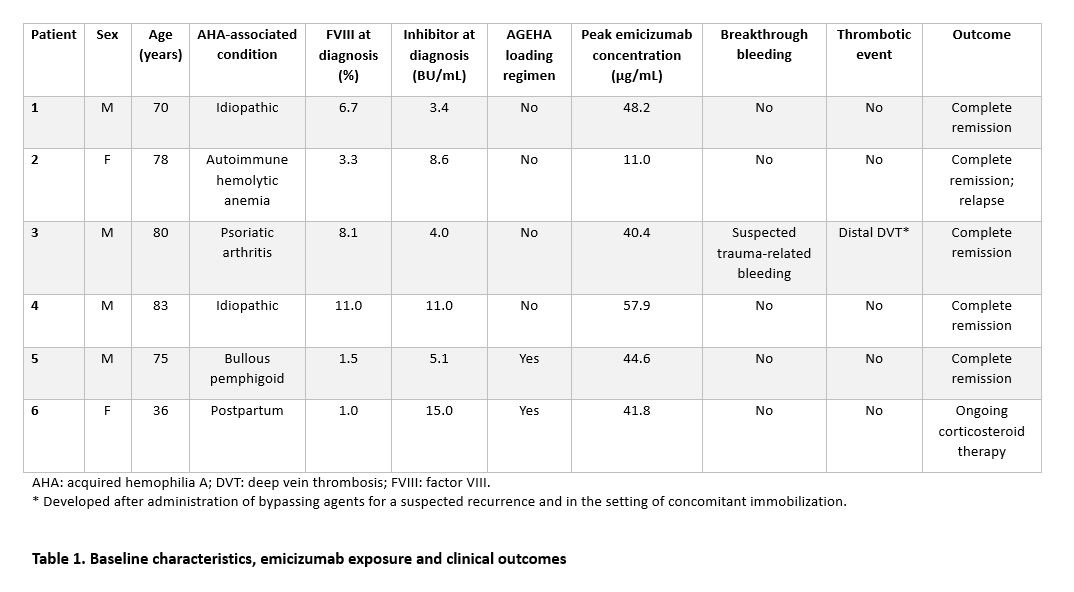
Results. Six patients with AHA (4 males, median age 76.5 years [range 36–83]) received emicizumab during the study period. Baseline characteristics, emicizumab exposure, and clinical outcomes are summarized in Table 1. Median FVIII activity and inhibitor titer at diagnosis were 5.0% and 6.9 BU/mL, respectively. Two patients received the AGEHA loading regimen, whereas four received individualized dosing schedules. Plasma concentrations increased during the first month and showed marked interindividual variability, ranging from 11.0 to 57.9 µg/mL. Complete remission was achieved in five patients, while one patient remained on corticosteroid therapy at last follow-up. One patient experienced a relapse after achieving initial remission. No spontaneous breakthrough bleeding was observed. A single patient experienced a suspected trauma-related bleeding episode approximately one month after emicizumab initiation despite a plasma concentration of 40.4 µg/mL. Because recurrent AHA could not be excluded, bypassing-agent treatment was administered. The patient subsequently developed a distal deep vein thrombosis in the setting of concomitant immobilization. No additional thrombotic events were recorded. No apparent relationship between plasma emicizumab concentrations and clinical outcomes was observed.
Conclusions. Emicizumab was associated with favorable clinical outcomes in this real-world cohort of patients with AHA, with no spontaneous breakthrough bleeding observed. Despite the use of both standard and individualized dosing regimens, plasma emicizumab concentrations showed substantial interindividual variability. Larger studies are needed to clarify the clinical significance of emicizumab exposure and the potential role of therapeutic drug monitoring in AHA.
Downloads
Citations




How to Cite

This work is licensed under a Creative Commons Attribution-NonCommercial 4.0 International License.



