


CO-75 | ASSAY DISCREPANCY IN HEMOPHILIA A CARRIERS: CLINICAL AND GENETIC INSIGHTS
M. Leotta, A. Strangio, A. Ierardi, R.C. Santoro | Hemophilia Treatment Center AOU Dulbecco, Catanzaro, Italy
All claims expressed in this article are solely those of the authors and do not necessarily represent those of their affiliated organizations, or those of the publisher, the editors and the reviewers. Any product that may be evaluated in this article or claim that may be made by its manufacturer is not guaranteed or endorsed by the publisher.
Authors
Background. Hemophilia A (HA) is an X-linked coagulopathy caused by F8 gene mutations. While research often focuses on males, female carriers frequently experience hemorrhagic diathesis due to skewed X-chromosome inactivation (lyonization). A critical diagnostic challenge is "assay discrepancy," where Factor VIII activity (FVIII:C) yields conflicting results between the One-Stage Clotting Assay (OSA) and the Chromogenic Substrate Assay (CSA). This study evaluates the incidence of these variations and their impact on clinical phenotyping in female carriers.
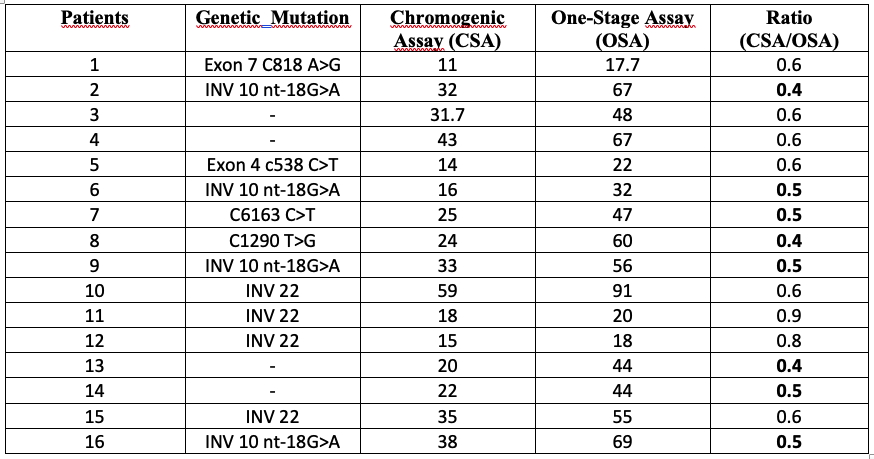
Methods. A cross-sectional analysis was conducted on 16 confirmed F8 mutation carriers. FVIII:C was quantified via OSA: Based on the activated partial thromboplastin time (aPTT). CSA: Assessing the kinetics of Factor Xa (FXa) generation. Inter-assay discrepancy was defined as a CSA/OSA ratio < 0.6 or > 1.6. Genotype-phenotype correlation was performed to identify mutations associated with divergent biochemical profiles.
Results. Data indicates that 50% of carriers exhibit a significant discrepancy, which was exclusively unidirectional (OSA > CSA). This systematic overestimation by the OSA may mask underlying functional deficiencies, leading to the misclassification of carriers as "hemostatically normal." In patients with "discrepancy-prone" mutations, traditional clotting assays failed to reflect clinical bleeding symptoms (ISTH-BAT scores), whereas the CSA superiorly represented the in vivo stability of the tenase complex. Specific molecular drivers identified include: Intron 10 Inversion (INV 10) and missense variants (Exons 4 and 7) consistently fall into the critical discrepancy zone (< 0.6). With ratios as low as 0.4, these mutations cause the OSA to significantly inflate FVIII levels, as seen in Patient 8 (60% OSA vs. 24% CSA). For these specific genotypes, the 0.6 threshold confirms that the OSA is unreliable and risks masking a patient's true bleeding vulnerability. Conversely, the two methods begin to converge (> 0.6) primarily in INV 22 cases (specifically Patients 11 and 12), where ratios reach 0.8–0.9. In this range, the discrepancy narrows enough that the OSA and CSA can be considered clinically consistent. Ultimately, your data identifies the 0.6 ratio as the decisive "red line": any mutation pushing the ratio below this mark, like INV 10, mandates the use of the chromogenic assay to ensure diagnostic safety.
Conclusions. Dependence on the One-Stage Assay (OSA) alone offers an incomplete assessment of the hemostatic profile in carriers. The observed OSA/CSA divergence represents a distinct biological phenomenon rooted in altered protein kinetics. To enhance clinical safety, specifically regarding perioperative management, the implementation of a dual-assay diagnostic strategy is essential. Such an approach ensures that therapeutic interventions are informed by a precise measurement of true physiological coagulant capacity.
Downloads
Citations




How to Cite

This work is licensed under a Creative Commons Attribution-NonCommercial 4.0 International License.



