


CO-69 | IN VITRO CORRECTION OF SEVERE FACTOR V DEFICIENCY USING A NOVEL PLASMA-DERIVED FACTOR V CONCENTRATE: A WHOLE BLOOD THROMBIN GENERATION STUDY
C. Bulato1, E. Campello1, L. Spiezia1, B. Serena1, S. Toffanin1, C. Simion1, A. Caricasole2, M. Sotgiu2, A. Salvatore2, F. Pierantoni2, T.M. Hackeng3|4, H.M.H. Spronk3|4, P. Simioni1 | 1First Chair of Internal Medicine, Thrombotic and Haemorrhagic Diseases Unit and Haemophilia Centre, Department of Medicine, Padova University Hospital, Padova, Italy; 2Kedrion SpA, Barga Lucca, Italy; 3Coagulation Profile B.V., Maastricht, Netherland; 4Department of Biochemistry, Cardiovascular Research Institute Maastricht, Maastricht University, Maastricht, Netherland
All claims expressed in this article are solely those of the authors and do not necessarily represent those of their affiliated organizations, or those of the publisher, the editors and the reviewers. Any product that may be evaluated in this article or claim that may be made by its manufacturer is not guaranteed or endorsed by the publisher.
Authors
Background and Aims. Severe factor V (FV) deficiency is a rare bleeding disorder currently managed with fresh frozen plasma. A novel plasma-derived FV concentrate has been developed as a targeted potential replacement therapy. We evaluated the in vitro ability of this concentrate to restore global hemostatic function in patients with severe FV deficiency using whole blood thrombin generation (WBTG).
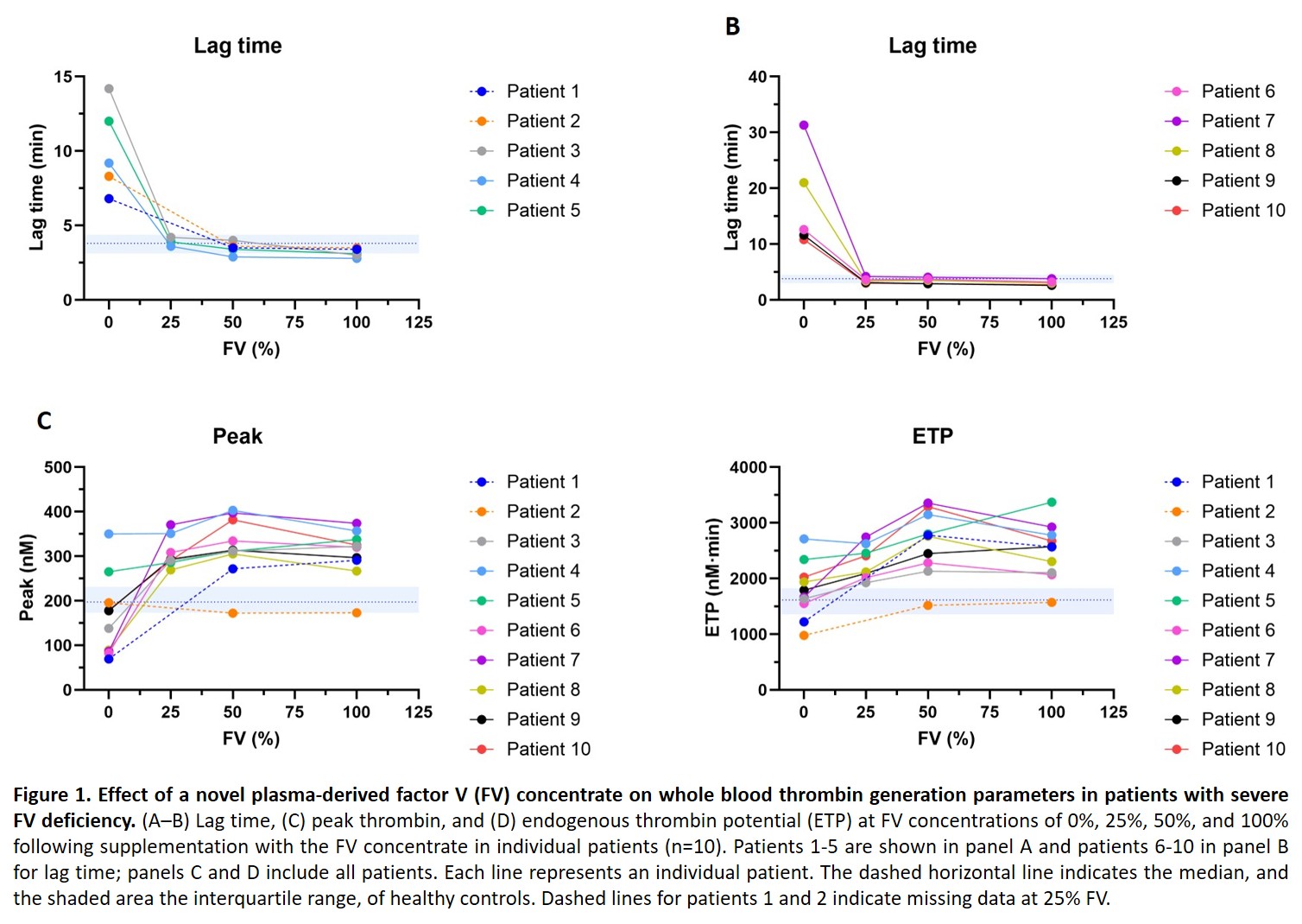
Materials and Methods. Whole blood from 10 patients with severe FV deficiency was spiked in vitro with FV concentrate (0%, 25%, 50%, and 100%). Owing to limited sample availability, 2 patients were not tested at 25%. WBTG was assessed with 1 pM tissue factor by measuring lag time, peak thrombin, and endogenous thrombin potential (ETP). Rotational thromboelastometry (ROTEM; INTEM, EXTEM, FIBTEM) was also performed. A mixed-effects model (REML) was used for statistical analysis, followed by Dunnett's multiple comparisons test versus baseline (0%). The interquartile range (IQR) of a healthy control group was used as a reference for lag time, peak thrombin, and ETP.
Results. FV supplementation decreased lag time (F(1.003, 8.361)=20.06, p=0.0018), with all concentrations showing shorter lag time than baseline (25%, p=0.0059; 50%, p=0.0032; 100%, p=0.0027). Peak thrombin increased (F(1.576, 13.13)=17.96, p=0.0003), with differences versus baseline at all concentrations (25%, p=0.0126; 50%, p=0.0026; 100%, p=0.0037). ETP increased at all concentrations, reaching significance at 50% (p=0.0006) and 100% (p=0.0009), but not at 25% (p=0.0624). At baseline, lag time was prolonged in all patients and returned within the IQR of controls already at 25% FV (Fig. 1A-B). Peak thrombin was normal or increased in half of cases (Fig. 1C), while ETP was within or above the IQR of controls in most patients (Fig. 1D); in five patients with low baseline peak thrombin values, levels at 25% FV exceeded the IQR of controls (Fig. 1C). Consistently, ROTEM showed prolonged clotting times at baseline. Both INTEM and EXTEM-clotting time normalized after FV supplementation at 25% in most patients, although a minority required 50% FV to reach normal values. Parameters reflecting clot propagation and strength were largely within the normal range at baseline, and FV supplementation had no relevant effect.
Conclusions. WBTG and ROTEM suggest that delayed coagulation initiation is the predominant functional abnormality in severe FV deficiency, while thrombin and fibrin-generating capacity are variably preserved. In our study, the novel plasma-derived FV concentrate effectively corrected this defect, restoring lag and clotting times within the IQR of healthy controls already at 25% FV. These findings support the potential clinical utility of WBTG as a global assay to evaluate treatment response.
Downloads
Citations




How to Cite

This work is licensed under a Creative Commons Attribution-NonCommercial 4.0 International License.



