


CO-68 | ACQUIRED FACTOR XIII DEFICIENCY ASSOCIATED WITH CROHN’S DISEASE: A CHALLENGING DIAGNOSTIC AND THERAPEUTIC CASE
A. Colombo1, A. Dal Buono2|3, I. Quaglia1, C. Novembrino4, M.R. Fasulo1, C. Lodigiani1, M.E. Mancuso1|2 | 1Center for Thrombosis and Hemorrhagic Diseases, IRCCS Humanitas Research Hospital, Rozzano, Milano, Italy; 2Department of Biomedical Sciences, Humanitas University, Pieve Emanuele, Milano, Italy; 3IBD Center, IRCCS Humanitas Research Hospital, Rozzano, Milano, Italy; 4Fondazione IRCCS Ca' Granda Ospedale Maggiore Policlinico Angelo Bianchi Bonomi, Hemophilia and Thrombosis Center and Fondazione Luigi Villa, Milano, Italy
All claims expressed in this article are solely those of the authors and do not necessarily represent those of their affiliated organizations, or those of the publisher, the editors and the reviewers. Any product that may be evaluated in this article or claim that may be made by its manufacturer is not guaranteed or endorsed by the publisher.
Authors
Background. Acquired factor XIII (FXIII) deficiency is a rare bleeding disorder that may be associated with autoimmune diseases, malignancies, or inflammatory conditions. Diagnosis is challenging because routine coagulation tests are normal.
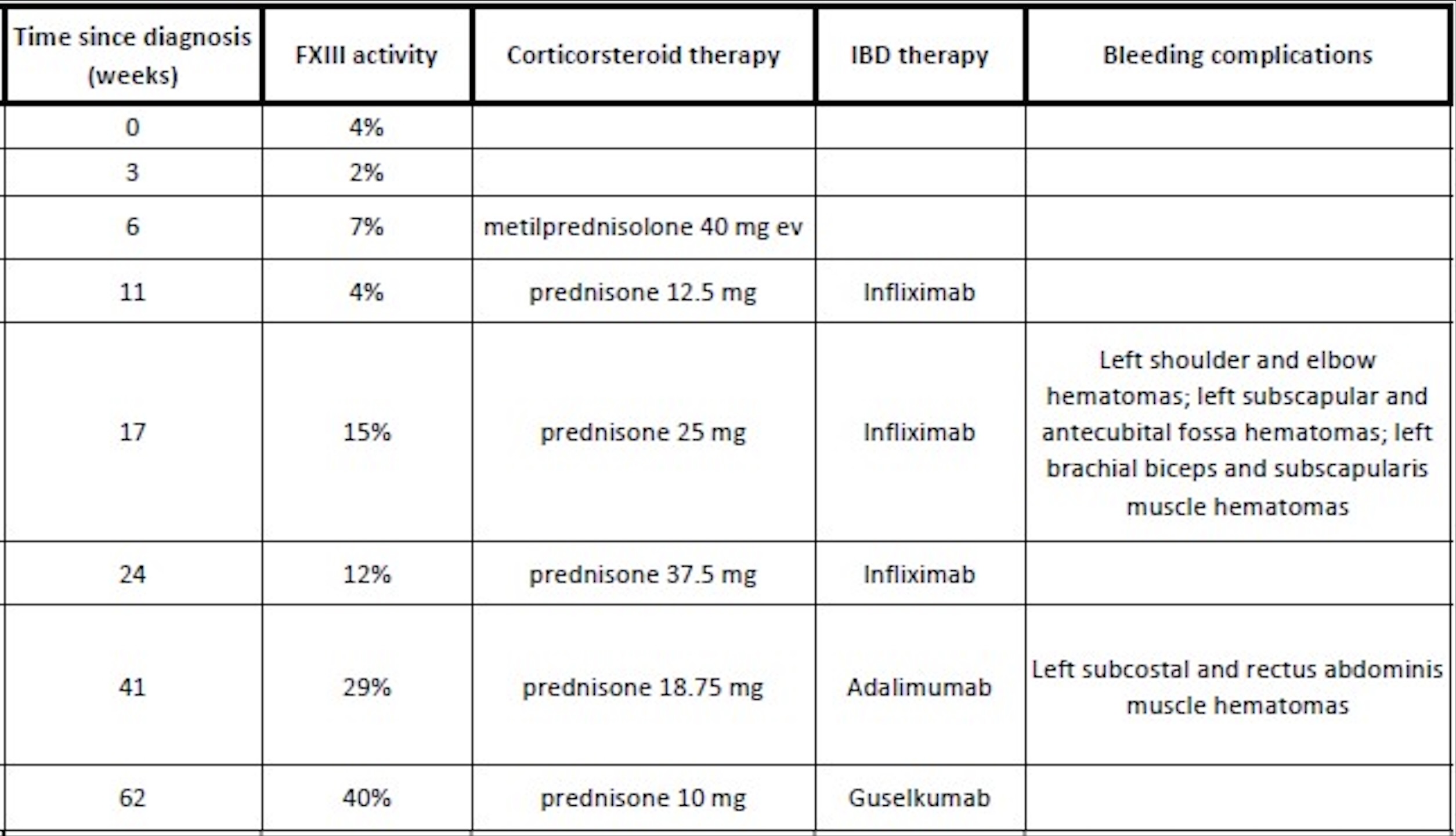
Case Report. A 60-year-old man was referred for haematuria, anaemia, and multiple spontaneous muscle haematomas. His bleeding history was negative, despite several hemostatic challenges. Terminal ileitis was found 6 months earlier and treated with a 10-week course of budesonide. At presentation, hemoglobin dropped from 14 to 7.5 g/dL. Routine coagulation tests (PT, aPTT) were normal. Acquired von Willebrand syndrome and platelet dysfunction were ruled out. The FXIII measurement revealed severe deficiency (2-4%). Neutralizing anti-FXIII antibodies were not detectable; however, exogenous FXIII given intravenously was rapidly cleared from the bloodstream. Partial and transient correction was achieved through continuous infusion of pdFXIII concentrate at 2 IU/kg/h. Given the reported association between inflammatory bowel disease (IBD) and FXIII deficiency, intestinal ultrasound and MR enterography were performed, suggesting Crohn’s disease. Active IBD has been associated with decreased FXIII levels through coagulation activation and accelerated FXIII turnover and consumption during tissue repair and mucosal healing. Initial treatment with intravenous corticosteroids and infliximab induction failed to significantly improve FXIII activity (4-7%), and the patient experienced multiple recurrent spontaneous hematomas involving the left shoulder and arm, requiring repeated hospitalizations and continuous FXIII infusions. Intravenous immunoglobulin infusion was attempted unsuccessfully. As a consequence of the muscle hematomas in the left arm, he developed permanent sensorimotor neuropathy. Two months after initiation of oral corticosteroids and infliximab maintenance therapy, MR enterography showed marked improvement of bowel inflammation, paralleled by stabilization of FXIII levels around 15% and resolution of major bleeding episodes. Infliximab was discontinued because of a severe cutaneous rash and replaced with adalimumab, and FXIII levels progressively increased up to 30% despite steroid tapering, with no further hemorrhagic complications (fig. 1). Due to radiological evidence of intestinal activity, biologic therapy was recently switched to guselkumab.
Conclusions. This case highlights the diagnostic and therapeutic challenges of acquired FXIII deficiency not due to the presence of anti-FXIII antibodies. Our case supports the evidence of a link between IBD and such acquired coagulopathy. Effective control of the underlying inflammatory condition was crucial for restoring FXIII levels and preventing bleeding complications.
Downloads
Citations




How to Cite

This work is licensed under a Creative Commons Attribution-NonCommercial 4.0 International License.



