


CO-66 | PREGNANCY OUTCOMES AND PERIPARTUM MANAGEMENT IN WOMEN WITH CONGENITAL FIBRINOGEN DISORDERS: A SINGLE-CENTRE EXPERIENCE
T. Martini1, B. Borsellino1|2, B. Pollio1 | 1Haemophilia Centre, Immune-Haematology and Transfusion Medicine, University Hospital “Città della Salute e della Scienza”, Torino, Italy; 2Department of Biomedicine and Prevention, PhD in Immunology, Molecular Medicine and Applied Biotechnology, University of Rome Tor Vergata, Roma, Italy
All claims expressed in this article are solely those of the authors and do not necessarily represent those of their affiliated organizations, or those of the publisher, the editors and the reviewers. Any product that may be evaluated in this article or claim that may be made by its manufacturer is not guaranteed or endorsed by the publisher.
Authors
Background and Aims. Congenital fibrinogen disorders (CFD) are rare inherited disorders that may cause not only bleeding but also thrombosis. Pregnancy is a high-risk setting because of increased incidence of miscarriage, vaginal bleeding, placental complications, postpartum hemorrhage (PPH), and thromboembolism. Our study aimed to describe the clinical and obstetric phenotype of CFD women followed at a single center, focusing on pregnancy outcome and peripartum management.
Materials and Methods. Medical records of women with CFD who delivered between 2013 and 2025 at Sant’Anna Hospital, Turin, were retrospectively reviewed. Collected data included patient characteristics (diagnosis, bleeding/thrombotic history, family history, recurrent miscarriage) and pregnancy characteristics (conception mode, pregnancy outcome, delivery mode, gestational age at delivery, PPH, fibrinogen activity level at delivery, use of fibrinogen concentrate, use of tranexamic acid, low-molecular-weight heparin [LMWH] prophylaxis, and newborn diagnosis of CFD). Categorical variables were reported as number and percentage, and continuous variables as median and interquartile range.
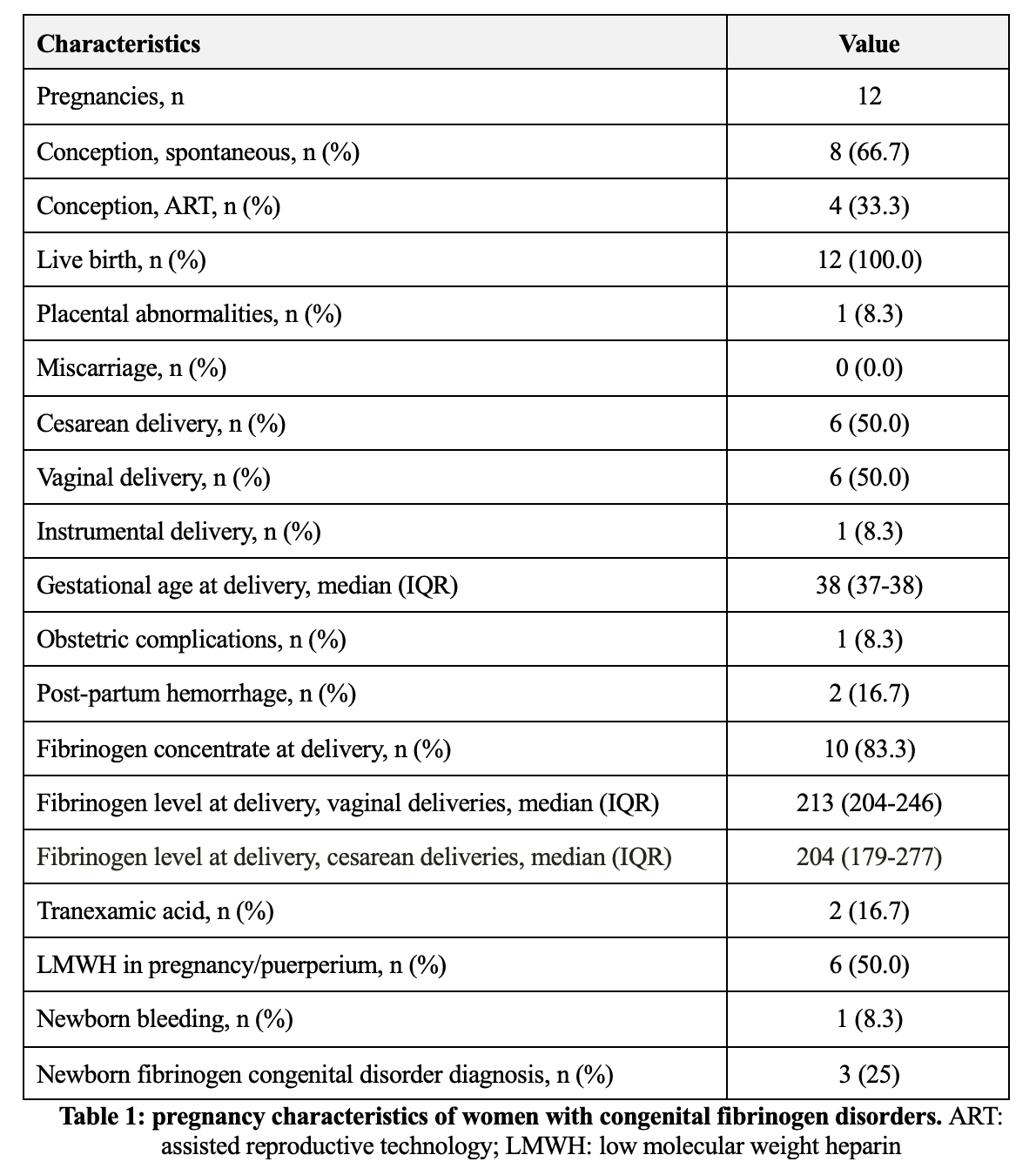
Results. Eight women were included, with a median age of 34 (Table 1). Three had hypofibrinogenemia, 2 dysfibrinogenemia, and 3 hypo-dysfibrinogenemia. Bleeding symptoms were reported in 2 patients (25%), and there was a history of thrombotic events in 2 (25%); one had recurrent miscarriage (12.5%). Four women (50%) had a positive family history. Twelve pregnancies were recorded: 8 (66.7%) spontaneous, 4 (33.3%) with assisted reproductive technology. All pregnancies resulted in live birth. Caesarean and vaginal delivery occurred in 6 pregnancies each; 1 delivery was instrumental (12.5%). Median gestational age at delivery was 38 weeks. Placental abnormalities (abruptio placentae in 1st trimester) and obstetric complications (preeclampsia and intrauterine growth restriction) occurred in 1 pregnancy (8.3%) each. PPH occurred in 2 pregnancies (16.7%). Median fibrinogen activity at delivery was 213 mg/dL in vaginal deliveries and 204 mg/dL in caesarean deliveries. Haemostatic prophylaxis was used in 10 pregnancies (83.3%): fibrinogen concentrate in all, and tranexamic acid in 2 (20%). In 6 pregnancies LWMH prophylaxis was used. Four neonates were diagnosed with CFD; 1 had major bleeding at birth (intracranial hemorrhage).
Conclusions. In this cohort all pregnancy outcomes were favorable, all resulting in live birth; the PPH rate was the same as the general obstetric population, reflecting frequent use of concentrate to achieve high fibrinogen activity levels at delivery. Given the rarity of CFD, this cohort represents a meaningful real-world series and adds clinically relevant data to the limited evidence on pregnancy management in these patients.
Downloads
Citations




How to Cite

This work is licensed under a Creative Commons Attribution-NonCommercial 4.0 International License.



