


CO-65 | COVID-19-ASSOCIATED HYPERCOAGULABILITY IN TYPE 2B VON WILLEBRAND DISEASE: INSIGHTS FROM GLOBAL HEMOSTATIC ASSAYS
I. Condonato, C. Simion, E. Zanon, P. Simioni | Hemophilia Center, University Hospital of Padua, Italy
All claims expressed in this article are solely those of the authors and do not necessarily represent those of their affiliated organizations, or those of the publisher, the editors and the reviewers. Any product that may be evaluated in this article or claim that may be made by its manufacturer is not guaranteed or endorsed by the publisher.
Authors
Background. Type 2B von Willebrand disease (VWD) is a rare inherited bleeding disorder characterized by gain-of-function variants of von Willebrand factor (VWF), resulting in enhanced platelet binding, loss of high-molecular-weight multimers, and variable thrombocytopenia. SARS-CoV-2 infection is associated with endothelial activation, thromboinflammation, and hypercoagulability, but its impact on patients with congenital bleeding disorders remains poorly characterized. We report a patient with type 2B VWD who developed severe thrombocytopenia during COVID-19 and underwent comprehensive hemostatic assessment.
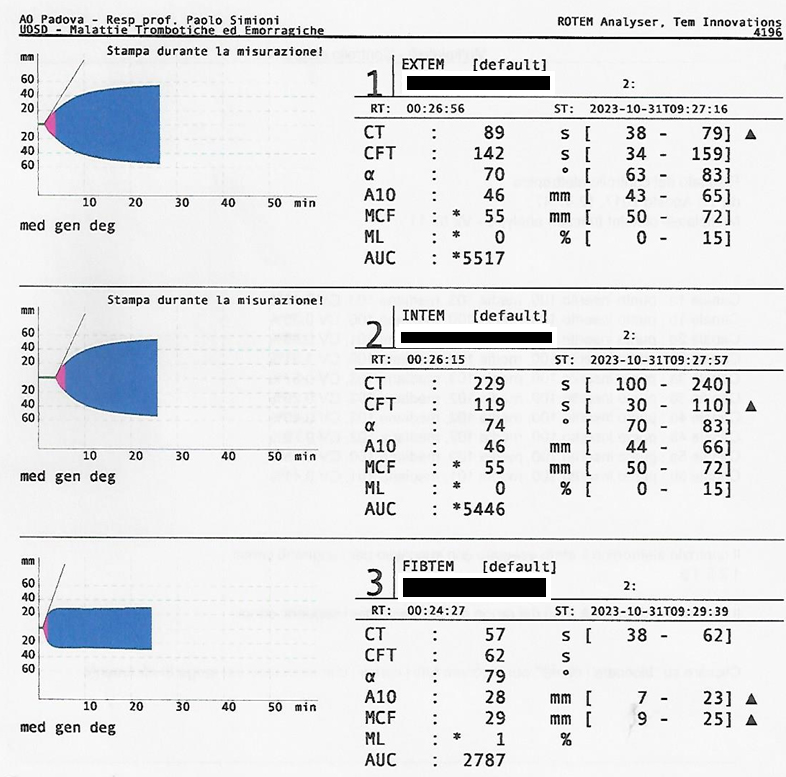
Case Report. An 88-year-old man with type 2B VWD, followed at our Hemophilia Center and treated on demand with FVIII/VWF concentrates, was admitted during SARS-CoV-2 infection because of malaise and suspected arrhythmia recurrence. Laboratory investigations revealed profound thrombocytopenia (platelet count 2×10⁹/L), acute kidney injury, and positive nasopharyngeal swab for SARS-CoV-2. During hospitalization, he experienced a syncopal episode followed by dorsal ecchymosis, without evidence of major bleeding or traumatic lesions on imaging studies. The patient received a platelet transfusion, FVIII/VWF replacement therapy, hydration, and antiviral treatment with nirmatrelvir/ritonavir, with progressive clinical improvement and normalization of platelet count. Hemostatic assessment showed FVIII activity 106%, VWF antigen 115%, ristocetin cofactor activity 47%, and collagen-binding activity 24%, consistent with loss of high-molecular-weight multimers typical of type 2B VWD. During platelet recovery (platelet count approximately 60×10⁹/L), rotational thromboelastometry demonstrated preserved clot firmness (EXTEM MCF 55 mm, INTEM MCF 55 mm) and increased fibrin-based clot strength (FIBTEM MCF 29 mm), suggesting a hypercoagulable state (Image 1). Platelet function testing by Multiplate showed only mild impairment of aggregation limited to the ASPI test. No major hemorrhagic complications occurred during hospitalization.
Conclusions. This case highlights the complex interaction between congenital bleeding disorders and SARS-CoV-2 infection. Although COVID-19 was associated with profound thrombocytopenia, global hemostatic assessment performed during platelet recovery revealed a hypercoagulable phenotype characterized by preserved clot firmness and enhanced fibrin-based clot strength. These findings seem to confirm that SARS-CoV-2–related thromboinflammatory activation may substantially influence the overall hemostatic balance even in patients with inherited bleeding disorders. Global hemostatic assays may provide clinically relevant information beyond conventional laboratory parameters and contribute to a more comprehensive evaluation of hemostasis in complex clinical settings.

Downloads
Citations




How to Cite

This work is licensed under a Creative Commons Attribution-NonCommercial 4.0 International License.



