


CO-60 | A TURNING POINT IN THE MANAGEMENT OF HEMOPHILIA B WITH INHIBITORS: OUTCOMES OF CONCIZUMAB PROPHYLAXIS IN TWO CHILDREN FROM EXPLORER10
G. Quintavalle1, A. Matichecchia1, M.I. Tassoni1, B.M. Roccon1, F. Riccardi1, R.P. Serra2, A. Tiri2, P. Bertolini2, A. Tagliaferri1, A. Coppola1 | 1Regional Hub Center for Hemophilia and Congenital Bleeding Disorders, University Hospital of Parma, Italy; 2Pediatric Hematology-Oncology Unit, University Hospital of Parma, Italy
All claims expressed in this article are solely those of the authors and do not necessarily represent those of their affiliated organizations, or those of the publisher, the editors and the reviewers. Any product that may be evaluated in this article or claim that may be made by its manufacturer is not guaranteed or endorsed by the publisher.
Authors
Introduction. Although less frequent than in hemophilia A (HA), inhibitors pose a severe challenge to the management of hemophilia B (HB). Beyond neutralizing factor IX (FIX) concentrates, anti-FIX antibodies are often associated with allergic reactions, including anaphylaxis, upon FIX exposure. Thus, prophylaxis and eradication by immune tolerance induction are unfeasible in most cases, exposing patients to the risk of severe bleeding and joint morbidity. Concizumab, a high-affinity anti-TFPI monoclonal antibody, has been recently authorized for prophylaxis in patients with HA and B with inhibitors aged >12 years, based on the results of the explorer trials. The pediatric trial explorer10 is ongoing.
Objectives and Methods. Outcomes of concizumab prophylaxis were evaluated in two children enrolled in Explorer 10 (follow-up 37 months). Annual bleeding rates (total, ABR; joint, AJBR), recombinant FVIIa (rFVIIa) use, hospital admissions, and joint status were compared to those in the three years prior to the trial. The study sponsor, Novo Nordisk, authorized data presentation.
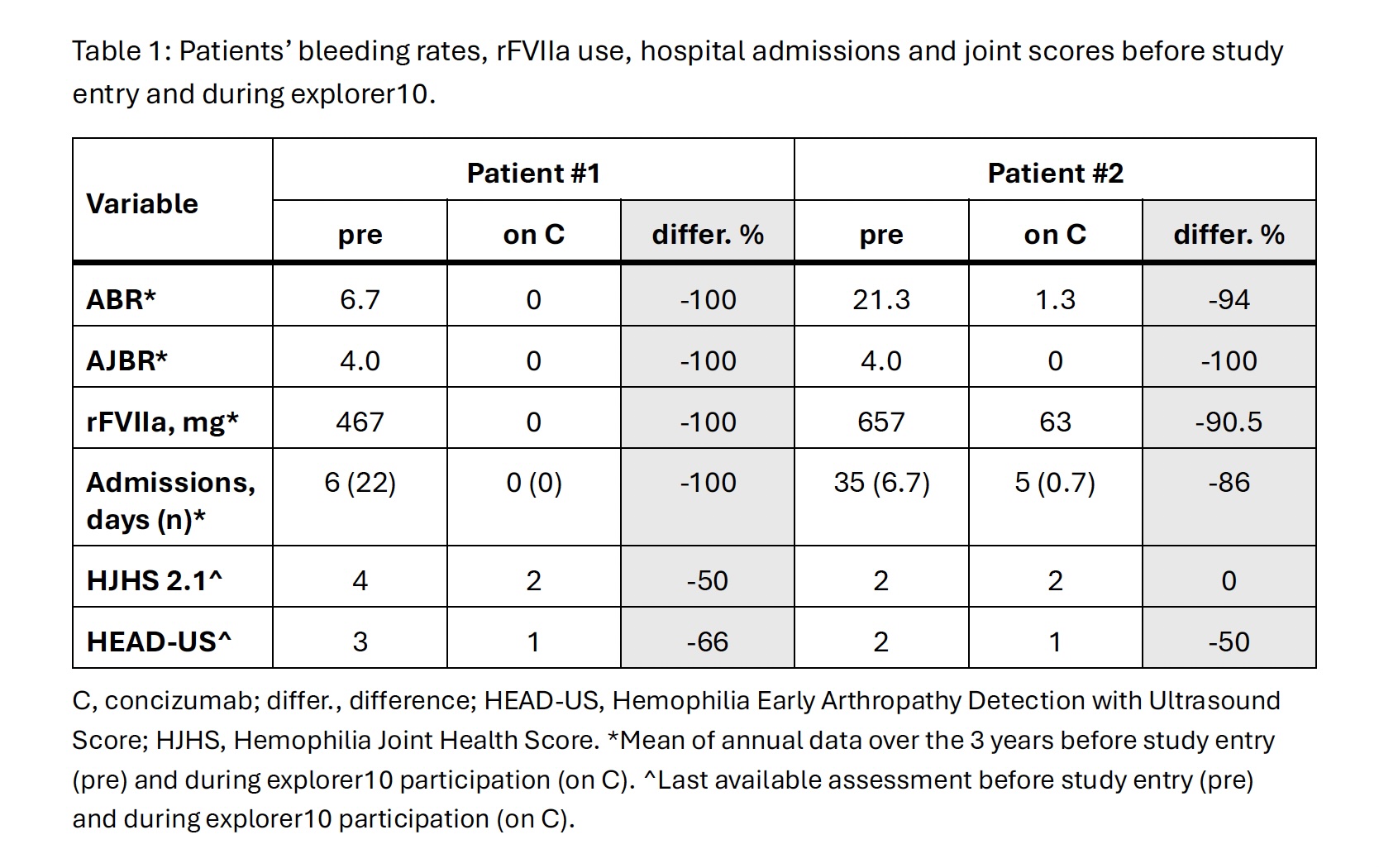
Results. Both children (11 and 9 yr-old at study entry) had sporadic severe HB, due to high inhibitor risk F9 variants (multiexon deletion and nonsense, respectively). At inhibitor detection (16 BU/mL and 0.8 BU/mL), both presented with suspected allergic reactions (11 and 12 exposure days to nonacog alfa and eftrenonancog alfa, respectively). Before study entry, the older child had a lower ABR than the younger one, but most were joint bleeds resulting in three target joints (TJ). In both children, rFVIIa prophylaxis failed due to bleeding recurrence and venous access issues. After starting concizumab prophylaxis, the older child did not experience any treated or joint bleed, resolving his TJ and eliminating rFVIIa use. The younger patient minimized bleeding rates, experiencing zero joint bleed. However, three bleeds (including a severe tonsillar hemorrhage) required admission and rFVIIa (overall decreased by >85%). Improved functional and ultrasound joint scores were observed (Table 1). The reduced ‘disease burden’ progressively improved the overall well-being of these children and their families. Both children increased physical activity and engaged in sports. Concizumab was well tolerated; two possibly treatment-related adverse events (hand cyanosis and focal liver steatosis) occurred in the younger patient.
Conclusions. Starting concizumab prophylaxis in Explorer 10 was a turning point in the management of these two children with HB and inhibitor. Effective protection from bleeding, particularly into joints, was observed, along with relevant reduction of the disease and treatment burden and favorable effects on quality of life. Long-term efficacy and safety data are needed.

Downloads
Citations




How to Cite

This work is licensed under a Creative Commons Attribution-NonCommercial 4.0 International License.



