


CO-54 | DECREASED BONE MINERAL DENSITY IN HEMOPHILIA IS NOT CORRELATED WITH INCREASED RISK OF FRACTURES
M.R. Fasulo1, F. Carrone2, G. Mazziotti3|4, A. Colombo1, C. Lodigiani1, M.E. Mancuso1|4 | 1Center for Thrombosis and Hemorrhagic Diseases, IRCCS Humanitas Research Hospital, Rozzano, Milano, Italy; 2Endocrinology and Diabetology Unit, Humanitas Mater Domini, Castellanza, Varese, Italy; 3Endocrinology, Diabetology and Medical Andrology Unit, Metabolic Bone Diseases and Osteoporosis Section, IRCCS Humanitas Research Hospital, Rozzano, Milano, Italy; 4Department of Biomedical Sciences, Humanitas University, Pieve Emanuele, Milano, Italy
All claims expressed in this article are solely those of the authors and do not necessarily represent those of their affiliated organizations, or those of the publisher, the editors and the reviewers. Any product that may be evaluated in this article or claim that may be made by its manufacturer is not guaranteed or endorsed by the publisher.
Authors
Background and Aims. A decrease in bone mineral density (BMD) is observed in people with hemophilia (PwH) due to several risk factors, including arthropathy causing limited mobility as well as chronic viral infections (i.e., HCV and HIV). The aim of this study was to evaluate BMD and bone microarchitecture (as per trabecular bone score, TBS) in an unselected cohort of PwH, assessing the prevalence of osteoporosis and osteopenia and the fracture risk.
Materials and Methods. Data on BMD and TBS measured by Dual Energy X-ray Absorptiometry (DEXA), fractures and deformities at spine X-ray, body mass index (BMI), lifestyle habits, comorbidities, and serum biomarkers were collected from medical records of PwH aged ≥12 years. Osteoporosis and osteopenia were defined according to WHO criteria.
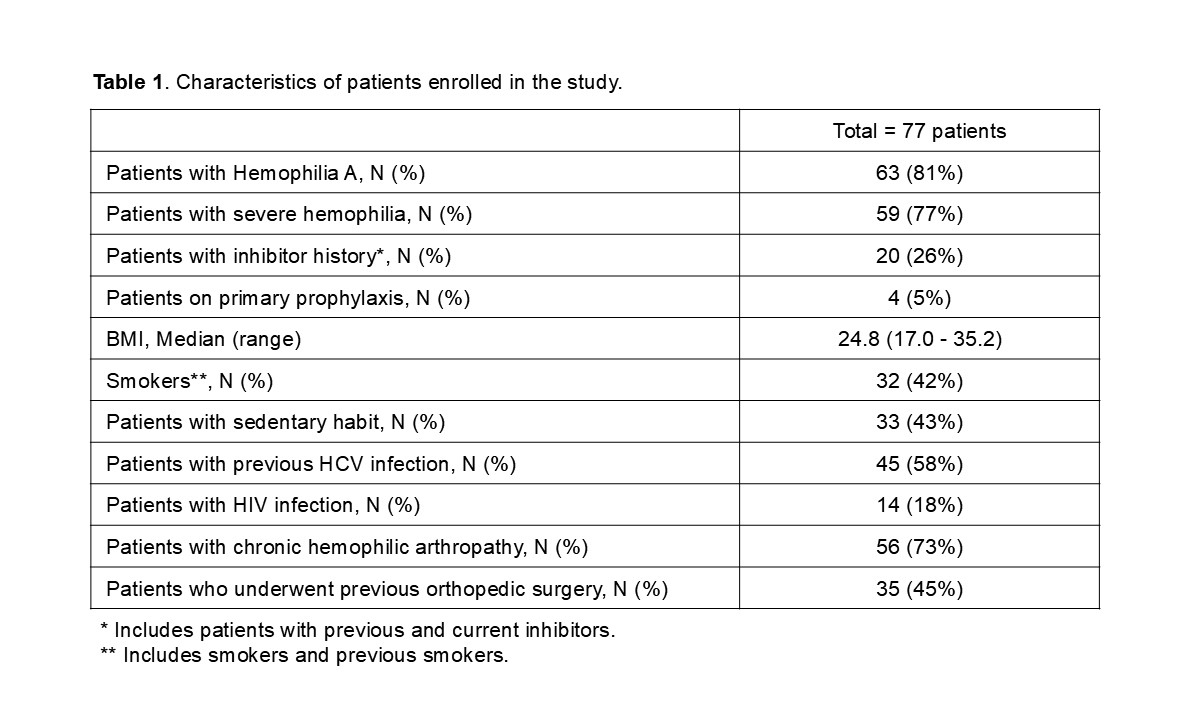
Results. Seventy-seven hemophilic men aged 14-76 years (median 44) were included. Their characteristics are reported in Table 1. Median total femoral BMD was 0.9 g/cm² (range 0.7 - 1.4), with median T score -0.8 (range -2.5 - 2.4) and median Z score -0.6 (range -2.2 - 2.5). Median femoral neck BMD was 0.7 g/cm² (range 0.5 - 1.3), with median T score -1.5 (range -3.0 - 3.0) and median Z score -0.7 (range -2.8 - 3.0). Median spine BMD was 1.0 g/cm² (range 0.7 - 1.3), with median T score -0.7 (range -3.8 - 1.5) and median Z score -0.2 (range -3.6 - 1.9). Median TBS at the spine level was 1.38; 13 patients (17%) had a partially degraded microarchitecture and 4 (5%) a degraded microarchitecture. Fifty-five patients (71%) had osteoporosis or osteopenia. The prevalence of osteoporosis in the spine and the femoral neck was 11% and 18%, respectively, and osteopenia in the spine and the femoral neck was seen in 44% and 73% of the patients, respectively. By pairing BMD and TBS, the risk of fracture was low in 16 patients (21%), intermediate in 41 (53%), and high in 9 (12%). A fracture or a deformity in at least 1 vertebra was found in 7 out of 46 patients (15%) who underwent a spine X-ray. Among those 7, all had severe hemophilia A, and 5 had previous HCV infection. With regard to biomarkers involved in mineral metabolism and bone health, the following results were found: median calcium levels 2.39 mmol/L (IQR 2.33 - 2.45), median phosphate levels 1.03 mmol/L (IQR 0.94 - 1.13), median vitamin D (25-OH) levels 24 ng/mL (IQR 17 - 31), median parathormone levels 51.1 pg/mL (IQR 42.7 - 64.0), median telopeptide levels 369.7 pg/L (IQR 226.3 - 667.0), and median alkaline phosphatase bone isoenzyme levels 15.5 mcg/L (IQR 11.7 - 22.8).
Conclusions. This study confirms that PwH have a high prevalence of osteoporosis and/or osteopenia but highlights that only 12% have a significantly increased risk for fractures.
Downloads
Citations




How to Cite

This work is licensed under a Creative Commons Attribution-NonCommercial 4.0 International License.



