


CO-53 | LIVER FIBROSIS, STEATOSIS AND SUBCLINICAL ATHEROSCLEROSIS IN PATIENTS WITH HEMOPHILIA: A CROSS-SECTIONAL STUDY
C. Simion1|2, B. Stocco1|2, I. Condonato1|2, E. Dalla Porta1|2, A. Napolitano1|2, E. Zanon1|2, L. Fabris1, L. Spiezia1|2, P. Simioni1|2 | 1First Chair of Internal Medicine and Thrombotic and Haemorrhagic Diseases Unit, Department of Medicine, Padova University Hospital, Italy; 2Hemophilia Center, Padova University Hospital, Italy
All claims expressed in this article are solely those of the authors and do not necessarily represent those of their affiliated organizations, or those of the publisher, the editors and the reviewers. Any product that may be evaluated in this article or claim that may be made by its manufacturer is not guaranteed or endorsed by the publisher.
Authors
Background and Aims. Metabolic dysfunction–associated steatotic liver disease (MASLD) is an emerging cardiovascular risk factor. As patients with hemophilia (PWH) age and develop metabolic comorbidities, cardiovascular disease is becoming increasingly relevant despite their inherited bleeding tendency. In addition, liver disease is common in PWH owing to the combined impact of metabolic dysfunction and previous viral infections. Whether liver fibrosis and steatosis contribute to cardiovascular risk in this population remains unclear. This study investigated their association with subclinical atherosclerosis.
Materials and Methods. We report an interim analysis of a cross-sectional study evaluating liver health in PWH. Liver fibrosis was assessed and graded from F0 to F4, while liver steatosis was evaluated and graded from S0 to S3. Subclinical atherosclerosis was assessed and recorded as present or absent. Clinical data included age, hemophilia type and severity, viral history (HCV, HBV, HIV), liver enzymes, platelet count, FIB-4, and traditional cardiovascular risk factors. Fibrosis and steatosis were analyzed as both ordinal variables and clinically relevant categories. Associations with atherosclerosis were assessed using non-parametric tests and contingency-table analyses.
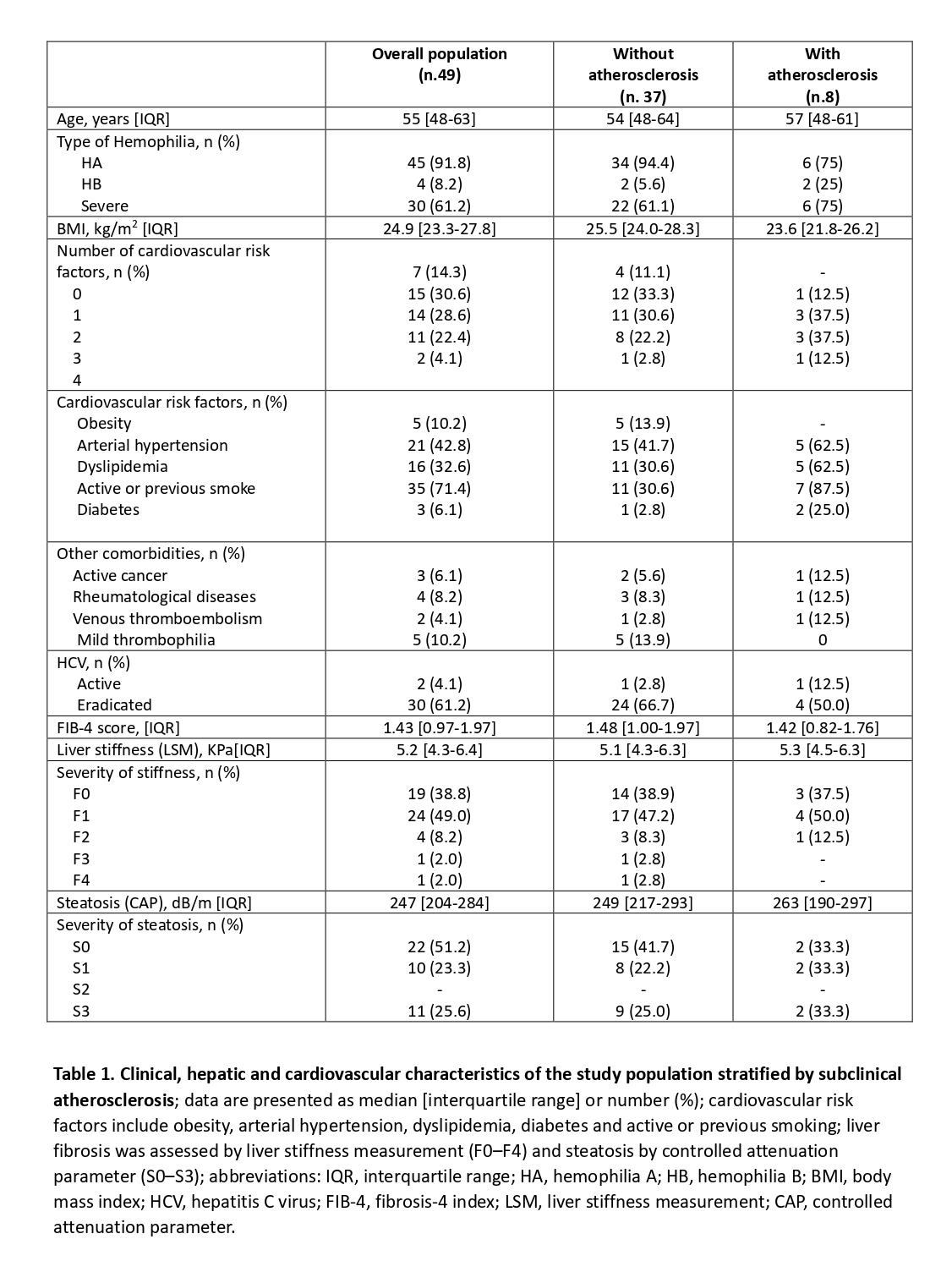
Results. A total of 49 patients with hemophilia were included (median age 55 years). Baseline characteristics of the study population are summarized in Table 1. Subclinical atherosclerosis was detected in 8/45 patients (16.3%). Liver fibrosis was generally mild, with significant fibrosis (F2–F4) observed in 6/49 patients (12.2%). Steatosis was present in 21/41 patients (51.2%), with moderate-to-severe steatosis (S2–S3) in 11/41 (26.8%). No significant association was found between fibrosis stage and the presence of atherosclerosis (p=0.524). Similarly, steatosis was not associated with atherosclerosis (p=0.389). Traditional cardiovascular risk factors were common, with hypertension in 42.8%, dyslipidemia in 32.6%, and active or previous smoking in 71.4% of patients. Atherosclerosis was more frequently observed in patients with a higher burden of cardiovascular risk factors (p=0.043). The number of cardiovascular risk factors showed a trend toward association with atherosclerosis (OR 2.22, 95% CI 0.94–5.22; p=0.068).
Conclusions. In this cohort of patients with hemophilia, liver fibrosis and steatosis were not associated with subclinical atherosclerosis. Cardiovascular risk appears to be mainly driven by traditional risk factors rather than liver-related parameters. These findings highlight the complex and heterogeneous nature of liver disease in this population and warrant further investigation in larger cohorts.
Downloads
Citations




How to Cite

This work is licensed under a Creative Commons Attribution-NonCommercial 4.0 International License.



