

Convegno Triennale sugli Aspetti Clinici e Sociali dell’Emofilia
Vol. 5 No. s2 (2026): XIX Convegno Triennale sugli Aspetti Clinici e Sociali dell’Emofilia

CO-51 | HEMOSTATIC AND CARDIOVASCULAR PROFILES IN HEMOPHILIA PATIENTS WITH AND WITHOUT ATHEROSCLEROSIS
A. Napolitano, E. Zanon, L. Spiezia, G. Camporese, P. Scarinzi, F. Ahmad, G. Saggiorato, C. Bulato, S. Toffanin, S. Gavasso, F. Sartorello, C. Simion, E. Campello, P. Simioni | Hemophilia Center, University Hospital of Padua, Italy
Publisher's note
All claims expressed in this article are solely those of the authors and do not necessarily represent those of their affiliated organizations, or those of the publisher, the editors and the reviewers. Any product that may be evaluated in this article or claim that may be made by its manufacturer is not guaranteed or endorsed by the publisher.
All claims expressed in this article are solely those of the authors and do not necessarily represent those of their affiliated organizations, or those of the publisher, the editors and the reviewers. Any product that may be evaluated in this article or claim that may be made by its manufacturer is not guaranteed or endorsed by the publisher.
Published: 14 October 2026
2
Views
0
Downloads
Authors
Materials and Methods. This cross-sectional study enrolled 105 adult patients with hemophilia A and B from the Hemophilia Centers of Padua and Castelfranco Veneto, Italy. Seventy-seven patients had no evidence of atherosclerosis and 28 had documented disease. Atherosclerosis was defined by carotid stenosis ≥50%, aortic plaque, or ABI ≤0.9. Clinical data, routine laboratory tests, ROTEM, and Multiplate assays were collected. Group comparisons were performed using the t-test, Mann–Whitney U test, or χ² test.
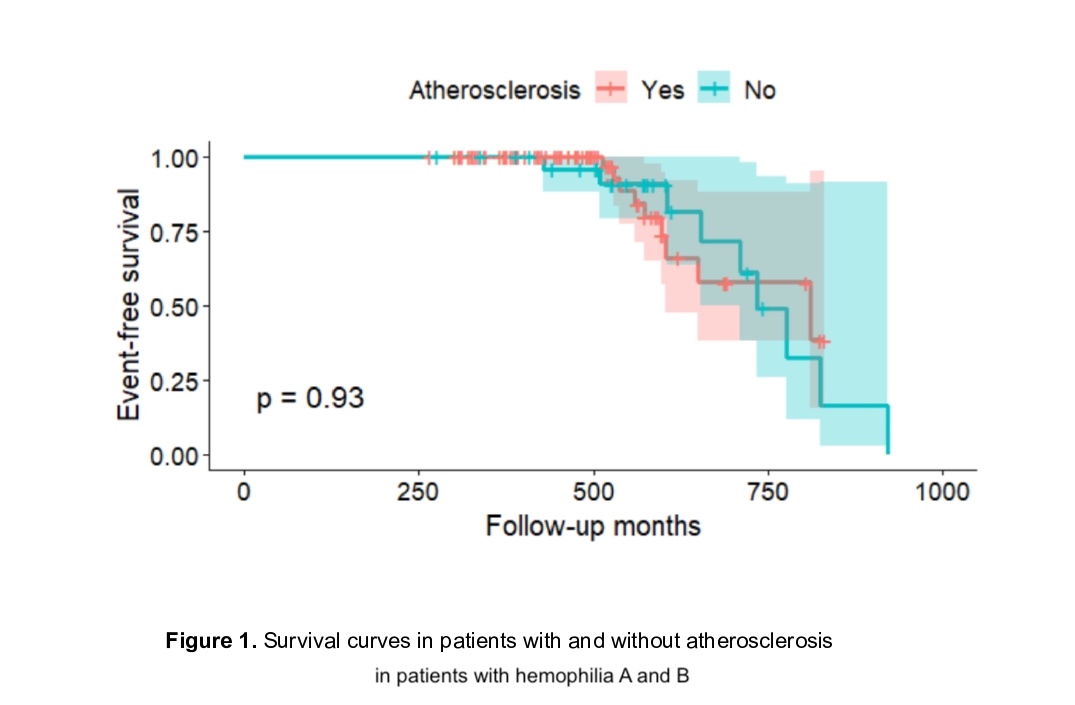
Results. Patients with atherosclerosis were older (63 ± 12.4 vs. 55.5 ± 10.9 years; p = 0.007) and had a higher prevalence of hypertension (60.7% vs. 33.7%; p = 0.013), dyslipidemia (75% vs. 35%; p < 0.001), antihypertensive therapy (53.6% vs. 28.6%; p = 0.018), lipid-lowering therapy (46.4% vs. 16.9%; p = 0.002), and previous cardiovascular or cerebrovascular events (28.6% vs. 6.5%; p = 0.002). No differences were observed in hemophilia type or severity, obesity, diabetes, alcohol use, or inhibitors. Most laboratory parameters, including hemoglobin, platelet count, renal function, lipid profile, Lp(a), hs-CRP, and HbA1c, were comparable. NT-proBNP was significantly higher but remained within the normal range. ROTEM showed shortened INTEM CT (254.9 ± 47.8 vs. 294.3 ± 140.1 sec; p = 0.04) and increased FIBTEM MCF (14 ± 3.7 vs. 12.2 ± 3.6 mm; p = 0.031), suggesting subtle procoagulant changes. EXTEM parameters and Multiplate ADP/ASPI assays did not differ significantly. Kaplan–Meier analysis showed no difference in survival between groups (p = 0.93) (Figure 1).
Conclusions. Despite inherited hypocoagulability, patients with hemophilia and atherosclerosis exhibit classical cardiovascular risk factors. ROTEM detected subtle procoagulant changes, including faster clot initiation and increased fibrin-based clot firmness. These findings highlight the importance of assessing both cardiovascular risk and global hemostasis in hemophilia and support ROTEM as a sensitive tool for identifying early coagulation alterations associated with atherosclerosis.
Downloads
Download data is not yet available.
Citations




How to Cite
1.
Napolitano A. CO-51 | HEMOSTATIC AND CARDIOVASCULAR PROFILES IN HEMOPHILIA PATIENTS WITH AND WITHOUT ATHEROSCLEROSIS: A. Napolitano, E. Zanon, L. Spiezia, G. Camporese, P. Scarinzi, F. Ahmad, G. Saggiorato, C. Bulato, S. Toffanin, S. Gavasso, F. Sartorello, C. Simion, E. Campello, P. Simioni | Hemophilia Center, University Hospital of Padua, Italy. Bleeding Thromb Vasc Biol [Internet]. 2026 Oct. 14 [cited 2026 Oct. 15];5(s2). Available from: https://www.btvb.org/btvb/article/view/661
Copyright (c) 2026 The Author(s)


This work is licensed under a Creative Commons Attribution-NonCommercial 4.0 International License.



