

Convegno Triennale sugli Aspetti Clinici e Sociali dell’Emofilia
Vol. 5 No. s2 (2026): XIX Convegno Triennale sugli Aspetti Clinici e Sociali dell’Emofilia

CO-50 | LEFT ATRIAL APPENDAGE OCCLUSION IN PATIENTS WITH ATRIAL FIBRILLATION AND BLEEDING DISORDERS: A SINGLE-CENTER EXPERIENCE
B.M. Roccon1, M.I. Tassoni1, G. Quintavalle1, G. Benatti2, F. Gurgoglione2, R. Rossi3, C. Cattabiani3, L. Vignali2, A. Tagliaferri1, A. Coppola1 | 1SSD Centro Hub Emofilia e Malattie Emorragiche Congenite, Azienda Ospedaliero-Universitaria di Parma, Italy; 2SSD Cardiologia Interventistica, Azienda Ospedaliero-Universitaria di Parma, Italy; 3Laboratorio di Coagulazione, UOC Patologia Clinica, Azienda Ospedaliero-Universitaria di Parma, Italy
Publisher's note
All claims expressed in this article are solely those of the authors and do not necessarily represent those of their affiliated organizations, or those of the publisher, the editors and the reviewers. Any product that may be evaluated in this article or claim that may be made by its manufacturer is not guaranteed or endorsed by the publisher.
All claims expressed in this article are solely those of the authors and do not necessarily represent those of their affiliated organizations, or those of the publisher, the editors and the reviewers. Any product that may be evaluated in this article or claim that may be made by its manufacturer is not guaranteed or endorsed by the publisher.
Published: 14 October 2026
0
Views
0
Downloads
Authors
Methods. Retrospective review of patients with BD and AF who underwent LAAO at the University Hospital of Parma.
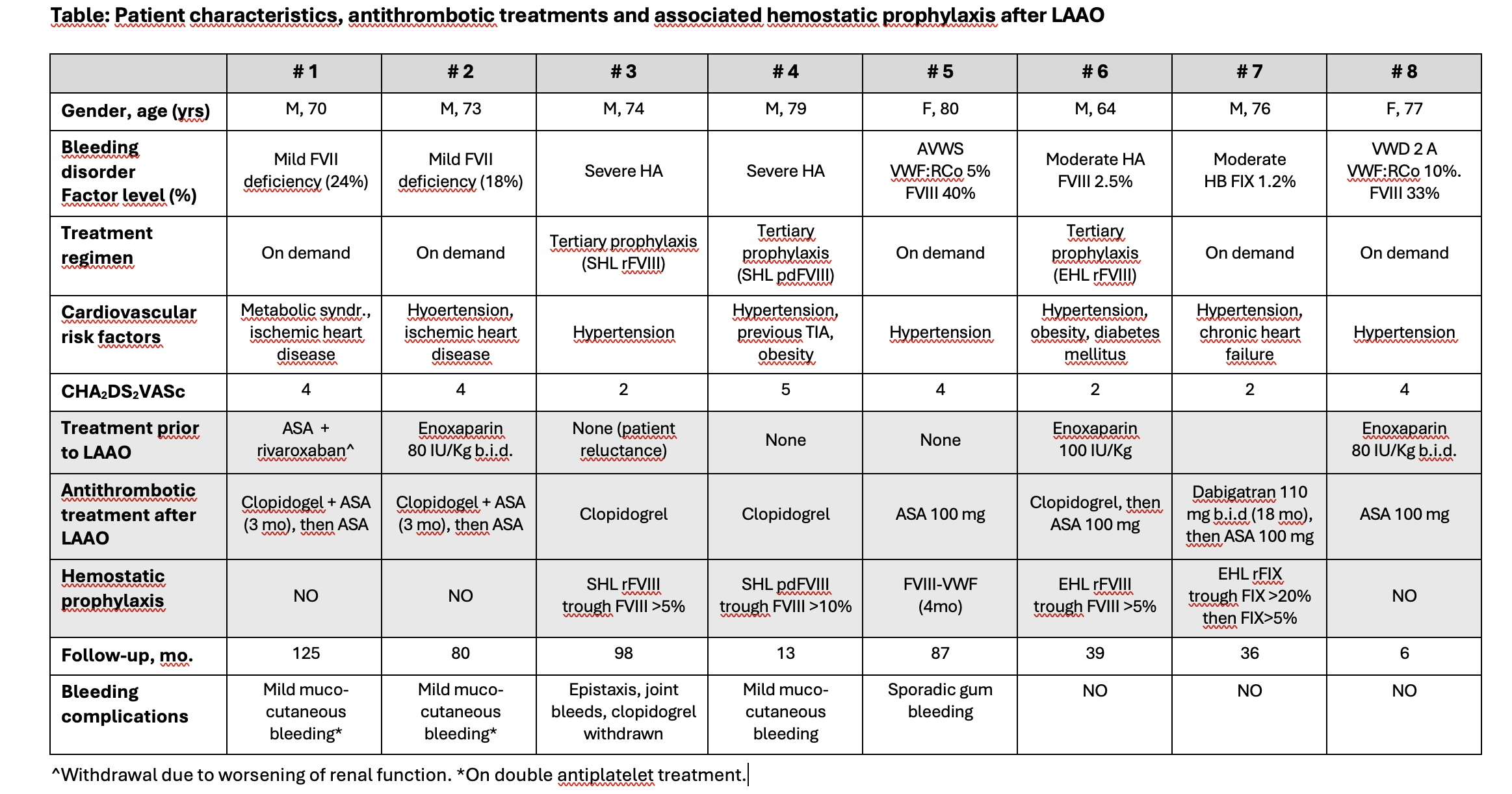
Results. Eight patients were identified, 6 males and 2 females, aged 64-80 yrs (Table). Mean CHA2DS2VASc was 4 (range 2-5). Two men had mild factor VII deficiency, both on aspirin (ASA) 100 mg/d because of history of myocardial revascularization due to diffuse coronary artery disease. Combined antiplatelet-anticoagulation treatment was considered in both patients after AF diagnosis, due to very high cardiovascular and stroke risk; the concomitant bleeding risk led to consider LAAO. Three elderly men with hemophilia A (2 severe, 1 moderate) on tertiary prophylaxis were reluctant to any long-term antithrombotic treatment. A moderate hemophilia B patient treated on demand developed AF in the setting of severe chronic heart failure. The two female patients had a type 2A von Willebrand disease (VWF:RCo 10%) and an acquired von Willebrand syndrome (AVWS, VWF:RCo 5%; concomitant detection of monoclonal gammopathy of uncertain significance). In all patients but one the Amplatzer plug was successfully implanted; heparinization was managed with specific replacement treatment, achieving factor levels ≥80% during and up to 24h after the procedure. One patient experienced mild pericardial effusion. No thromboembolic events were observed. Overall, bleeding episodes occurred In 5/8 cases. Patients with mild FVII deficiencies received double antiplatelet treatment for 3-6 months reporting mild mucocutaneous bleeding, then remained on ASA. Single antiplatelet treatment and FVIII personalized prophylaxis (FVIII trough >5-10%) were used in the 3 hemophiliacs, one withdrew clopidogrel after 2 months due to severe epistaxis and joint bleeds. No relevant bleeding occurred in the old men on anticoagulation, made possible by sustained prophylaxis with extended half-life FIX, nor in the two women with VWF abnormalities on ASA (the AVWS patient received VWF-FVIII concentrate prophylaxis for 4 months).
Conclusions. Adequate factor levels to allow safe antithrombotic treatments in BD patients remain uncertain. LAAO, when performed at experienced facilities, is a safe alternative to anticoagulation in BD with AF-related stroke risk.
Downloads
Download data is not yet available.
Citations




How to Cite
1.
Coppola A. CO-50 | LEFT ATRIAL APPENDAGE OCCLUSION IN PATIENTS WITH ATRIAL FIBRILLATION AND BLEEDING DISORDERS: A SINGLE-CENTER EXPERIENCE: B.M. Roccon1, M.I. Tassoni1, G. Quintavalle1, G. Benatti2, F. Gurgoglione2, R. Rossi3, C. Cattabiani3, L. Vignali2, A. Tagliaferri1, A. Coppola1 | 1SSD Centro Hub Emofilia e Malattie Emorragiche Congenite, Azienda Ospedaliero-Universitaria di Parma, Italy; 2SSD Cardiologia Interventistica, Azienda Ospedaliero-Universitaria di Parma, Italy; 3Laboratorio di Coagulazione, UOC Patologia Clinica, Azienda Ospedaliero-Universitaria di Parma, Italy. Bleeding Thromb Vasc Biol [Internet]. 2026 Oct. 14 [cited 2026 Oct. 14];5(s2). Available from: https://www.btvb.org/btvb/article/view/660
Copyright (c) 2026 The Author(s)


This work is licensed under a Creative Commons Attribution-NonCommercial 4.0 International License.



