


CO-42 | LONGITUDINAL THROMBIN GENERATION PROFILING IN A PATIENT WITH SEVERE HEMOPHILIA A DURING ANTITHROMBIN-LOWERING THERAPY, CANCER, AND MAJOR SURGERY
C. Simion1|2, C. Bulato1, E. Campello1|2, E. Zanon1|2, B. Serena1, S. Toffanin1, P. Simioni1|2 | 1First Chair of Internal Medicine and Thrombotic and Haemorrhagic Diseases Unit, Department of Medicine, Padova University Hospital, Italy; 2Hemophilia Center, Padova University Hospital, Italy
All claims expressed in this article are solely those of the authors and do not necessarily represent those of their affiliated organizations, or those of the publisher, the editors and the reviewers. Any product that may be evaluated in this article or claim that may be made by its manufacturer is not guaranteed or endorsed by the publisher.
Authors
Background and Aims. Thrombin generation (TG) is one of the few functional assays available to assess global hemostatic balance in patients with hemophilia receiving non-replacement therapies. However, longitudinal TG data over extended periods and during major biological stressors, such as cancer and surgery, remain limited. We aimed to describe five-year longitudinal changes in plasma TG in a patient with severe hemophilia. Receiving the antithrombin-lowering siRNA therapy fitusiran, including the impact of cancer diagnosis and major surgery.
Materials and Methods. Serial TG measurements were performed in platelet-poor plasma from 2020 to 2025 using the calibrated automated thrombogram (CAT). TG was assessed at low (1 pM) and intermediate (5 pM) tissue factor (TF) concentrations at predefined clinical timepoints: pre-treatment, stable therapy, peri-cancer diagnosis, and post-surgical resection. Lag time, endogenous thrombin potential (ETP), peak thrombin, velocity index, and tail formation were analyzed. Antithrombin levels were measured in parallel. Pooled normal plasma was included as a reference. Written informed consent was obtained according to local ethical standards.
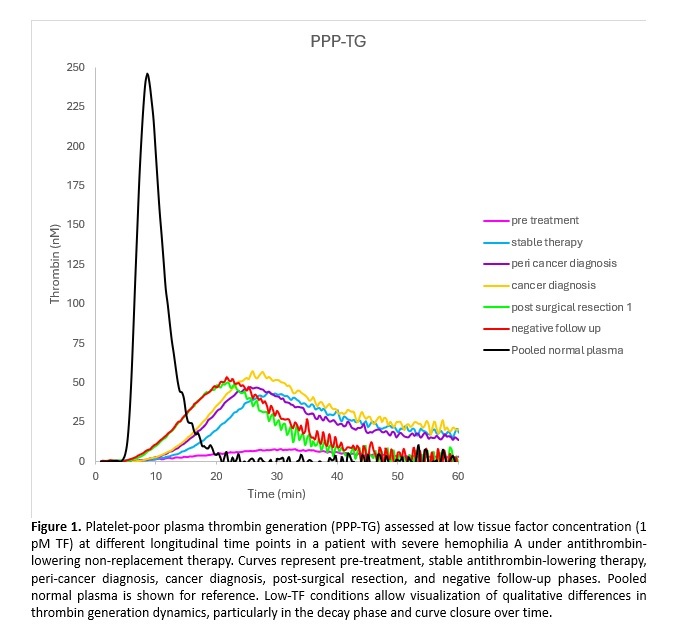
Results. At 1 pM TF, a trend toward shorter lag time and higher peak thrombin was observed during the pre-tumor phase compared with stable therapy, while ETP remained non-measurable due to persistent thrombin activity. No relevant changes were observed around colorectal cancer diagnosis. Following colorectal cancer resection in March 2024, thrombin generation at 1 pM TF became fully measurable at the first post-surgical assessment, with ETP increasing from unmeasurable to 895 nM·min and late-phase tail formation (StartTail 55 min), despite only moderate peak thrombin (45 nM) (Figure 1). Antithrombin levels ranged between approximately 15–30% during stable follow-up before surgery and decreased to about 10–26% after surgery. At 5 pM TF, TG remained consistently high throughout the entire observation period, confirming preserved thrombin-generating capacity.
Conclusions. In this long-term longitudinal case, colorectal cancer diagnosis was not associated with major changes in low-trigger TG, consistent with a localized disease stage. In contrast, surgical resection induced a distinct qualitative shift in TG dynamics, with the emergence of sustained thrombin activity despite moderate peak values. These findings suggest that, in pharmacologically rebalanced hemophilia, major biological stressors may primarily affect thrombin persistence rather than overall thrombin generation.
Downloads
Citations




How to Cite

This work is licensed under a Creative Commons Attribution-NonCommercial 4.0 International License.



