


CO-40 | ONE-STAGE ASSAYS VS. CHROMOGENIC ASSAYS IN rpFVIII: STILL A DISCREPANCY?
L. Banov, G. Gazzelli, Y. Azzanelli, C. Vernarecci, F. Marotta, F. Giacopelli, F. Tappino, A.C. Molinari | IRCCS Istituto Giannina Gaslini, Genova, Italy
All claims expressed in this article are solely those of the authors and do not necessarily represent those of their affiliated organizations, or those of the publisher, the editors and the reviewers. Any product that may be evaluated in this article or claim that may be made by its manufacturer is not guaranteed or endorsed by the publisher.
Authors
Background and Aims. Acquired Haemophilia A (AHA) management requires accurate monitoring of susoctocog alfa (rpFVIII, Obizur®). Chromogenic assays (CHA) have been reported to underestimate rpFVIII activity compared with one-stage assays (OSA). In addition, discrepancies between spiked and in vivo studies have been described, further complicating interpretation. Data on the performance of Stago reagents in this setting remain limited. Clinicians relying on Stago platforms may face uncertainty in result interpretation and dose optimisation. This study aims to evaluate the performance of Stago OSA and CHA reagents for susoctocog alpha measurement.
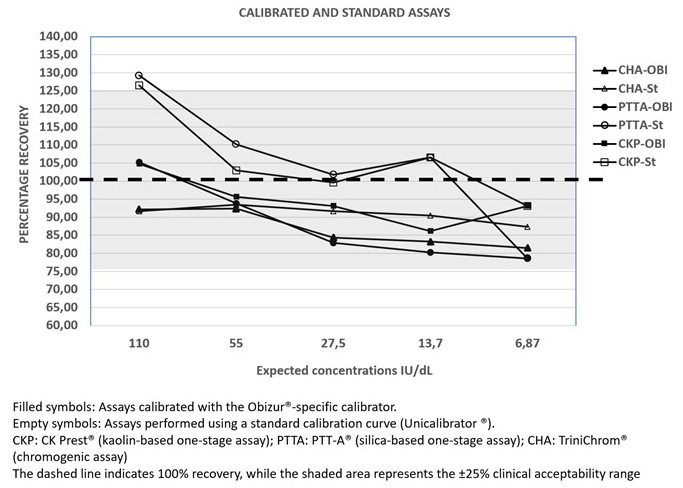
Methods. The susoctocog alfa calibrator, provided by Takeda, served as the primary standard. v It was analysed both undiluted and at four serial dilutions (1:2, 1:4, 1:10, 1:20) in FVIII-deficient plasma (Stago). Based on the certified potency of the calibrator, the expected FVIII activity levels were defined as 110, 55, 27.5, 13.75, and 6.87 IU/dL. For standard clotting assays, Unicalibrator® (Stago) was utilised as the reference plasma to establish the standard curves. All measurements were performed on the STA R Max3® (Stago) automated coagulation analyser using three different methodological approaches: two OSA (CK-Prest® and PTT-A®) and a CHA (TriniCHROM®). All reagents and deficient plasmas were stored and handled in strict accordance with the manufacturer's instructions. Each dilution was analysed in five replicates to ensure statistical robustness and assess intra-assay precision. The same dilution series was analysed against a dedicated calibration curve established using the susoctocog alfa (Obizur) calibrator itself. We first compared the performance of the OSA against the CHA based solely on measurements derived from the calibrated curve. Subsequently, we compared the activity levels measured using the standard curve with those obtained using the calibrated curve. Results were expressed as percentage recovery relative to the expected theoretical activity.
Results. All analytical methods and reagents tested demonstrated high repeatability across all concentrations and experimental conditions. When the assays were calibrated specifically using the Obizur (susoctocog alfa) calibrator, all reagents showed high concordance with each other and closely matched the certified expected values. In contrast, when using a standard calibration curve, the two OSA (kaolin-based and silica-based) consistently yielded activity levels that were slightly higher than those produced by the CHA but falling almost entirely within the clinically acceptable range of ±25% of the expected theoretical activity.
Conclusions. OSA and CHA Stago reagents provide high precision and accuracy for the measurement of rpFVIII. However, as this study was conducted using spiked samples, these findings must be confirmed in a clinical setting. Further studies on plasma samples from rpFVIII-treated AHA patients are necessary to validate these analytical performances in the presence of real-world biological variables and inhibitors.
Downloads
Citations




How to Cite

This work is licensed under a Creative Commons Attribution-NonCommercial 4.0 International License.



