


CO-20 | REAL-WORLD EXPERIENCE ON THE MANAGEMENT OF MILD HEAD INJURY IN A COHORT OF CHILDREN WITH HEMOPHILIA A WITH AND WITHOUT INHIBITORS TREATED WITH EMICIZUMAB
B. Pollio1, B. Borsellino1|2, T. Martini1 | 1Haemophilia Centre, Immune-Haematology and Transfusion Medicine, University Hospital “Città della Salute e della Scienza”, Torino, Italy; 2Department of Biomedicine and Prevention, PhD in Immunology, Molecular Medicine and Applied Biotechnology, University of Rome Tor Vergata, Roma, Italy
All claims expressed in this article are solely those of the authors and do not necessarily represent those of their affiliated organizations, or those of the publisher, the editors and the reviewers. Any product that may be evaluated in this article or claim that may be made by its manufacturer is not guaranteed or endorsed by the publisher.
Authors
Background and Aims. Children with hemophilia have a significantly increased risk of intracranial hemorrhage (ICH) compared to the normal population; newborns have the highest risk of ICH, estimated to be 33-fold higher than the general population (2.1% vs 0.062% per 100 live births); the great majority of ICH occur in children <2 years of age. Trauma is the main risk factor for ICH in children with hemophilia: mild head trauma is a common occurrence in this population, and there is a lack of data regarding its management. This work represents the experience of the Turin Pediatric Hemophilia Centre in the management of mild head trauma.
Materials and Methods. We retrospectively collected from medical records of our patient in prophylaxis with emicizumab data about age at the time of trauma, severity of head trauma, and medical treatment. Mild head trauma is defined by a Glasgow Coma Scale (GCS) of 14-15; GCS together with PECARN rules allows us to distinguish children with mild head trauma in low, intermediate, and high risk. Following PECARN rules, in children <2 years, very low-risk head trauma is defined by: GCS 15, no loss of consciousness, no severe mechanism of injury (fall >0.9 m; head struck by high-impact object; motor vehicle collision with potent ejection, death of another passenger, or rollover; pedestrian or bicyclist without helmet struck by a motorized vehicle), no non-frontal scalp hematoma, no palpable skull fracture, and normal behavior per caregiver. In children ≥2 years, very low risk requires GCS 15, no loss of consciousness, no severe mechanism, no vomiting, no severe headache, and no signs of basilar skull fracture. Low-risk patients (GCS 15 and no PECARN findings) can be discharged without a CT scan; for intermediate-risk patients (only 1 PECARN finding) Clinical observation is required for high-risk patients (≥2 PECARN findings). A CT scan is recommended.
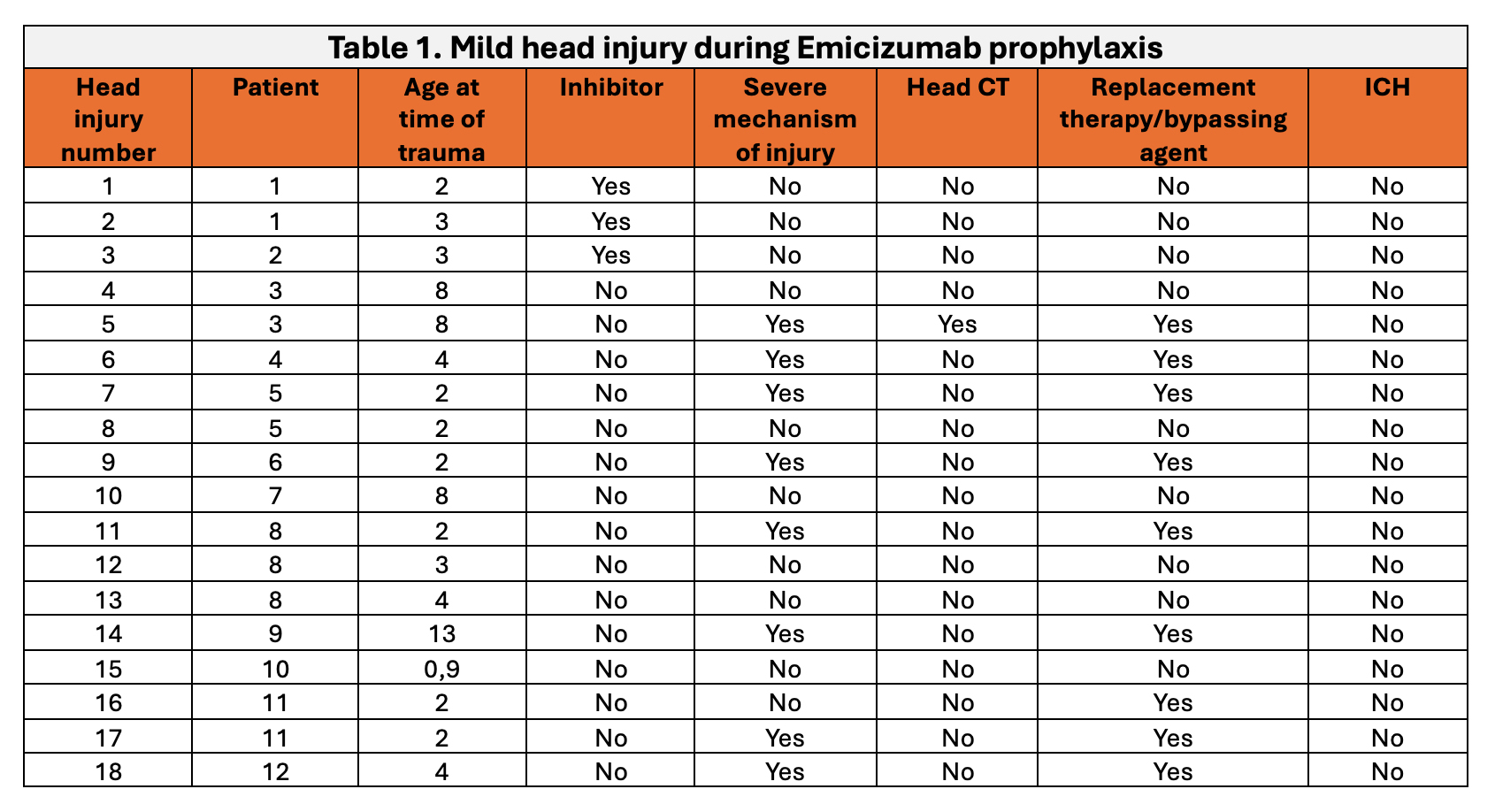
Results. From February 2020 to April 2026, we observed 18 consecutive mild head traumas in 12 children (including 2 patients with inhibitors). All these events were managed with the collaboration of the Emergency Department and the Haemophilia Centre. Median age at time of trauma is 4 years old, with 8 events occurring <2 years of age. Only one patient required a CT scan for the presence of neurological symptoms. In 9 cases the high-impact dynamics of trauma needed the administration of factor VIII concentrate. All 18 traumas had a favorable outcome (table 1).
Conclusions. We managed the high-impact traumas with factor VIII concentrate administration, while low-impact traumas did not require replacement treatment. No ICH was reported in 18 mild head traumas. The synergic cooperation of the Emergency Department and the Haemophilia Centre plays a key role in the effective management of these events.
Downloads
Citations




How to Cite

This work is licensed under a Creative Commons Attribution-NonCommercial 4.0 International License.



