


CO-19 | A CASE OF LOSS OF EFFICACY OF EMICIZUMAB AFTER 6 YEARS OF REGULAR USE
M.R. Fasulo1, I. Quaglia1, A. Colombo1, C. Lodigiani1, M.E. Mancuso1|2 | 1Center for Thrombosis and Hemorrhagic Diseases, IRCCS Humanitas Research Hospital, Rozzano, Milano, Italy; 2Department of Biomedical Sciences, Humanitas University, Pieve Emanuele, Milano, Italy
All claims expressed in this article are solely those of the authors and do not necessarily represent those of their affiliated organizations, or those of the publisher, the editors and the reviewers. Any product that may be evaluated in this article or claim that may be made by its manufacturer is not guaranteed or endorsed by the publisher.
Authors
Background. Anti-drug antibodies (ADAs) against emicizumab can reduce treatment efficacy by neutralizing drug function or accelerating its clearance. They are rare and usually develop within the first 25 weeks of exposure. We report a case of loss of efficacy likely due to ADAs' development after 6 years of regular use.
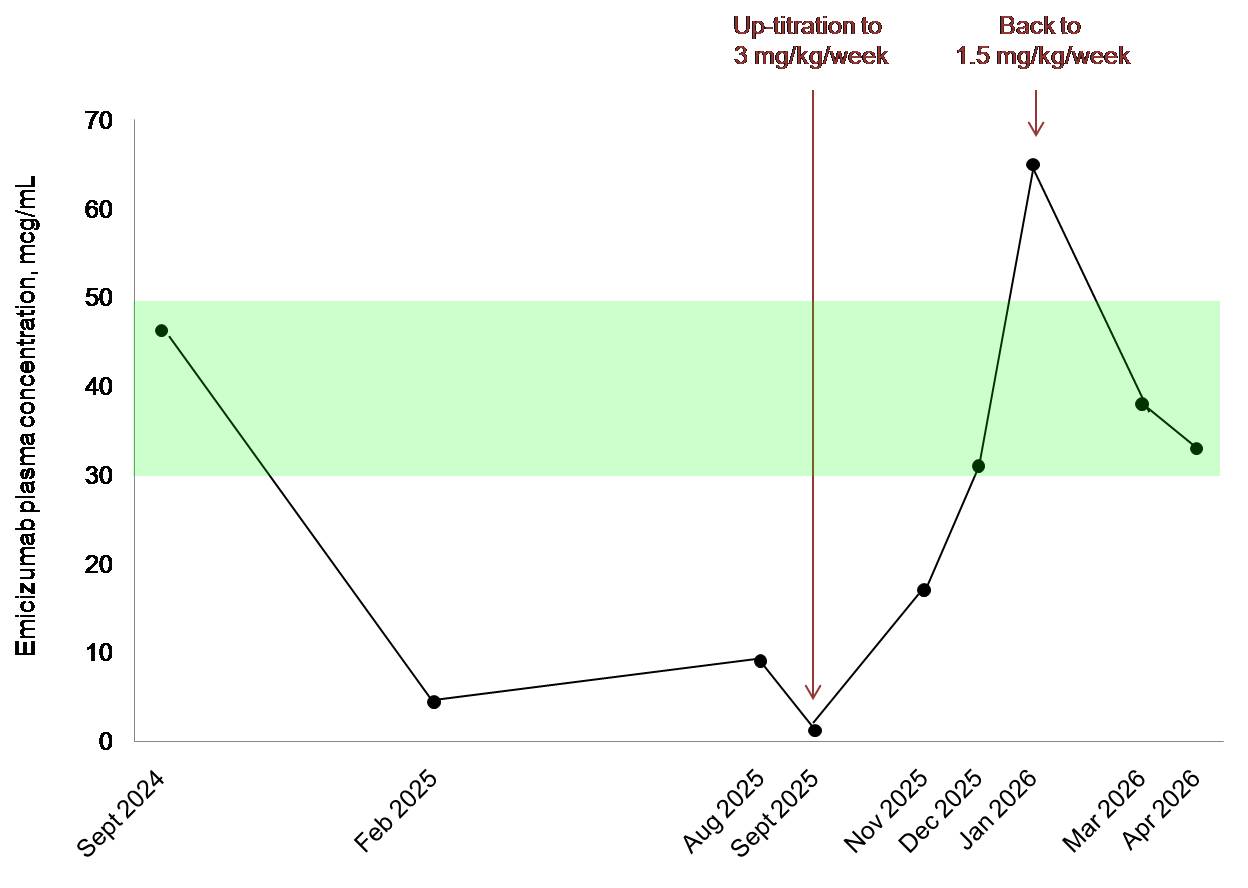
Case Report. A 24-year-old man with congenital severe hemophilia A who developed high-responding inhibitors at 1 year of age and failed multiple courses of immune tolerance induction, including association with immunosuppressive therapy with steroids and cyclosporine. In 2018, after many years of on-demand treatment with bypassing agents for recurrent joint bleeds, he started prophylaxis with emicizumab (dosing regimen: 1.5 mg/kg/week). From 2018 to October 2024, he had no breakthrough bleeds and received recombinant activated factor VII (rFVIIa) only for an elective surgical procedure (pilonidal cyst removal). From November 2024, he reported a significant increase in his bleeding tendency with 6 bleeding episodes over 10 months: 1 subcutaneous hand hematoma, 1 episode of hematuria, and 4 elbow bleeds with evidence of synovial hypertrophy at point-of-care musculoskeletal ultrasound examination. All these bleeding events were spontaneous and treated with rFVIIa. Regular checks of emicizumab plasma concentration allowed us to detect a significant reduction in concomitance with the worsened bleeding phenotype. In fact, levels dropped from 46.3 mcg/mL to 1.2 mcg/mL (Figure 1). Adequate adherence to treatment regimen and drug storage were confirmed, therefore suggesting the development of ADAs with neutralizing potential against emicizumab. To overcome the neutralizing effect of those ADAs and considering that they could be transient, the emicizumab dose was up-titrated to 3 mg/kg/week with favorable clinical and laboratory outcomes. A significant improvement of the bleeding phenotype was observed with no further events and progressive improvement of synovial hypertrophy. In parallel, emicizumab plasma concentration increased up to 65 mcg/mL as of January 2026, when he resumed his previous dosing regimen (1.5 mg/kg/week), maintaining emicizumab plasma concentration levels around 35 mcg/mL without bleeds thereafter (Figure 1).
Conclusions. This report demonstrates that clinically significant ADAs can occur even after several years of continuous regular use of emicizumab and supports the evidence that drug plasma concentration is a valid indicator of their presence as well as a useful tool to monitor the effect of treatment tailoring. Additionally, this case confirms that emicizumab up-titration could be considered as a strategy to overcome the effect of ADAs and restore good protection against bleeds.

Downloads
Citations




How to Cite

This work is licensed under a Creative Commons Attribution-NonCommercial 4.0 International License.



