


CO-18 | PSYCHOMETRIC ASSESSMENT OF PATIENT REPORTED EXPERIENCES WITH ARTIFICIAL INTELLIGENCE TOOLS IN HEMOPHILIA CARE
G. Sottilotta 1|2 , G. Praticò 1 , D. Megalizzi 1 , M. Hart 2 , C. Komar 2 , F. Luise 3 | 1 UOSD Centro Microcitemie - Servizio Emostasi e Trombosi. Grande Ospedale Metropolitano di Reggio Calabria, Italy; 2 Save One Life Inc., USA; 3 Laboratorio Analisi. Grande Ospedale Metropolitano di Reggio Calabria, Italy
All claims expressed in this article are solely those of the authors and do not necessarily represent those of their affiliated organizations, or those of the publisher, the editors and the reviewers. Any product that may be evaluated in this article or claim that may be made by its manufacturer is not guaranteed or endorsed by the publisher.
Authors
Introduction. Artificial intelligence (AI) is increasingly integrated into everyday life and is expected to influence clinical practice by supporting tasks traditionally performed by healthcare professionals. People with hemophilia (PWH) have historically shown a strong interest in understanding scientific, diagnostic, and therapeutic advances related to their condition, often seeking information through conferences, online platforms, and, more recently, AI-based applications. As AI tools become more accessible, evaluating how PWHs perceive the quality and reliability of AI-generated medical information is essential.
Aims. The study aimed to assess patient-reported satisfaction with AI-generated responses to hemophilia-related questions, focusing on clarity, accuracy, and perceived usefulness through a psychometric evaluation.
Materials and Methods. A 10-item questionnaire was developed from questions proposed directly by PWH, addressing innovative therapies, emerging treatment strategies, and future perspectives in hemophilia care. Twelve adult males with hemophilia (mean age 49.2, range 19–65) submitted the same questionnaire to five AI tools: ChatGPT®, Gemini®, Copilot®, DeepSeek®, and Perplexity®. Participants evaluated each set of responses using a Likert-type psychometric scale, generating a total satisfaction score ranging from 0 to 50 for each AI system.
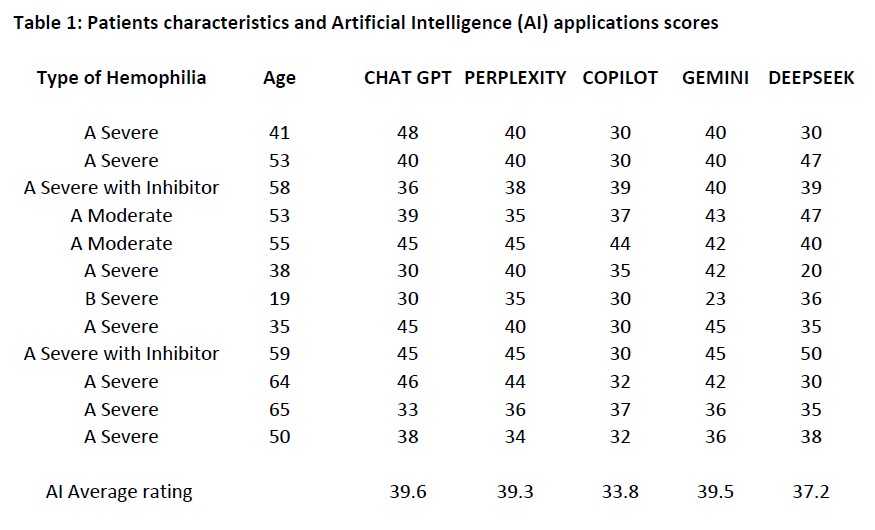
Results. All AI applications achieved medium to high satisfaction scores, with a mean value of 37.9 (range 33.8–39.6), corresponding to an average rating of 3.8 on a 1–5 scale. Participants generally considered the information provided to be clear, relevant, and aligned with their expectations. The use of patient-generated questions ensured accessibility and avoided excessive technical complexity, supporting the applicability of AI tools for non-professional users. Detailed results are summarized in Table 1.
Conclusions. PWH expressed overall appreciation for the quality of AI-generated answers. These findings suggest that AI systems may already serve as valuable resources for patient education in hemophilia, particularly in settings with limited access to specialized hemophilia centers or insufficient availability of trained healthcare personnel. Nonetheless, AI-generated information must always be interpreted under medical supervision to prevent misunderstandings or inappropriate self-management. Continued monitoring and evaluation of AI tools remain essential to ensure accuracy, safety, and alignment with evolving standards of hemophilia care
Downloads
Citations




How to Cite

This work is licensed under a Creative Commons Attribution-NonCommercial 4.0 International License.



