


CO-13 | USE OF THE MULTIDIMENSIONAL HEMOPHILIA PAIN QUESTIONNAIRE IN PATIENTS WITH SEVERE HEMOPHILIA A TREATED WITH EMICIZUMAB: A PILOT CROSS-SECTIONAL, SINGLE-CENTER STUDY
I.L. Calcaterra, S. Donnarumma, G. D’Errico, C. De Luca, C. Caputo, P. Ciciola, E. Cimino, M. Di Minno | Università Federico II di Napoli, Italy
All claims expressed in this article are solely those of the authors and do not necessarily represent those of their affiliated organizations, or those of the publisher, the editors and the reviewers. Any product that may be evaluated in this article or claim that may be made by its manufacturer is not guaranteed or endorsed by the publisher.
Authors
Background. Despite effective bleed prevention with emicizumab, pain remains a relevant clinical burden in adults with severe hemophilia A (sHA). A multidimensional assessment is needed to better characterize contemporary hemophilia-related pain.
Objectives. To evaluate the prevalence, characteristics, and functional impact of pain in adults with sHA receiving emicizumab prophylaxis using the Multidimensional Haemophilia Pain Questionnaire (MHPQ).
Methods. In this single-center, cross-sectional pilot study, 27 adults with sHA on emicizumab prophylaxis completed the MHPQ. Pain localization, frequency, triggering factors, intensity, and interference across life domains were assessed descriptively.
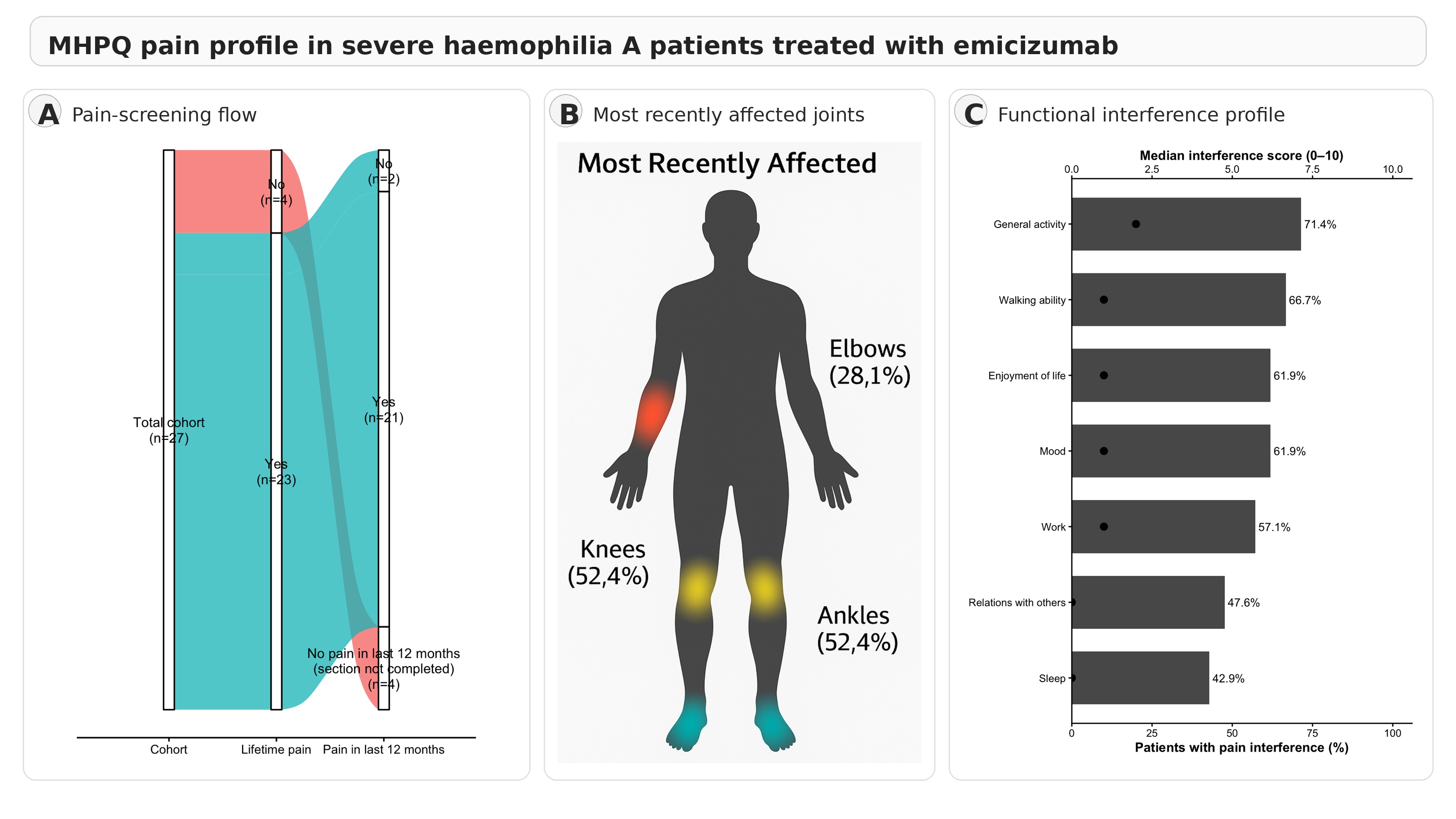
Results. Lifetime hemophilia-related pain was reported by 85.2% of participants, and 77.8% experienced pain within the previous 12 months. Pain most frequently involved ankles (52.4%), knees (52.4%), and elbows (28.6%). All patients with recent pain reported pain during bleeding episodes; however, movement-related triggers, including accidental movements (66.7%) and physical activity (54.2%), were also common. Pain intensity was generally mild-to-moderate, with the highest median scores observed after accidental movements (median 4, IQR 2–6). Pain interfered predominantly with general activity (71.4%), walking ability (66.7%), mood (61.9%), and enjoyment of life (61.9%). Arthropathy was documented in 70.4% of patients.
Conclusions. In the non-factor prophylaxis era, pain remains prevalent and functionally relevant in adults with sHA despite effective bleed control. These findings suggest that haemophilia-related pain is not exclusively bleeding-driven and highlight the importance of structured, multidimensional pain assessment in routine haemophilia care.

Downloads
Citations




How to Cite

This work is licensed under a Creative Commons Attribution-NonCommercial 4.0 International License.



