


CO-12 | BEYOND CLOTTING FACTORS: NURSING AS A CORNERSTONE OF LIFELONG HEMOPHILIA CARE
M.V. Puliga1, C. Manzi2, A. Besagni3, S. Linari1, C. Carulli4, M. Morfini5 | 1SODc Malattie Emorragiche e della Coagulazione, AOU Careggi, Firenze, Italy; 2SSD Malattie Emorragiche Congenite, IRCCS Policlinico Sant'Orsola, Bologna, Italy; 3Indipendente, Italy; 4Clinica Ortopedica, Università di Firenze, SOD Ortopedia, AOU Careggi, Firenze, Italy; 5Associazione Italiana Centri Emofilia, AICE, Milano, Italy
All claims expressed in this article are solely those of the authors and do not necessarily represent those of their affiliated organizations, or those of the publisher, the editors and the reviewers. Any product that may be evaluated in this article or claim that may be made by its manufacturer is not guaranteed or endorsed by the publisher.
Authors
Background and Aims. Haemophilia is a rare inherited bleeding disorder requiring specialized, multidisciplinary, lifelong care. Despite major therapeutic advances, optimal outcomes depend on coordinated healthcare delivery, patient education, psychosocial support, and regular follow-up. Within Haemophilia Centres, nurses play a key role in education, care coordination, and treatment adherence. This study analyzed the clinical, organizational, educational, and psychosocial aspects of comprehensive hemophilia care across the lifespan, focusing on nursing contributions and their potential impact on patient outcomes.
Materials and Methods. A narrative review of the literature and organizational practices adopted in specialized hemophilia centers was conducted. The analysis explored hemophilia management during childhood, adolescence, adulthood, and older age. Areas examined included nursing interventions, patient and family education, communication, treatment adherence, multidisciplinary collaboration, home care, psychosocial support, and the Italian legislative framework for rare diseases. Findings were synthesized to identify the main domains of nursing practice in hemophilia care.
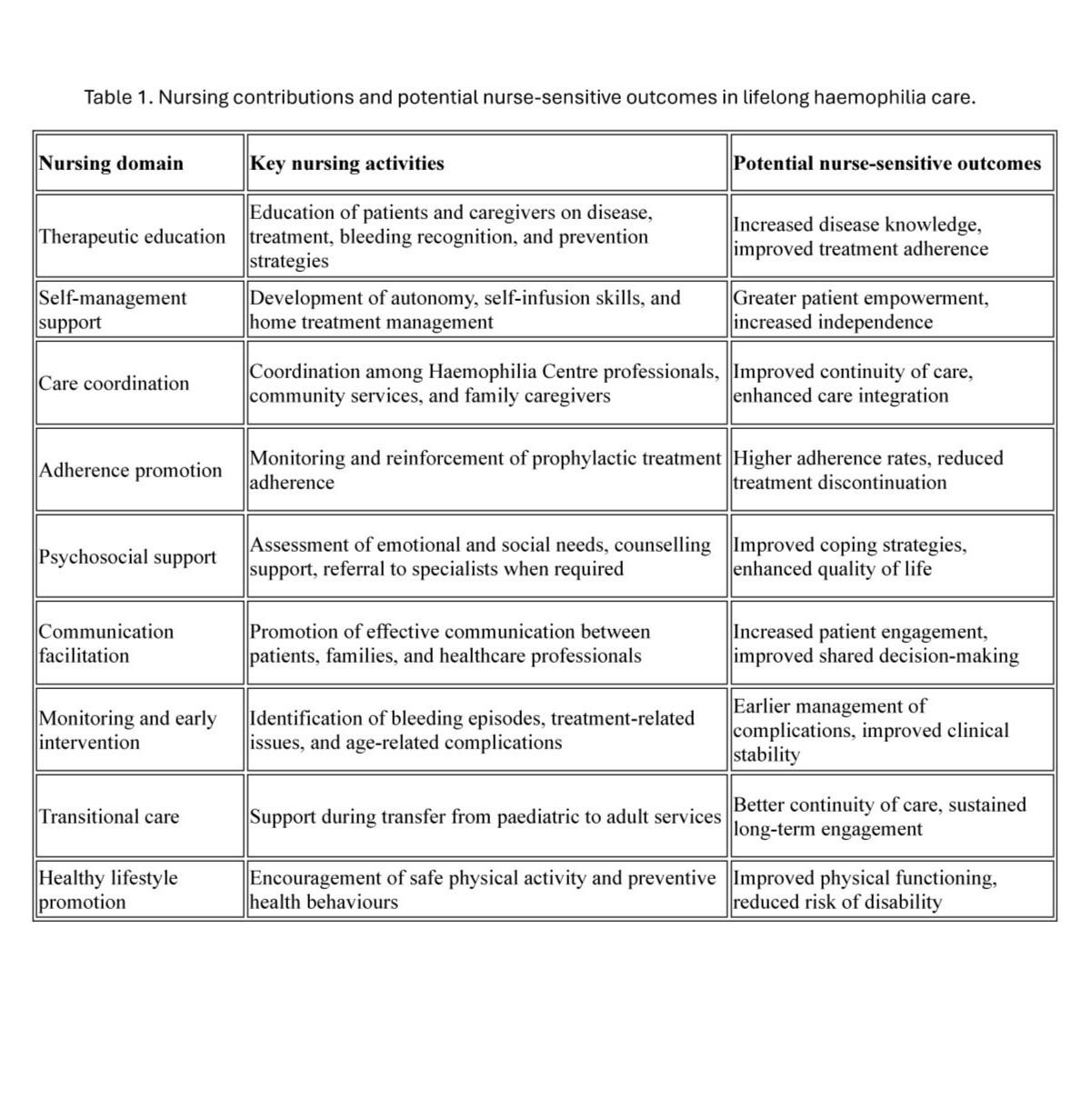
Results. Comprehensive hemophilia management requires continuous, individualized care from diagnosis onwards. During childhood and adolescence, family education, promotion of autonomy, safe physical activity, and prevention of complications were key elements of care. During the transition to adulthood, communication with healthcare professionals, self-management, and adherence to prophylaxis become increasingly important. Older adults often present with age-related comorbidities requiring more complex multidisciplinary management. The analysis identified major nursing domains, including therapeutic education, support for self-management and adherence, coordination of care pathways, psychosocial support, monitoring of complications, and facilitation of communication between patients, families, and healthcare professionals. Electronic communication tools and integrated care models may further improve continuity of care and patient engagement.
Conclusions. Haemophilia management extends beyond replacement therapy and requires a holistic, patient-centered approach integrating clinical, educational, psychological, and organizational aspects of care. Nurses are essential members of the multidisciplinary team, supporting patients and families throughout the disease course while promoting self-management, adherence, and quality of life. The identified domains may provide a basis for developing nurse-sensitive outcomes and strengthening specialized nursing practice within hemophilia centers.
Downloads
Citations




How to Cite

This work is licensed under a Creative Commons Attribution-NonCommercial 4.0 International License.



