


CO-11 | MAPPING THE COMPETENCIES OF NURSES IN ITALIAN HEMOPHILIA CENTERS: CURRENT STATUS AND PERSPECTIVES FOR THE IDENTIFICATION OF NURSE-SENSITIVE OUTCOMES
M.V. Puliga1, A.C. Ferrini2, C. Manzi3, D. Meneghini4, E. Tosi4, P. Berto5, M. Amelotti-Botta6, E. Quercio6, M.E. Mancuso7, R.C. Santoro8 | 1SODc Malattie Emorragiche e della Coagulazione, AOU Careggi, Firenze, Italy; 2SSI Malattie Emorragiche e Tromboemboliche, Osp. Bufalini, Cesena, Italy; 3SSD Malattie Emorragiche Congenite, IRCCS Policlinico Sant'Orsola, Bologna, Italy; 4Centro Emofilia e UOC Medicina Trasfusionale, AOU Integrata, Verona, Italy; 5Centro Emofilia Hub, AO di Padova, Italy; 6SSD Emostasi e Coordinamento Malattie Rare, AO SS. Antonio e Biagio, Alessandria, Italy; 7UOC Centro Trombosi e Malattie Emorragiche, IRCCS Humanitas Research Hospital, Rozzano, Milano, Italy; 8UOD Emofilia, Emostasi e Trombosi, AOU Renato Dulbecco, Catanzaro, Italy
All claims expressed in this article are solely those of the authors and do not necessarily represent those of their affiliated organizations, or those of the publisher, the editors and the reviewers. Any product that may be evaluated in this article or claim that may be made by its manufacturer is not guaranteed or endorsed by the publisher.
Authors
Background and Aims. Congenital Bleeding Disorders (CBDs) require a multidisciplinary approach in which nurses play a key role in patients’ clinical, educational, and organizational management. Despite significant therapeutic and healthcare advances in hemophilia care, scientific evidence regarding specialist nursing competencies and nurse-sensitive outcomes remains limited. The AICE Nursing Working Group analyzed the current nursing organization within Italian HCs by investigating nursing skills and activities.
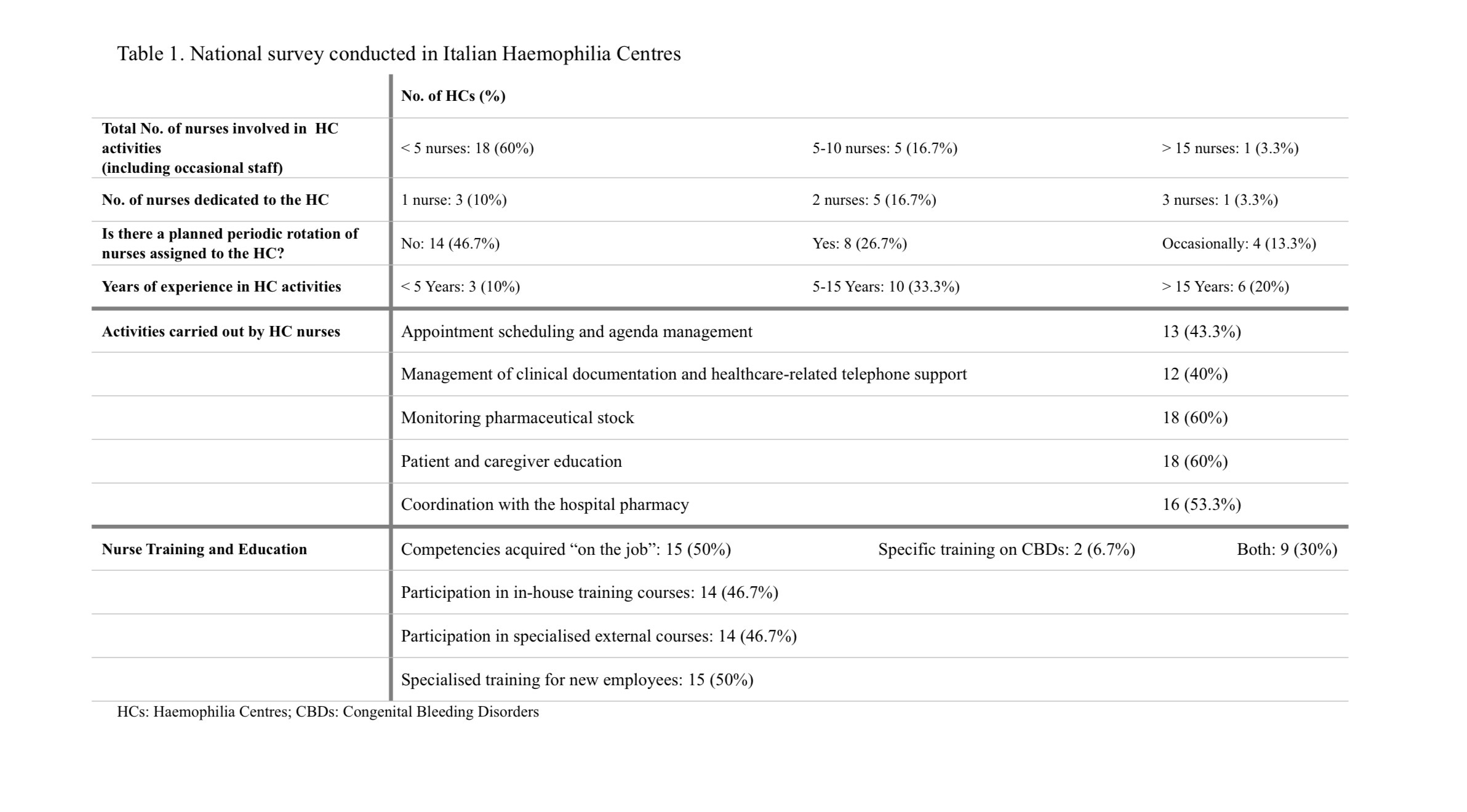
Materials and Methods. In 2024, the AICE Nursing Working Group distributed a national survey to the directors of Italian HCs. The questionnaire collected data on center organization, the presence (or absence) of dedicated nurses, training pathways, professional experience, and the main nursing activities performed.
Results. Thirty centers throughout Italy responded to the survey: 17 HCs (56.7%) cared for patients of all ages, 7 (23.3%) mainly adults, and 4 (13.3%) mainly children; data were missing for two centers. Twenty-one HCs (70%) reported nurses simultaneously caring for other patient groups during the same shift, while 3 (10%) reported the presence of nurses exclusively dedicated to CBDs. In 14 HCs (46.7%), nurses were not subject to periodic rotation, contributing to greater continuity of care. In terms of professional experience, 10 HCs (33.3%) reported nursing experience of 5–15 years, while six (20%) reported experience exceeding 15 years. Nursing activities were broad and multidisciplinary: 13 HCs (43.3%) reported nurse involvement in appointment scheduling and agenda management; 12 (40%) in the administrative management of clinical documentation and healthcare-related telephone support; 18 (60%) in monitoring pharmaceutical stock; and 18 (60%) in providing education to patients and caregivers. Collaboration with hospital pharmacies was reported in 16 centers (53.3%). Regarding training pathways, competencies were acquired primarily “on the job” in 15 HCs (50%); only 2 (6.7%) reported exclusively specialist training dedicated to CBDs, while 9 (30%) combined both approaches. In 15 HCs (50%), a specific training program was available for newly recruited staff. Participation in internal educational courses dedicated to CBDs was reported in 14 HCs (46.7%), and the same proportion reported participation in specialized external courses.
Conclusions. Nurses play a fundamental role within the multidisciplinary teams of Italian HCs. This survey confirms their strategic importance and highlights the need to define specific competencies, dedicated educational pathways, and measurable nurse-sensitive outcomes.

Downloads
Citations




How to Cite

This work is licensed under a Creative Commons Attribution-NonCommercial 4.0 International License.



