


BEST-10 | CHANGES IN HYPERTROPHIC SYNOVIUM STATUS IN ADULT PATIENTS WITH SEVERE HEMOPHILIA A RECEIVING EMICIZUMAB PROPHYLAXIS: THE RESOLVE STUDY
I.L. Calcaterra1, M. Di Minno1, E. Baldacci2, G. D’Errico1, C. Santoro2, A. Strangio3, S. Sorella2, M. Leotta3, R.C. Santoro3 | 1Department of Clinical Medicine and Surgery, Federico II University, Napoli, Italy; 2Haematology, University Hospital Policlinico Umberto I, Roma, Italy; 3Hemostasis and Thrombosis Centre, Azienda Ospedaliero Universitaria Renato Dulbecco, Catanzaro, Italy
All claims expressed in this article are solely those of the authors and do not necessarily represent those of their affiliated organizations, or those of the publisher, the editors and the reviewers. Any product that may be evaluated in this article or claim that may be made by its manufacturer is not guaranteed or endorsed by the publisher.
Authors
Background. Evidence on the impact of emicizumab on joint health, particularly hypertrophic synovium, remains limited.
Objectives. To evaluate changes in joint status, with a specific focus on HS, using point-of-care ultrasound and clinical examination in PwH switching from replacement therapy to emicizumab.
Methods. The RESOLVE study is a retrospective observational, multicenter cohort study including adults with severe hemophilia A (FVIII <1%), with and without anti-FVIII inhibitors, who started a treatment with emicizumab and were followed for at least 2 years. Clinical data, annualized bleeding rates (ABR, AjBR), HJHS, and HEAD-US assessments were collected during replacement therapy and after ≥2-year emicizumab. HS was graded according to the HEAD-US protocol. Changes in HS represented the primary outcome.
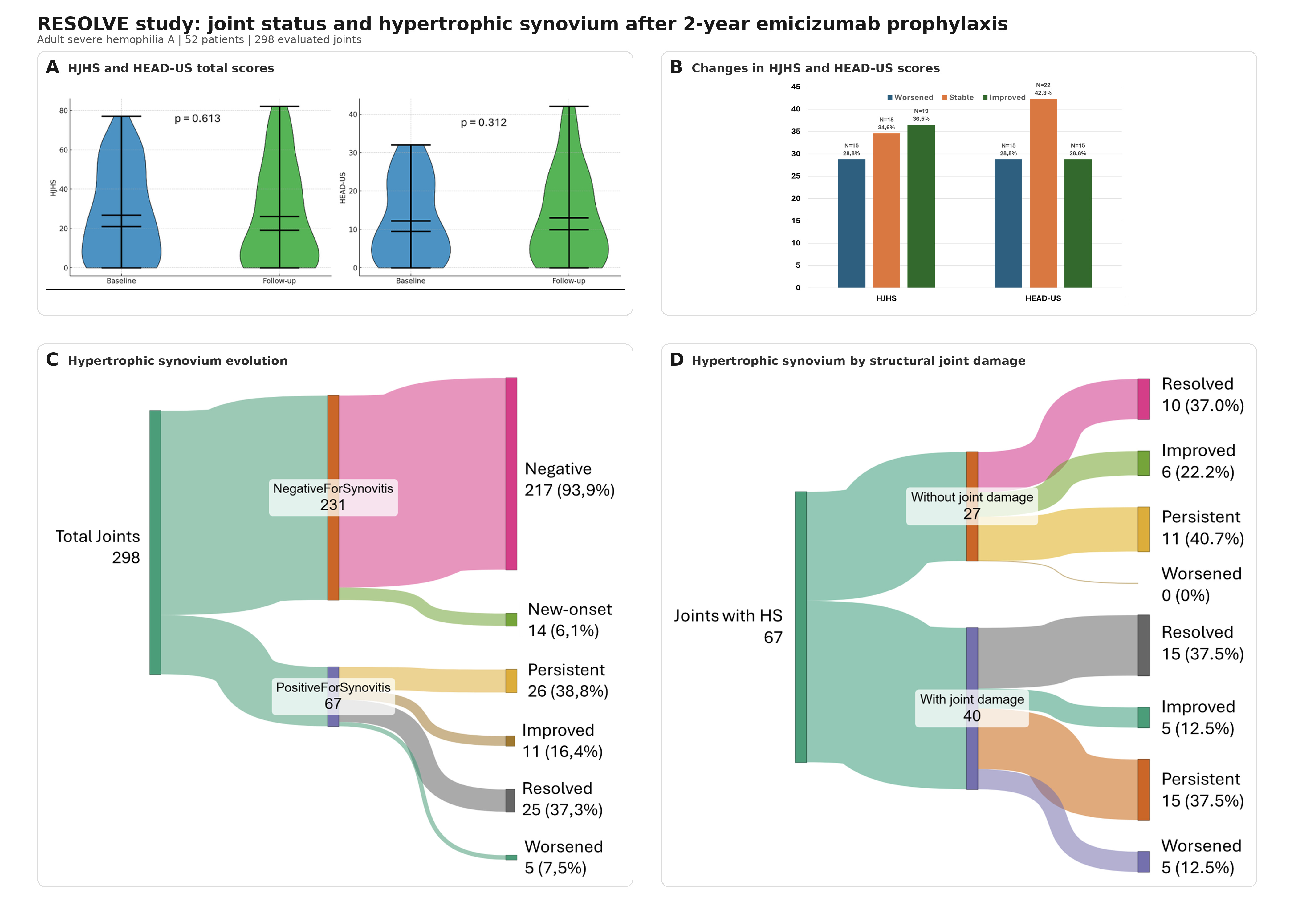
Results. Fifty-two PwH (mean ± SD age: 37.9±12.1years) were enrolled, with data on 298 joints. Emicizumab prophylaxis resulted in a significant reduction in ABR and AjBR compared with replacement therapy, with an increase in patients achieving ABR zero and AjBR zero. At baseline, HS was present in 22.5% of joints. After ≥2-year-emicizumab, HS was improved/resolved in 53.7% of affected joints, while it persisted in 38.8% and worsened in 7.5% of joints. New-onset HS was developed in 6.1% of previously unaffected joints. Baseline structural joint damage was strongly associated with the presence and persistence of HS.
Conclusions. In this real-world setting, emicizumab provides bleeding protection and is associated with reduction/resolution of HS in more than 50% of affected joints. In case of persistent HS, a tailored approach to joint health management may be needed to fully prevent or reverse HS.

Downloads
Citations




How to Cite

This work is licensed under a Creative Commons Attribution-NonCommercial 4.0 International License.



