


BEST-08 | PERIOPERATIVE MANAGEMENT OF CHILDREN WITH MILD FACTOR VII DEFICIENCY UNDERGOING SURGERY: A RETROSPECTIVE COHORT STUDY
B. Borsellino1, T. Martini1, I. Ricca2, B. Pollio1 | 1Haemophilia Centre, Immune-Haematology and Transfusion Medicine, University Hospital “Città della Salute e della Scienza”, Torino, Italy; 2Transfusion Medicine, Ivrea Hospital, Ivrea, Italy
All claims expressed in this article are solely those of the authors and do not necessarily represent those of their affiliated organizations, or those of the publisher, the editors and the reviewers. Any product that may be evaluated in this article or claim that may be made by its manufacturer is not guaranteed or endorsed by the publisher.
Authors
Background and Aims. Perioperative bleeding risk assessment in children with mild factor VII (FVII) deficiency remains challenging because bleeding history is often uninformative and laboratory parameters correlate poorly with clinical phenotype. Consequently, the optimal use of prophylactic recombinant activated FVII (rFVIIa) before surgery remains uncertain, and management varies across centers. We evaluated perioperative bleeding outcomes in children with mild FVII deficiency (FVII activity 20–40%) undergoing surgery and explored factors associated with prophylactic treatment.
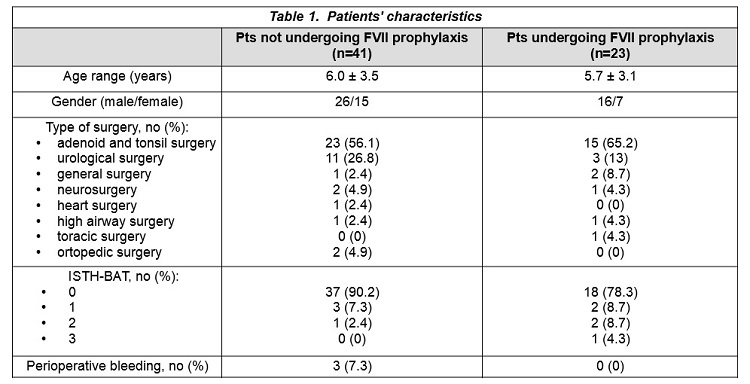
Materials and Methods. We retrospectively analyzed 64 consecutive pediatric patients who underwent surgery at Regina Margherita Children’s Hospital, Turin, Italy, between January 2017 and February 2020. Procedures included adeno-tonsillar surgery (59.3%), urological surgery (21.9%), and other specialties (18.8%). Patients were managed either with a watch-and-wait strategy, with rFVIIa immediately available in the operating room if abnormal bleeding occurred (n=41), or with prophylactic preoperative rFVIIa administration (n=23). Bleeding phenotype was assessed using the ISTH Bleeding Assessment Tool (BAT): BAT score 0 in 85.9%, 1 in 7.8%, 2 in 4.7%, and 3 in 1.6%. Multivariable analyses were performed to identify factors associated with prophylaxis use and perioperative bleeding.
Results. Perioperative bleeding occurred in 3/41 patients (7.3%) managed without prophylaxis, whereas no bleeding events occurred among patients receiving prophylactic rFVIIa (0/23), although the difference did not reach statistical significance (p=0.29). Overall perioperative bleeding prevalence was 4.7% (3/64). Lower baseline FVII activity and lower hemoglobin concentration were independently associated with the decision to administer prophylaxis. Mean FVII activity was significantly lower in the prophylaxis group than in the non-prophylaxis group (30.9±6.4% vs 40.5±6.5%; p<0.0001), as was mean hemoglobin concentration (12.1±1.3 vs 13.0±1.2 g/dL; p=0.03). No independent predictor of perioperative bleeding was identified.
Conclusions. The overall perioperative bleeding prevalence in this cohort was 4.7% (3/64), confirming the insidiousness of FVII deficiency. Both strategies—having rFVIIa immediately available intraoperatively and administering preventive rFVIIa—were effective and safe in children with FVII levels between 20% and 40%. Although the difference in bleeding incidence between strategies did not reach statistical significance, bleeding events occurred only in the untreated group. These findings suggest that a prophylactic approach may be preferable for patients with FVII values below approximately 31%, but confirmation in larger, prospective studies is warranted.
Downloads
Citations




How to Cite

This work is licensed under a Creative Commons Attribution-NonCommercial 4.0 International License.



