


BEST-06 | OPTIMIZING LABORATORY MONITORING OF EFANESOCTOCOG ALFA: IMPACT OF APTT REAGENTS AND CHROMOGENIC ASSAYS ON DIAGNOSTIC ACCURACY
A. Strangio, A. Ierardi, M. Leotta, L.C. Elia, M. Falbo, C. Condina, G. Procopio, R.C. Santoro | Hemophilia Hemostasis and Thrombosis Unit, Azienda Ospedaliero Universitaria Renato Dulbecco, Catanzaro, Italy
All claims expressed in this article are solely those of the authors and do not necessarily represent those of their affiliated organizations, or those of the publisher, the editors and the reviewers. Any product that may be evaluated in this article or claim that may be made by its manufacturer is not guaranteed or endorsed by the publisher.
Authors
Background. Efanesoctocog alfa (FVIII-ULTRA) represents a paradigm shift in hemophilia. A treatment as a first-in-class recombinant factor VIII engineered for high, sustained activity. Due to its unique structural modifications—including the fusion of the D’D3 domain of von Willebrand factor and XTEN polypeptides—the molecule presents significant diagnostic challenges. Precise laboratory monitoring is mandatory to validate its pharmacokinetic profile and ensure clinical safety; however, its structural complexity necessitates a rigorous validation of standard laboratory assays to prevent therapeutic misinterpretation.
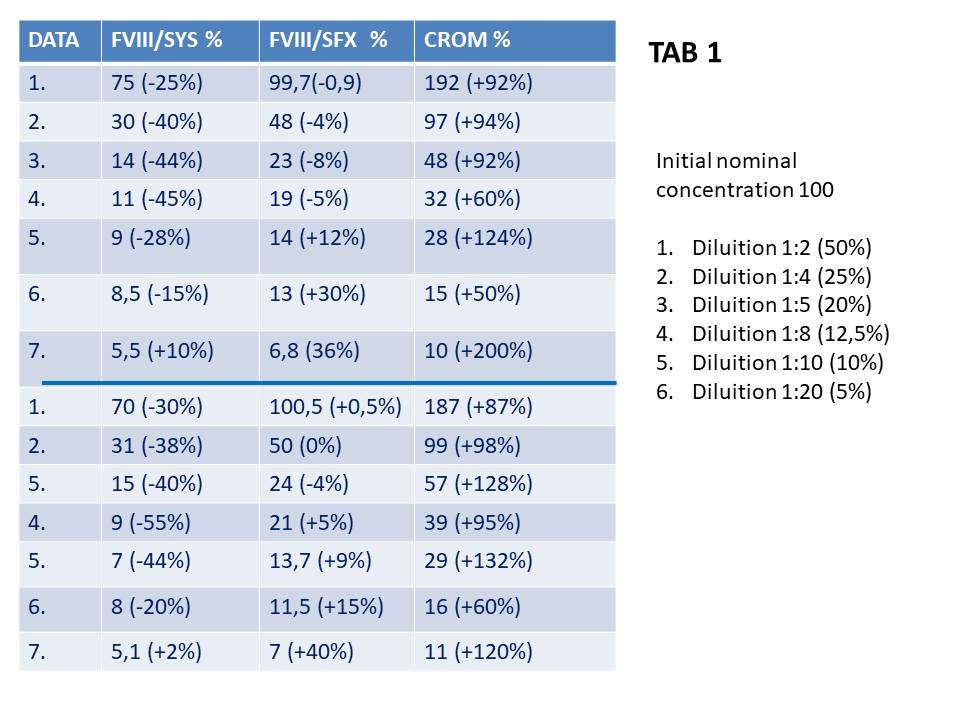
Methods. FVIII-ULTRA activity was comprehensively evaluated at a 100% nominal concentration and across a six-step dilution series (ranging from 50% down to 5%), using HemosIL Factor VIII deficient plasma (Werfen) as the matrix. Measurements were conducted on a Werfen instrumentation platform employing three distinct analytical methodologies: two one-stage clotting assays (OSA) utilizing SynthASil (SYS) and Synthafax (SFX) reagents, and a chromogenic substrate assay (CA) using the Coamatic reagent. Accuracy was quantified by calculating the percentage deviation from nominal values, supported by a robust statistical analysis of mean deviations and 95% Confidence Intervals (CI) derived from two independent, high-throughput datasets.
Results. The study revealed critical, reagent-specific variations that could impact clinical decision-making. SFX emerged as the most accurate reagent for the high-to-intermediate therapeutic range (10%–100%), demonstrating a negligible mean deviation of only -2.0% at the 50% activity level. In contrast, SYS significantly underestimated activity at higher concentrations, showing a negative deviation of up to -42%. Interestingly, SYS proved superior in precision at the 5% trough level, with a minimal deviation of +6.0%. Notably, the CA consistently and markedly overestimated FVIII activity across the entire spectrum, with deviations reaching a staggering +160%, rendering it potentially unreliable for routine monitoring without specific calibration.
Conclusions. For clinical laboratories utilizing the Werfen platform, SFX is the most reliable reagent for standard therapeutic monitoring where trough levels remain $\ge 10\%$. Conversely, SYS provides a more accurate assessment for lower-range troughs (approx. 5%), which is particularly critical for tailoring prophylaxis in the pediatric population. The dramatic overestimation observed with the CA underscores the urgent need for standardized, reagent-specific protocols. Establishing these guidelines is essential to prevent over-dosing or under-dosing, ensuring the safe and effective long-term management of patients treated with efanesoctocog alfa. For laboratories utilizing the Werfen platform, SFX is the most reliable reagent for standard therapeutic monitoring (trough levels ≥10%). However, SYS may offer a more accurate assessment for lower trough levels (approx. 5%), which are particularly relevant in the pediatric population. The significant overestimation by the chromogenic assay highlights the critical need for reagent-specific protocols to ensure the safe and effective management of patients treated with efanesoctocog alfa.
Downloads
Citations




How to Cite

This work is licensed under a Creative Commons Attribution-NonCommercial 4.0 International License.



