


BEST-03 | CRISPR-CAS9 CORRECTION IN SEVERE HEMOPHILIA A
A. Benetti1, C.M. Radu1, M. Trevisan2, C. Samà1, C. Simion1, E. Campello1, P. Simioni1 | 1First Chair of Internal Medicine and Thrombotic and Haemorrhagic Diseases Unit, Department of Medicine, Padova University Hospital, Italy; 2Department of Molecular Medicine, University of Padua, Italy
All claims expressed in this article are solely those of the authors and do not necessarily represent those of their affiliated organizations, or those of the publisher, the editors and the reviewers. Any product that may be evaluated in this article or claim that may be made by its manufacturer is not guaranteed or endorsed by the publisher.
Authors
Background and Aims. Haemophilia A (HA) is a rare X-linked recessive bleeding disorder caused by variants in the F8 gene, which encodes coagulation factor VIII (FVIII). HA is characterized by FVIII deficiency, leading to impaired hemostasis and spontaneous bleeding episodes. In patients with HA, increasing FVIII activity above 2–5% can significantly improve quality of life. The aim of the study is to correct the F8 variant and to restore FVIII expression in a male patient with severe hemophilia A through CRISPR–Cas9 base editing in liver sinusoidal endothelial cells (LSECs).
Materials and Methods. Peripheral blood stem cells were isolated and reprogrammed into induced pluripotent stem cells (iPSCs) after transduction with a non-integrative Sendai virus system. The clones obtained were stabilized, and their pluripotency was characterized by specific markers such as Oct4, Sox2, Klf4, and Nanog. Gene correction of HA-iPSCs was performed using CRISPR-Cas9 DNA base editing technology targeting the F8 variant NM_000132.4: c.6967C>T. Following editing, cells were differentiated into LSECs using an optimized differentiation protocol, and FVIII expression was assessed by immunofluorescence (IF) and real-time PCR (RT-qPCR).
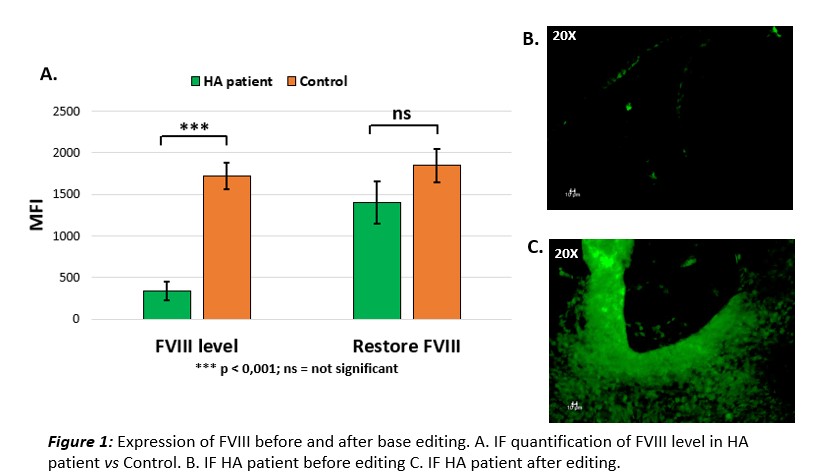
Results. HA-iPSCs were positive for alkaline phosphatase staining, and IF validated the expression of pluripotency markers. The differentiated LSECs were positive for FCGR2B expression, as assessed by both IF and RT-qPCR. Furthermore, embryoid body formation was performed, demonstrating the expression of markers from all three germ layers. FVIII expression in HA-derived LSECs was evaluated before and after gene editing using IF, RT-qPCR, and western blot. The gene correction was confirmed, resulting in approximately 70% restoration of FVIII levels (Figure 1).
Conclusions. The iPSCs derived from the severe HA patient were successfully edited, highlighting the potential of CRISPR–Cas9 technology for future patient-specific correction of pathogenic variants. Furthermore, differentiation into LSECs proved to be a relevant and robust in vitro model for evaluating FVIII restoration in HA patients. In conclusion, given the limitations of current treatments, gene therapy may provide a promising and personalized therapeutic approach for these patients.
Downloads
Citations




How to Cite

This work is licensed under a Creative Commons Attribution-NonCommercial 4.0 International License.



