


BEST-02 | PERIOPERATIVE BLEEDING IN CHILDREN WITH LOW VON WILLEBRAND FACTOR UNDERGOING ADENOID AND TONSIL SURGERY: A 15-YEAR SINGLE-CENTER EXPERIENCE
T. Martini1, B. Borsellino1|2, B. Pollio1 | 1Haemophilia Centre, Immune-Haematology and Transfusion Medicine, University Hospital “Città della Salute e della Scienza”, Torino, Italy; 2Department of Biomedicine and Prevention, PhD in Immunology, Molecular Medicine and Applied Biotechnology, University of Rome Tor Vergata, Roma, Italy
All claims expressed in this article are solely those of the authors and do not necessarily represent those of their affiliated organizations, or those of the publisher, the editors and the reviewers. Any product that may be evaluated in this article or claim that may be made by its manufacturer is not guaranteed or endorsed by the publisher.
Authors
Background and Aims. Low VWF (von Willebrand Factor) subjects have VWF antigen or activity levels of 0.30–0.50 IU/mL; its perioperative significance is, mainly in children, uncertain. Adenoid and tonsil surgery (ATS) represents a clinically relevant model, as bleeding risk may reflect systemic hemostatic impairment and local surgical and fibrinolytic mechanisms. We aimed to evaluate incidence, timing, predictors, and management of perioperative bleeding in children with low VWF undergoing ATS, comparing outcomes with a large healthy pediatric controls cohort.
Methods. We conducted a retrospective single-center study including 138 children with low VWF and 1,152 healthy pediatric controls, derived from institutional databases collected between 2010 and 2025 in Regina Margherita Hospital. Collected variables: age, sex, surgery type, family bleeding history, ISTH-BAT (International Society of Thrombosis and Haemostasis Bleeding Assessment Tool) score, VWF:RCo (VWF Ristocetin Cofactor), VWF:Ag (VWF antigen), FVIII (factor VIII), aPTT (activated partial thromboplastin time) ratio, platelet function analyzer (PFA) closure times, and hemostatic treatment. The primary outcome was intra- and postoperative bleeding (early: 0–48 h; late: day 7–14). Continuous variables were analyzed using the Mann–Whitney U test, and categorical variables with Fisher’s exact test.
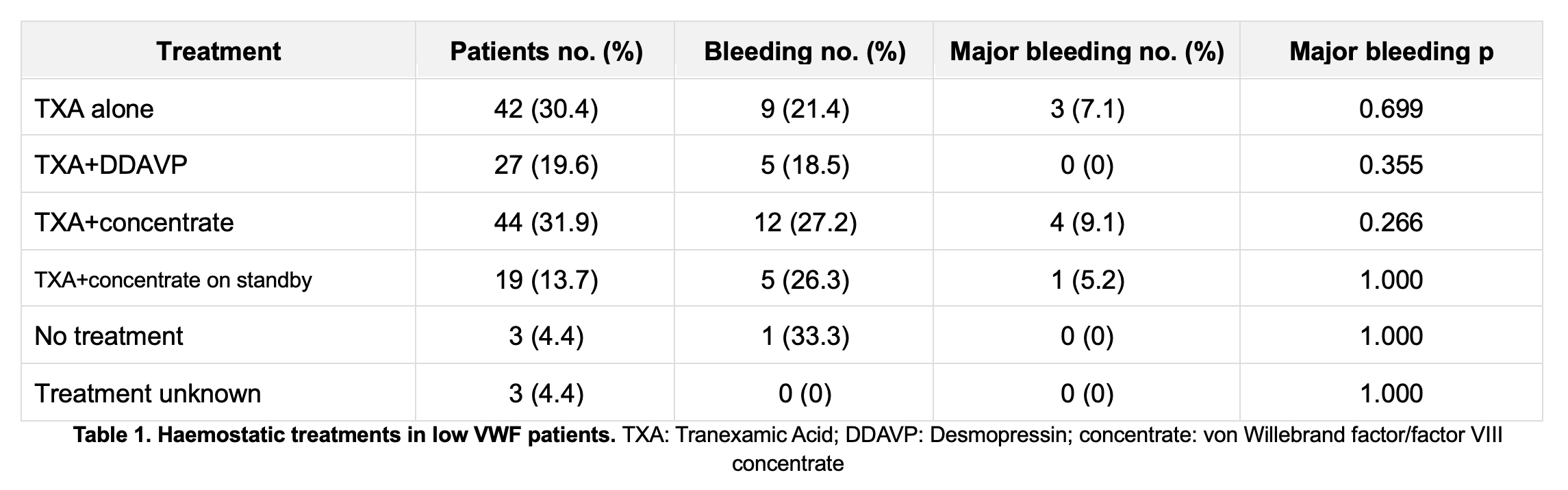
Results. The low VWF cohort (n=138) was comparable to controls for age and sex. ISTH-BAT≥1 was 8.1% for low VWF (vs 3.9%, p=0.185); family history 15.3% vs 1.1% (p<0.001). Major perioperative bleeding occurred in 5.8% vs 3.0% (p=0.125). In the low VWF cohort, no baseline clinical or laboratory parameter predicted bleeding. Bleeding showed bimodal temporal distribution: 70.0% within 48 h, 23.3% on day 7–13, and 6.7% not defined. Tranexamic Acid (TXA) was the most used hemostatic treatment, ± concentrate or Desmopressin; bleeding incidence does not significantly differ between treatments (table 1). VWF:Ag and VWF:RCo were the main determinants in treatment choice (p<0.05), and ISTH-BAT and family history show a non-significant tendency.
Conclusions. Low VWF children undergoing ATS show a relevant increase of surgical bleeding risk, supporting the availability of VWF concentrate in the operating room; the bleeding temporal pattern supports the coexistence of systemic and local mechanisms (eschar falling). Despite higher prevalence of baseline bleeding phenotype, no clinical or laboratory parameter predicted surgical bleeding; VWF levels were the treatment choice's main determinants, together with ISTH-BAT and family history (even if not statistically significant). Despite updated guidelines, the management of VWF deficiency remains a diagnostic and therapeutic challenge, warranting particular caution in pediatric patients.
Downloads
Citations




How to Cite

This work is licensed under a Creative Commons Attribution-NonCommercial 4.0 International License.



