
PO19 | THE INTER-RELATIONSHIP BETWEEN NETOSIS, THE ADAMTS-13/VWF AXIS, AND HEMOSTATIC ACTIVATION IN PATIENTS WITH GYNECOLOGICAL MALIGNANCIES: PROGNOSTIC SIGNIFICANCE AND IMPACT OF CHEMOTHERAPY
A. Makatsariya1, E. Beloborodova2,V. Bitsadze1, J. Khizroeva1, A. Vorobev1, A. Solopova1, M. Tretyakova1, N. Gashimova1, K. Grigoreva1, A. Oskolkova1, J. Christophe Gris1|3, I. Elalamy1|4|5, G. Gerotziafas1|4|5 | 1Department of Obstetrics, Gynecology and Perinatal Medicine, N. F. Filatov Clinical Institute of Children’s Health, I. M. Sechenov First Moscow State Medical University Sechenov University, Moscow, Russia; 2MEDSI Network of Medical Centers, Moscow, Russia; 3Faculty of Pharmaceutical and Biological Sciences, Montpellier University, France; 4Department Hematology and Thrombosis Center, Medicine Sorbonne University, Paris, France; 5Hospital Tenon, Paris, France

All claims expressed in this article are solely those of the authors and do not necessarily represent those of their affiliated organizations, or those of the publisher, the editors and the reviewers. Any product that may be evaluated in this article or claim that may be made by its manufacturer is not guaranteed or endorsed by the publisher.
Authors
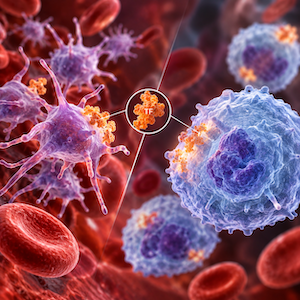
Aim. To assess the role of thromboinflammation (NETosis) and disturbances in the ADAMTS-13/von Willebrand factor (VWF) axis in the pathogenesis of hypercoagulability and their dynamics during anticancer therapy in patients with gynecological malignancies.
Methods. A prospective non-randomized controlled study included 262 patients with endometrial, ovarian, cervical, and breast cancer (TNM stages I-III) and 50 healthy women (control group). We evaluated the dynamics of NETosis markers (citrullinated histone H3, myeloperoxidase—MPO), parameters of the ADAMTS-13/VWF axis, markers of hemostatic activation (D-dimer, thrombin-antithrombin complexes—TAT), interleukin-8 (IL-8), and antiphospholipid antibodies. Blood samples were collected before treatment, as well as 14 days after surgery or after the 2nd, 4th, and 6th cycles of chemotherapy (CT).
Results. Prior to treatment, it showed a significant increase in NETosis markers (citH3: 1.78±1.03 vs 0.33±0.13 ng/mL, p<0.05; MPO: 15.97±11.83 vs 2.45±0.2 ng/mL, p<0.05), IL-8 (p<0.05), and VWF (p<0.05) and a decrease in ADAMTS-13 levels (antigen: 0.40±0.12 vs 0.98±0.34 IU/mL, p<0.05; activity: 0.43±0.13 vs 0.88±0.29 IU/mL, p<0.05) compared to the control group. A strong correlation was found between NETosis markers and VWF level (for citH3, ρ=0.80, p<0.01), as well as an inverse correlation with ADAMTS-13 (for MPO and ADAMTS-13 activity in the ovarian cancer subgroup, ρ=-0.58, p<0.01). During CT (after the 2nd cycle), a significant increase in NETosis markers (citH3: from 1.23±0.71 to 2.46±1.24 ng/mL, p=0.0001); VWF (to 2.34±0.42 IU/mL, p<0.05); the VWF/ADAMTS-13 ratio (to 6.42, p<0.05); and markers of hemostatic activation (TAT: to 1210.35±98.97 pg/mL, p≤0.05) were observed compared to the postoperative period. The increase in VWF and the VWF/ADAMTS-13 ratio correlated with the increase in TAT (p < 0.05). Administration of low molecular weight heparin (LMWH) and a combination of LMWH and aspirin during CT led to a significant decrease in NETosis markers and hemostatic activation markers after the 4th and 6th cycles (p<0.05).
Conclusions. The obtained data indicate a key role of NETosis and imbalance of the ADAMTS-13/VWF axis in the development of a prothrombotic state in oncogynecological patients, which is particularly exacerbated during chemotherapy. Thromboinflammation markers, specifically citrullinated histone H3 and MPO, as well as the VWF/ADAMTS-13 ratio, are promising prognostics.
Downloads
Citations




How to Cite

This work is licensed under a Creative Commons Attribution-NonCommercial 4.0 International License.