

The LIKT sequence in C-terminus of tissue factor pathway inhibitor (TFPIα) crucially important for the synergistic TFPIα-cofactor activity of protein S and FV-short
All claims expressed in this article are solely those of the authors and do not necessarily represent those of their affiliated organizations, or those of the publisher, the editors and the reviewers. Any product that may be evaluated in this article or claim that may be made by its manufacturer is not guaranteed or endorsed by the publisher.
Authors
Background: Inhibition of factor Xa (FXa) by tissue factor pathway inhibitor α (TFPIα) is potentiated by FV-Short and protein S. The C-terminus of TFPIα is important for formation of the TFPIα/protein S/FV-Short complex. It contains a hydrophobic sequence (LIKT). The purpose was to investigate the importance of the LIKT sequence.
Methods: Two TFPIα C-terminal peptides were synthesized, one wild-type and the other with LIKT replaced by AAKA. The effect of the peptides on TFPIα function was tested. An AAKA-mutant TFPIα was created and compared with wild-type TFPIα. AlphaFold was used to elucidate a mechanism for the role of the LIKT sequence.
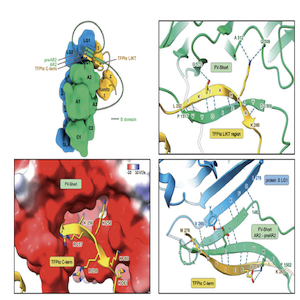
Results: The wild-type peptide efficiently inhibited the FXa-inhibitory activity of TFPIα/protein S/FV-Short complex, whereas the AAKA peptide did not. The LIKT sequence in TFPIα was crucially important for the synergistic TFPIα-cofactor activity between protein S and FV-Short. AlphaFold (DeepMind, London, UK) suggested an interaction between LIKT and FV-Short B-loop 1510-1517 mediated through a network of hydrogen bonds and hydrophobic interactions.
Conclusions: The C-terminal TFPIα-peptide induced complex formation between protein S and FV-Short. The LIKT sequence in TFPIα was crucially important for the ability of protein S and FV-Short to function as synergistic TFPIα cofactors.
Downloads
Citations




Ethics Approval
Not applicableCRediT authorship contribution
BD initiated, designed and supervised the study, analyzed data and wrote the manuscript. ST performed experiments, analyzed data and participated in writing of the paper. PD performed the structural analysis using AlphaFold and participated in writing the paper
Supporting Agencies
The study is supported by grants from the Swedish Research Council, the Swedish Heart-Lung Foundation, the Österlund’s Foundation, the SciLifeLab & Wallenberg Data Driven Life Science Program, Knut and Alice Wallenberg Foundation (grants: KAW 2020.0239 and KAW 2017.0003), and by the National Bioinformatics Infrastructure Sweden (NBIS) at SciLifeLab.Data Availability Statement
Available upon request
How to Cite

This work is licensed under a Creative Commons Attribution-NonCommercial 4.0 International License.



