Original Articles
Vol. 5 No. 3 (2026): In memory of Armando D’Angelo

Clinical characteristics, prescription patterns and clinical outcomes of patients with extended therapy with direct oral anticoagulants for unprovoked venous thromboembolism.

Insights from the RIETE Registry

Publisher's note
All claims expressed in this article are solely those of the authors and do not necessarily represent those of their affiliated organizations, or those of the publisher, the editors and the reviewers. Any product that may be evaluated in this article or claim that may be made by its manufacturer is not guaranteed or endorsed by the publisher.
Published: 28 August 2026
0
Views
0
Downloads

Authors

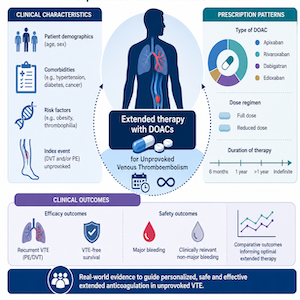
Background: Extended therapy with direct oral anticoagulants (DOACs) is common for managing unprovoked venous thromboembolism (VTE), but real-world data on dosing decisions and their association with outcomes are limited.

Methods: From April 2013 to September 2023, we identified patients with unprovoked VTE in the RIETE registry who survived the first 6 months without recurrent VTE or major bleeding. We examined predictors of reduced- vs. full-dose DOACs (rivaroxaban or apixaban), and the association between dosing and recurrent VTE and major bleeding. Logistic regression was used to identify predictors of dosing, and competing risk regression models to identify predictors of outcomes.

Results: Among 3749 patients undergoing extended DOAC therapy, 921 (25%) received reduced doses. Predictors of reduced-dose use included age >75 years [adjusted odds ratio (aOR): 1.74; 95%CI: 1.48-2.05], body weight <60 kg (aOR: 1.36; 95%CI: 1.08-1.71), renal failure (aOR: 1.78; 95%CI: 1.41-2.24), and apixaban (vs. rivaroxaban) use (aOR: 2.33; 95%CI: 1.80-3.00). Over a median of 240 days, among all 3749 patients, 44 developed VTE recurrence and 15 bled. Apixaban (vs. rivaroxaban) use [adjusted hazard ratio (aHR): 0.42; 95%CI: 0.40-0.45] and antiplatelet therapy (aHR: 1.72; 95%CI: 1.68-1.77) were associated with VTE recurrence. Male sex (aHR: 0.70; 95%CI: 0.65-0.76), weight <60 kg (aHR: 2.02; 95%CI: 1.91-2.14), renal failure (aHR: 2.76; 95%CI: 2.72-2.81), reduced- (vs. full-dose) DOACs (aHR: 0.83; 95%CI: 0.80-0.87), and antiplatelet use (aHR: 8.18; 95%CI: 7.89-8.47) were associated with major bleeding.

Conclusions: We highlight a mismatch between dosing decisions and clinical outcomes, suggesting a need for more outcome-focused strategies in DOAC prescribing.

Downloads

Download data is not yet available.

Citations

1. Stevens SM, Woller SC, Baumann Kreuziger L, et al. Antithrombotic therapy for VTE disease: Compendium and review of CHEST guidelines 2012-2021. Chest 2024:S0012-3692.
2. Konstantinides SV, Meyer G, Becattini C, et al. 2019 ESC Guidelines for the diagnosis and management of acute pulmonary embolism developed in collaboration with the European Respiratory Society (ERS). Eur Heart J 2020;41:543-603.
3. Agnelli G, Buller HR, Cohen A, et al. Apixaban for extended treatment of venous thromboembolism. NEJM 2013;368:699-708.
4. Weitz JI, Lensing AWA, Prins MH, et al. Rivaroxaban or aspirin for extended treatment of venous thromboembolism. NEJM 2017;376:1211-22.
5. Ebraheem M, Alzahrani I, Crowther M, et al. Extended DOAC therapy in patients with VTE and potential risk of recurrence: a systematic review and meta-analysis. J Thromb Haemost 2020;18:2308-17.
6. Barra ME, Fanikos J, Connors JM, et al. Evaluation of dose-reduced direct oral anticoagulant therapy. Amer J Med 2016;129:1198-204.
7. Donato A, Forman D. Review: extended therapy with DOACs, but not VKAs, reduces mortality after VTE treatment with initial anticoagulation. Ann Intern Med 2019;171:JC42.
8. Mai V, Guay CA, Perreault L, et al. Extended anticoagulation for VTE: a systematic review and meta-analysis. Chest 2019;155:1199-216.
9. Khan F, Tritschler T, Kimpton M, et al. Long-term risk for major bleeding during extended oral anticoagulant therapy for first unprovoked venous thromboembolism: a systematic review and meta-analysis. Ann Intern Med 2021;174:1420-9.
10. Bikdeli B, Zahedi Tajrishi F, Sadeghipour P, et al. Efficacy and safety considerations with dose-reduced direct oral anticoagulants: a review. JAMA Cardiol 2022;7:747-59.
11. Bortoluzzi C, Bernardi E, Camporese G, et al. Safety and efficacy of rivaroxabán for extended-phase anticoagulation of patients with unprovoked or recurrent venous thromboembolism: real-life data from the MAC project. Life 2022;12:1657.
12. Groat D, Martin KA, Rosovsky RP, et al. Physician perceptions and use of reduced-dose direct oral anticoagulants for extended phase venous thromboembolism treatment. Res Pract Thromb Haemost 2022;6:e12740.
13. Su X, Yan B, Wang L, et al. Comparative efficacy and safety of oral anticoagulants for the treatment of venous thromboembolism in the patients with different renal functions: a systematic review, pairwise and network meta-analysis. BMJ Open 2022;12:e048619.
14. Pawar A, Gagne JJ, Gopalakrishnan C, et al. Association of type of oral anticoagulant dispensed with adverse clinical outcomes in patients extending anticoagulation therapy beyond 90 days after hospitalization for venous thromboembolism. JAMA 2022;327:1051-60.
15. Fang MC, Reynolds K, Fan D, et al. Clinical outcomes of direct oral anticoagulants vs warfarin for extended treatment of venous thromboembolism. JAMA Network Open 2023;6: e2328033.
16. Park H, Jones BL, Huang PL, et al. Trajectories of oral anticoagulation adherence and associated clinical outcomes during long-term anticoagulation among Medicare beneficiaries with venous thromboembolism. Ann Pharmacother 2023;57:1349-60.
17. Palareti G, Barinov V, Urbanek T, et al. Recurrences and bleeding during extended treatment of patients with venous thromboembolism: results of the international, prospective, observational WHITE study. Int Angiol 2023;42:37-44.
18. Iyer GS, Tesfaye H, Khan NF, et al. Trends in the use of oral anticoagulants in the US, 2010-2020. JAMA Network Open 2023;6:e234059.
19. Gabara C, Aibar J, Nishimoto Y, et al. Clinical outcomes after discontinuing anticoagulant therapy in patients with first unprovoked venous thromboembolism. J Thromb Haemost 2024:S1538-7836.
20. Bikdeli B, Jimenez D, Hawkins M, et al. Rationale, design and methodology of the computerized registry of patients with venous thromboembolism (RIETE). Thromb Haemost 2018;118:214-24.
21. Trujillo-Santos J, Di Micco P, Dentali F, et al. Real-life treatment of venous thromboembolism with direct oral anticoagulants: the influence of recommended dosing and regimens. Thromb Haemost 2017;117:382-9.
22. Camporese G, Simioni P, Di Micco P, et al. Edoxaban for the long-term therapy of venous thromboembolism: Should the criteria for dose reduction be revised? Clin Transl Sci 2020;14: 335-42.
23. Palareti G, Testa S, Legnani C, et al. The use of reduced DOAC doses in atrial fibrillation patients does not always lead to good anticoagulation levels and avoid adverse events. Int J Cardiol 2024;416-132484.

Ethics Approval

all enrollees provided written or verbal informed consent according to the lo-cal ethics protocols of enrolling centers. The institutional review board at each enrolling center approves participation in RIETE for the site investigators and allows the entry of de-identified pa-tient information into the RIETE database

CRediT authorship contribution

All the authors read and approved the final version of the manuscript and agreed to be accountable for all aspects of the work 

Supporting Agencies

SANOFI and ROVI supported this Registry with an unrestricted educational grant

Data Availability Statement

All relevant data are included in the manuscript. Additional original data will be made available by contacting the corresponding author 

How to Cite


1.
Lorenzo A, Siniscalchi C, Morales SN, Sancho T, Valle R, Gil-Diaz A, et al. Clinical characteristics, prescription patterns and clinical outcomes of patients with extended therapy with direct oral anticoagulants for unprovoked venous thromboembolism.: Insights from the RIETE Registry. Bleeding Thromb Vasc Biol [Internet]. 2026 Aug. 28 [cited 2026 Aug. 28];5(3). Available from: https://www.btvb.org/btvb/article/view/403

Most read articles by the same author(s)