
PO57 | A NOVEL RISK ASSESSMENT MODEL FOR CANCER DETECTION WITHIN ONE YEAR AFTER INCIDENT VENOUS THROMBOEMBOLISM
C. Antoun1, J. Hansen1|3, S. Brækkan1|3, C. Langholm1, N. Eide1, V. Morelli1|3, K. Hveem2 | 1Department of Clinical Medicine, UiT The Arctic University of Norway, Tromsø; 2HUNT Center for Molecular and Clinical Epidemiology, Norwegian University of Science and Technology, Trondheim; 3Thrombosis Research Center, Division of Internal Medicine, University Hospital of North Norway, Tromsø, Norway

All claims expressed in this article are solely those of the authors and do not necessarily represent those of their affiliated organizations, or those of the publisher, the editors and the reviewers. Any product that may be evaluated in this article or claim that may be made by its manufacturer is not guaranteed or endorsed by the publisher.
Authors
Introduction. The cumulative incidence of cancer within 1 year after incident VTE is high (5-10%) with a poor prognosis. Extensive screening strategies (ESS) for cancer in incident unprovoked VTE have shown earlier cancer detection but without a clear benefit on survival. As ESS are resource-demanding and burdensome with potential adverse events for patients and health care systems, targeted screening in high-risk VTE patients is justified. However, existing risk assessment models (RAMs) (e.g., RIETE) are not recommended in clinical guidelines due to limited discriminative power.
Aim. To develop a novel RAM for the prediction of cancer diagnosis within 1 year after incident VTE using readily available markers registered at the VTE event.
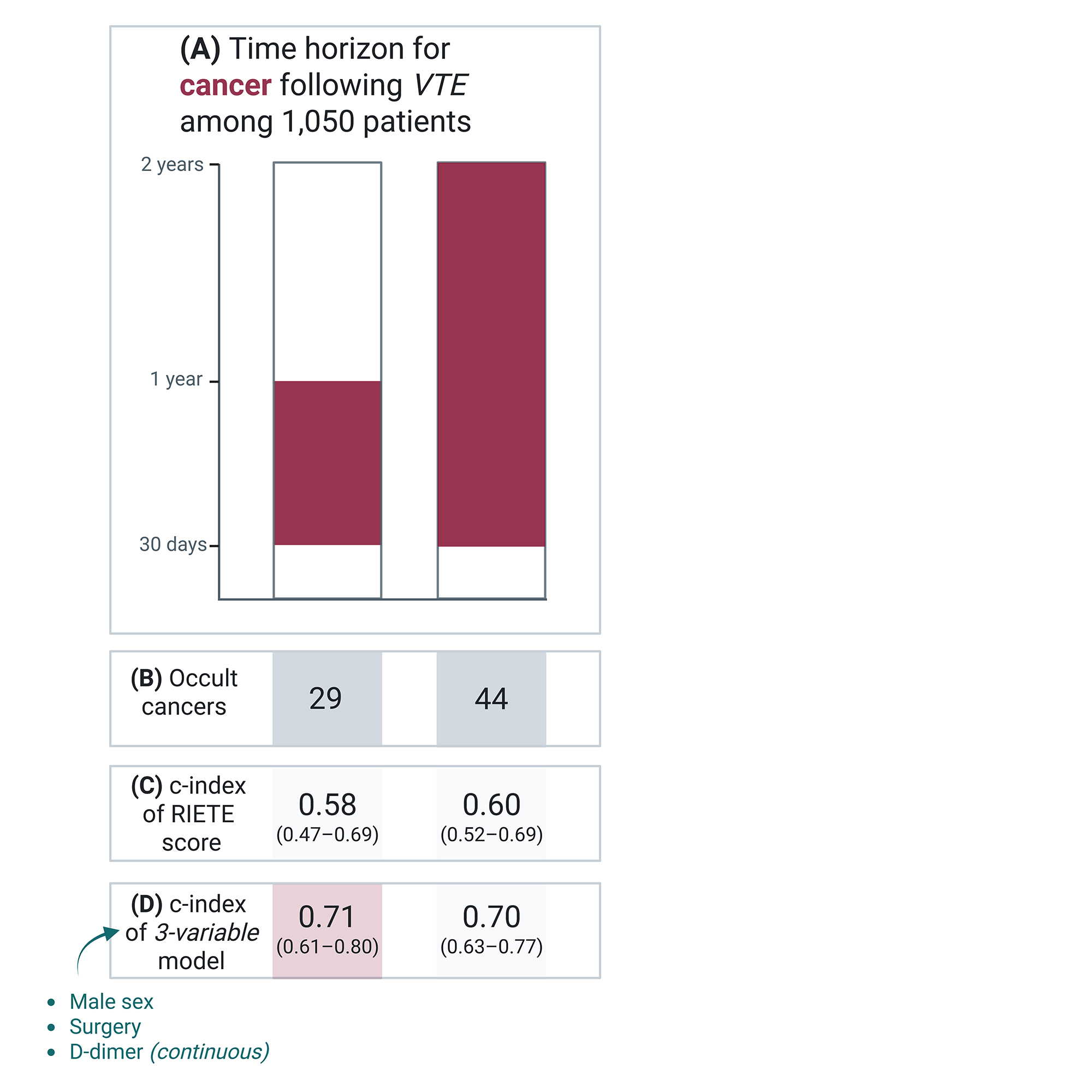
Methods. Leveraging data from a population-based Norwegian cohort with a validated first VTE (n = 1,050), we developed a prediction model from variables routinely captured at VTE diagnosis. The candidate predictor set comprised demographics (age, sex), anthropometrics (BMI), VTE characteristics, and routine laboratory measures, including D-dimer levels. The outcome was incident cancer diagnosed between 1 and 12 months (primary, n=29) and between 1 and 24 months (secondary, n=44) after VTE. Penalized Cox regression (LASSO) was applied for variable selection given the expected low event rate, identifying six candidate predictors, which were reduced to a parsimonious three‑variable model for better clinical translation. Discrimination was assessed using the c‑index with 95% bootstrap confidence intervals. Decision curve analysis (DCA) compared the model against screen‑none and screen‑all strategies.
Results. The final model included male sex, surgery <3 months preceding VTE, and quantitative D-dimer, with a c-index of 0.71 (0.61-0.80) for the primary and 0.70 (0.63-0.77) for the secondary outcome (see figure). The c-index for the RIETE score was 0.58 (0.47-0.69) for the primary and 0.60 (0.52-0.69) for the secondary outcome, consistent with prior external validation. DCA showed that the derived model yielded higher net clinical benefit than screen-none or screen-all from a risk threshold of 6%.
Conclusions. We developed a promising RAM including readily accessible variables (sex, surgery, and D-dimer levels) that provided moderate discrimination and meaningful net benefit for predicting 12-month occult cancer after a first VTE. External validation is warranted to evaluate generalizability and inform threshold-guided clinical decision-making.

Downloads
Citations




How to Cite

This work is licensed under a Creative Commons Attribution-NonCommercial 4.0 International License.